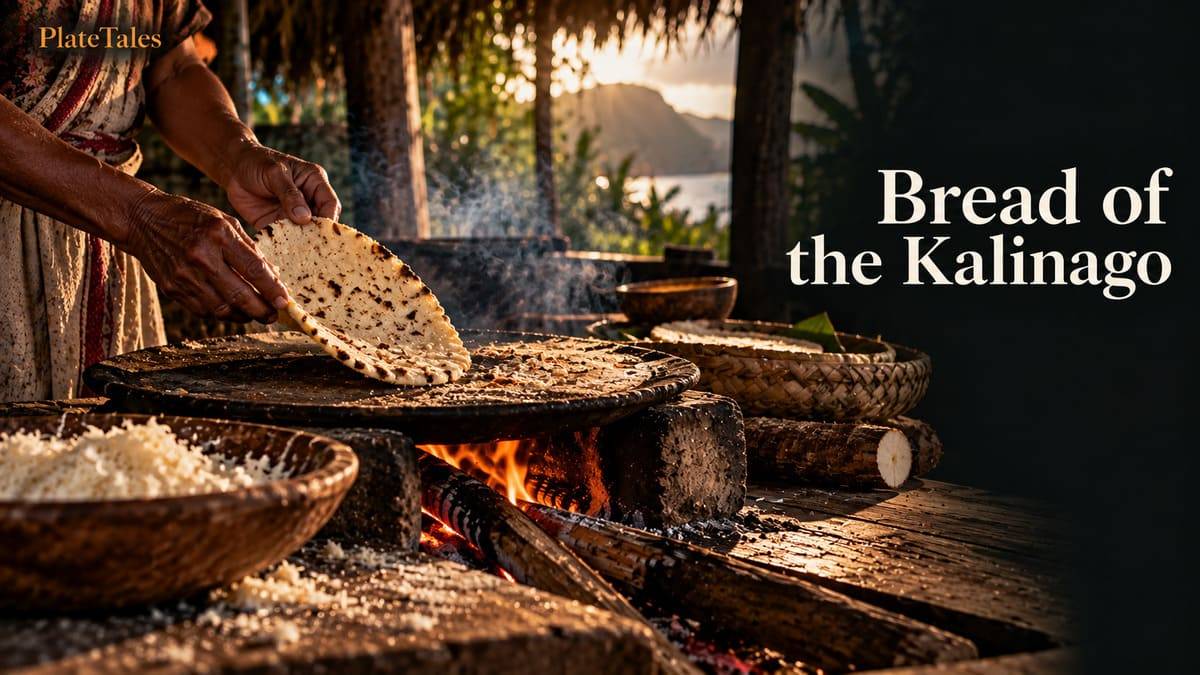
Kalinago cassava bread is a thin, dry flatbread made from grated bitter cassava root, squeezed to remove its poison and baked on a hot griddle. In Dominica it is tied to the Kalinago Territory on the island's east coast, where the descendants of the Island Caribs still bake it on open-fire griddles. The method is old. The territory is younger than most people expect.
What is cassava bread, and why does it need so much work?
Bitter cassava cannot be eaten as it comes out of the ground. It is toxic until processed, and cyanide dissolves in water, so the work is mostly about getting water out. The root is peeled and grated, then squeezed hard to extract the liquid. In the wider Caribbean and South America the squeezing was often done with a sieve-like device called a matapi. What remains is sifted into flour, mixed with water into a smooth dough and shaped into rounds, from half a centimetre to a few centimetres thick.
The rounds go onto a hot flat griddle. In much of the region that griddle is called a budare, and the bread cooks in a few minutes, until the water has gone. About one kilogram of raw cassava gives roughly a third of a kilogram of bread. The finished bread is dry and keeps well, which is one reason it travelled.
The word for it, casabe, comes from an Arawakan language. Spanish uses it only for the bread, while English speakers say cassava bread, and other regional names exist, including couac. In Dominica it goes by the French-Creole name khali. The DOM767 reference site says its production and sale are a vital economic driver in the Kalinago Territory, and that baking on open-fire griddles has survived there virtually intact. The griddle is a cast-iron or steel plate called a platin, and the bread bakes in 10 to 15 minutes.
Who the Kalinago are, and what the Caribs ate
Europeans called the people of the Lesser Antilles Caribs. The name Kalinago is what they call themselves now. Their language was Arawakan, not Cariban, which surprises people who assume the names match. Their diet centred on fish, with meat, greens and root vegetables such as dasheen, yams and tannia, plus green bananas in the everyday one-pot meal.
Cassava sits underneath all of that. Bitter cassava was the main staple of the pre-Columbian Antilles, and casabe was probably a common provision across the islands. Taino women made the griddles in the Greater Antilles, and casabe was linked to the deity Yucahu. The Island Caribs ate casabe with pepperpot, and they made ouicou, a fermented drink, by chewing casabe and spitting it out as a starter. Until the 1630s they cooked it on clay griddles. After that, iron pans became common.
That date matters. The 1630s is when French colonists reached the Lesser Antilles, where casabe was the main staple. The bread was already old when Europeans met it, and the tools for making it changed with contact. The bread itself did not.
How Europeans learned to tolerate it
Spanish colonists took up casabe in the 1490s, though they disliked the taste. Columbus is recorded as being given casabe in Hispaniola in 1492, and Ramon Pane called it bread in 1494. By the 1570s it was widely used as sailors' rations, and in 1588 casabe in Cartagena was priced below cornbread. José de Acosta, writing around 1590, recorded Spanish disdain for the flavour.
Europeans wanted wheat. Casabe stayed a regional food, never a global one. If you want the other side of that comparison, the history of bread shows how wheat travelled and why it was so hard to give up. Another root that crossed the Atlantic in the opposite direction is the subject of how potatoes changed Europe.
A reserve of 232 acres, then 3,700
The Kalinago who remained in Dominica were not given a territory until late. In 1763 British colonial authorities set aside 232 acres of mountainous land and rocky shoreline around Salybia. Later officials could not find a title deed for it.
In 1902 and 1903 the administrator Henry Hesketh Bell proposed 3,700 acres for the Kalinago, with a recognised chief who would receive a token allowance of 6 pounds. The Carib Reserve was formally established in 1903, with boundaries gazetted on 4 July. The population was about 400.
| Year | What happened |
|---|---|
| 1763 | 232 acres set aside near Salybia |
| 1903 | Carib Reserve established, about 3,700 acres |
| 1930 | The "Carib War" at Salybia |
| 1952 | Chief's position restored, Kalinago Council created |
| 1978 | Carib Reserve Act reaffirms boundaries, common ownership |
| 2015 | Renamed Kalinago Territory |
The 1930 shooting and the lost chieftaincy
In 1930 police tried to seize smuggled rum and tobacco in Salybia. They fired into a crowd, and two of the four people wounded later died. The chief, Jolly John, was charged. A 1931 inquiry led to the abolition of the chief's position. It came back in 1952, along with the Kalinago Council.
Accounts differ on whether the incident took place at St. Cyr or Salybia, so the exact place is one detail to treat with care.
Communal land and crafts
Since the 1978 act, land in the territory is held in common. Residents cannot buy, sell or mortgage parcels, but they can claim vacant land with the council's approval. The 2011 census counted 2,112 residents, though Kalinago sources have given higher figures. In 2015 an amendment changed the official name from Carib Territory to Kalinago Territory, because residents considered "Carib" and "reserve" derogatory.
Tourism is the main outside source of income, though the territory receives little of the revenue. Handicrafts are a key product, and the Larouma reed baskets are the best known. The historian Lennox Honychurch called them the Carib people's "strongest link with the past."
In that sense, the bread is a working piece of cultural identity, kept alive in a place that was formally recognised barely a century ago.
Casabe and UNESCO in 2024
In December 2024 UNESCO inscribed the "Traditional knowledge and practices for the making and consumption of cassava bread" on its Representative List. The listing covers Cuba, the Dominican Republic, Haiti, Honduras and Venezuela. Dominica is not among the named countries on the UNESCO page, so the Kalinago bread sits outside that inscription even though the craft is the same one.
Questions people ask
What is Kalinago territory food like?
The Kalinago Territory in northeast Dominica is associated with a diet built on fish, meat, greens and root vegetables such as dasheen, yams and tannia, plus green bananas in a one-pot meal. Cassava bread, called khali in Dominica, is part of the older pattern and is still baked and sold in the territory.
Is Carib cassava bread the same as casabe?
Yes. Casabe is the Arawakan-derived name for the baked cassava flatbread eaten across the Caribbean. The Island Caribs, now called Kalinago, ate it with pepperpot and used it to start the fermented drink ouicou. Other names for the same bread include cassava bread and couac.
How do you make cassava bread safe to eat?
Bitter cassava is toxic until processed, and its cyanide dissolves in water. Traditional makers peel and grate the root, squeeze out the liquid, sift the flour, shape a dough and bake it on a hot griddle. Squeezing was often done with a sieve called a matapi, and the finished bread keeps only a small share of the original toxins.
When did the Kalinago Territory become official?
The Carib Reserve in Dominica was formally established in 1903, with its boundaries gazetted on 4 July. It covered about 3,700 acres and held a population of roughly 400. In 2015 the official name changed from Carib Territory to Kalinago Territory, because residents found the older words derogatory.
Filed under Cultural Identity
Want more stories like this?
One food history story, every week. No spam, just the stories behind what the world eats.