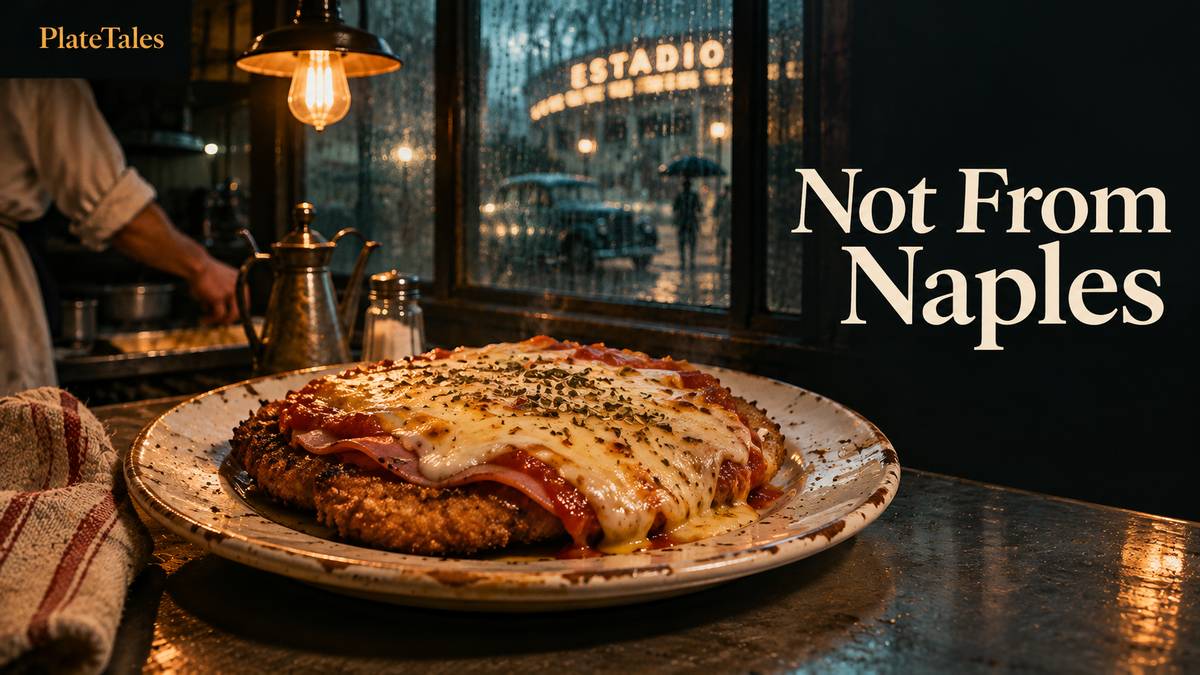
The milanesa napolitana origin story has a trap in the first word. The dish is not from Naples. It is a breaded cutlet from Buenos Aires, topped with tomato sauce, ham and melted cheese, and the "napolitana" most likely points to a restaurant called Nápoli across from the Luna Park stadium in the late 1940s. Or possibly to no restaurant at all, because at least one historian says it never existed.
A cutlet that sailed in from Milan
Before the napolitana there had to be a milanesa, and that part of the story is better documented. Breaded veal fried in fat is old in northern Italy. A banquet menu from Milan dated 1134 lists lombos cum panitio, breaded loin, and a 1749 French treatise, La science du maître d'hôtel, that gives a recipe for breaded, fried cutlets. Whether the Milanese or the Austrians get the credit for the modern version is a long-running quarrel. Clarín's 2017 piece says Italy and Austria both claim it, that Austrian troops occupying northern Italy after Napoleon's defeat carried the recipe home as the Wiener schnitzel, and that Italy seems to have the better case.
What is not in doubt is how it reached the River Plate. Around 3 million Italians came through the port of Buenos Aires between 1870 and 1920, and the city grew from about 180,000 people in 1870 to roughly 1,300,000 by 1910. The Argentine version is widely seen as an inheritance from that migration, most likely from Lombardy. Clarín puts it flatly: the dish came to the coasts of the river with Italian immigration.
The word itself took a while to settle. "Milanesa" began as an adjective describing how something was prepared, and only later became a noun for the dish. The earliest print use found is the eighth edition of Francisco Figueredo's El libro de cocina, published in 1914, with two recipes for veal ribs and cutlets cooked "a la milanesa." The first edition has not been found, so the real first appearance may be earlier.
Milanesa napolitana origin: the Nápoli on Bouchard street
The popular account of the napolitana goes like this. In the 1940s, a restaurant called Nápoli stood on Bouchard street, between Avenida Corrientes and Lavalle, facing the Luna Park boxing stadium. According to Clarín articles from 2017, the owner was Jorge La Grotta and that the dish was first served there in the late 1940s under the name "milanesa a la Nápoli." The name drifted into "napolitana" later, and the Italian city got the blame.
Descendants of La Grotta, according to those articles, say the plate was a deliberate marriage: the pizza habits of southern Italy on one side, the cotoletta alla milanese of the north on the other. That is a tidy way to describe a country where both kinds of immigrant ended up eating at the same tables. It is also a family account, and it should be read as one.
The burnt cutlet
Then there is the kitchen accident. In the version told by the Realidad SM blog, near closing time a kitchen assistant was cooking one last milanesa for a regular customer after the cook had gone home, and he burned the breading. La Grotta, the story says, told him to cover the damage with ham, tomato sauce and cheese, the way a pizza is dressed, and bake it. The customer liked it. The restaurant put it on the menu.
This version looks unlikely, and the Realidad SM author is no kinder. His objection is practical: an assistant careless enough to burn a cutlet is not someone an owner would trust to finish a dish. "Hay algo en esa historia que no cierra," he writes, something about the story does not add up. Clarín's 2017 piece mentions the burnt-cutlet tale only as something malicious tongues said. A good anecdote, a doubtful source, and a plate that can be built on the same logic as a margherita. That is how most kitchen legends are made.
Did the Nápoli exist?
Here the story turns on itself. Clarín cites the historian Daniel Balmaceda, author of La comida en la historia argentina, who contradicts the myth: according to his research, the restaurant Nápoli never existed. In his account the milanesa a la napolitana grew out of an adaptation of the pizza topped with cheese and slices of tomato.
So the sources split. Clarín's 2017 articles name a restaurant, an owner and a street. Balmaceda, as reported by Clarín, denies the restaurant outright. Both agree on the part that matters most: the dish is a local creation and not a transplant from Italy. Clarín says it "parece" a local creation, and the cautious verb is fair. No menu from the 1940s, as far as these pages show, has been put on the table to settle it.
The Realidad SM piece goes in a different direction again. Its author treats the Argentine "invention" as partly a myth, saying Argentines claimed a dish that already existed in Italy in a cutlet baked with cheese and tomato, and he names an Italian precursor cooked in a covered pan with broth. That is one writer's argument and not an established finding, but it is a reminder that cheese-and-tomato cutlets are not a miracle that can happen in only one city.
What the name does tell you
If the restaurant story is right, the name is a shortened trade name. If Balmaceda is right, the name borrows from the pizza napoletana that Italian bakers and pizzerias had been selling in Buenos Aires. Either way the link is to the pizza on the dish, not to the cooking of Naples. The tomato sauce, the cheese and the oven give it away. For the older story of how those toppings came together, see the history of pizza and how tomatoes came to Italy.
Argentina keeps a day for it
The milanesa now has its own calendar. National Milanesa Day falls on May 3 and has been celebrated since 2011, starting as a social media initiative. A separate Milanesa Sandwich Day on March 18 began in Tucumán in 2013, in memory of José Norberto "Chacho" Leguizamón, who died in 2010 and was tied to a well-known sandwich shop there. The Tucumán National Milanesa Sandwich Festival has run every November since 2022, and a milanesa festival at the Hipódromo de Palermo in Buenos Aires has been held yearly since 2024.
In 2017 the city government even ran a contest among 32 bodegones, the old-style neighborhood restaurants, for the best milanesa in the capital, with voting open until the 26th of July. Immigrant food made a home here and then became a municipal cause. That pattern repeats wherever newcomers cook, as in how immigration changed American food.
Questions people ask
Why is it called milanesa napolitana if it is not from Naples?
The name most likely comes from a Buenos Aires restaurant called Nápoli, which Clarín places across from the Luna Park stadium and says was owned by Jorge La Grotta. It was first sold there as "milanesa a la Nápoli" in the late 1940s. The historian Daniel Balmaceda disputes that the restaurant existed.
Who invented the milanesa napolitana?
Clarín credits Jorge La Grotta, owner of the Nápoli restaurant in Buenos Aires, in the late 1940s. His descendants say he joined southern Italian pizza habits with the northern cotoletta alla milanese. The historian Daniel Balmaceda, quoted in Clarín, says the Nápoli never existed and the dish adapted a pizza with cheese and tomato slices.
What is on a milanesa napolitana?
A milanesa napolitana is a breaded cutlet of meat, fried and then covered with tomato sauce, ham and melted cheese. In Buenos Aires it is treated as a classic dish. The toppings echo a pizza, which fits both the restaurant story and the explanation that the dish adapted a cheese-and-tomato pizza.
When is Dia de la Milanesa in Argentina?
National Milanesa Day in Argentina is May 3, celebrated since 2011 and begun as a social media initiative. Argentina also marks a separate Milanesa Sandwich Day on March 18, which started in Tucumán in 2013 in memory of José Norberto "Chacho" Leguizamón, who died in 2010.
How did the milanesa get to Argentina?
Italian immigrants brought it. About 3 million Italians arrived at the port of Buenos Aires between 1870 and 1920, and the city grew from about 180,000 people in 1870 to around 1,300,000 in 1910. The Argentine milanesa is widely seen as an inheritance from that migration, most likely from Lombardy.
Filed under Accidental Inventions
Want more stories like this?
One food history story, every week. No spam, just the stories behind what the world eats.