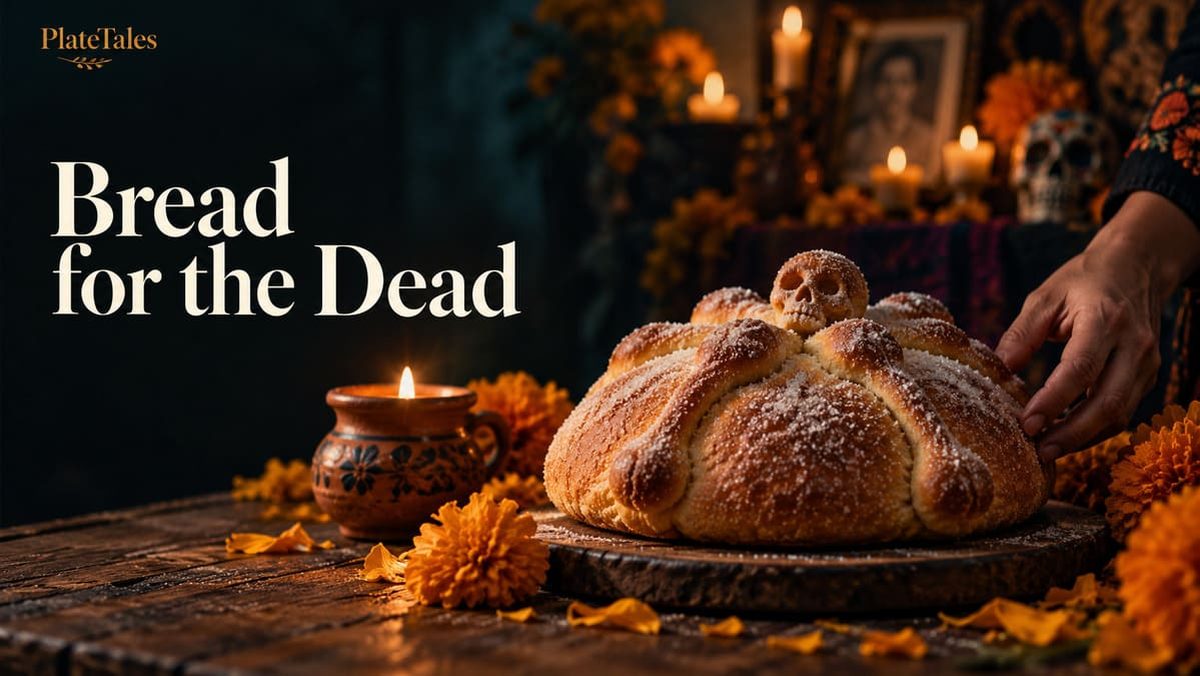
Pan de muerto is a sweet, round egg bread baked in Mexico for Day of the Dead on 1 and 2 November. Its history is two stories braided together: a Spanish tradition of blessed "soul bread" carried to New Spain, and a set of Indigenous offerings that Mexican institutions point to as ancestors. Historians still argue about the proportions.
The loaf on the altar
The bread sits on the ofrenda, the home altar built for the returning dead. UNESCO, which listed the Indigenous festivity of the dead on its Intangible Cultural Heritage list in 2008, describes families preparing the favorite dishes of the deceased and setting them around the home shrine and the tomb. The period falls at the end of the annual maize cycle, from late October into early November.
The loaf itself is a dome of enriched dough, usually flavored with anise, orange zest or orange flower water, and dusted with sugar. Strips of dough lie across the top like crossed bones, with a small ball at the center. Bakers and writers call the strips canillas, roughly "little shin bones." A 2021 Kantar Worldpanel report found that about eight in ten Mexican households buy the bread on those two days.
What do the bones on pan de muerto mean?
The usual reading is simple. The dome is a grave or the round of life and death, the ball is a skull, and the strips are bones. Some commentators go further and tie the four arms to the cardinal points and to Aztec deities such as Tezcatlipoca, Tlaloc and Quetzalcoatl. Others see the strips as tears, and a baked teardrop is sometimes said to stand for the tears of the goddess Chimalma.
These are interpretations, and they do not agree. The chef and food writer Ricardo Munoz Zurita has proposed that the decoration is meant as a flower, not bones at all. No surviving recipe or baker's account fixes one meaning, so treat any single explanation with some caution.
The heart-and-amaranth story
The best-known origin tale says the bread replaced human sacrifice: a heart once offered to the gods became a sweet bun, with the bone strips and the red sugar standing in for blood. It is vivid, and it keeps circulating. The sources consulted here call it false. A 1999 study says plainly that this origin is not true, and it is best treated as a myth, though one that helps explain how people read the bread's ritual meaning.
The Spanish bread of souls
The strongest documented ancestor is Spanish. Pan de animas, "bread of souls," was made around All Saints and All Souls in Castile, Aragon, Portugal and Sicily, among other places. Parishioners brought loaves to church on 1 November, the priest blessed them, and people said an Our Father for the dead before eating. It also went by pan de muerto, pan de difunto and pan bendecido.
The forms were sometimes human. In Toledo the All Saints bread was shaped like a shrouded corpse. In Menorca, panets de mort were small buns shaped like people or rabbits, strung like a rosary and given to children, with evidence reaching back to the 17th century. In Sicily, breads of the dead took the form of a person with crossed arms. A bread shaped like a body is not a Mexican surprise.
The custom faded in Europe, first in big cities and then in villages, as industrial baking spread. It survives in Mexico and in the Andes, where the same family appears as t'anta wawa, "bread baby," and in Ecuador as guaguas de pan.
The ingredients arrived on ships
Look at what goes into the loaf: wheat flour, cane sugar, cow's milk, butter, eggs and orange. None of these existed in the Americas before the Spanish came. They traveled over the Atlantic in what historians call the Columbian exchange. Anyone tracing the dough back to a pre-Hispanic kitchen has to explain how a recipe built on wheat and sugar got there. For the wider story of the grain, see the history of bread, and for the sweetener, the history of sugar.
The anthropologist Stanley Brandes, in his 2009 book Skulls to the Living, Bread to the Dead, argues that the Mexican Day of the Dead is largely a colonial creation, with its food customs descended from Europe. He points out that the thing is called pan de muertos, not tortilla de muertos. The historian Elsa Malvido, writing in 1999, likewise argued that Catholic influence on the festival is underrated.
The butterfly tortilla and the case for older roots
The other side has a document of its own. Mexican government bodies, among them the National Institute of Indigenous Peoples, link the bread to the papalotlaxcalli, a butterfly-shaped tortilla described in the chronicles of Fray Bernardino de Sahagun as an offering connected with the Cihuapipiltin and with women who died in childbirth. A university blog from Cuautitlan Izcalli suggests a different ancestor, the huitlatamalli, a votive tamale. The butterfly-tortilla thesis is the most widely supported of these today.
Two things are fair to say together. Indigenous peoples did make ritual foods for the dead and for deities long before 1519. And the loaf as eaten today is wheat bread with a Spanish name and Spanish relatives. Even the festival is argued over: some Mexican academics see pre-Hispanic roots while others see a 20th-century version of a Spanish tradition, promoted under President Lazaro Cardenas to build national identity. Mexican schools teach the native origin.
One bread, many shapes
Because nobody enforces a standard, the bread varies by region. In San Andres Mixquic the despeinadas, "unkempt ones," carry sesame seeds and sprinkles. In Michoacan the glossy brown pan de hule often bears a dedication to the dead. In the Mixteca of Puebla the bread is shaped like a person, dusted with white sugar for children and red sugar for adults. In Tlaxcala, breads take animal shapes, and in Apizaco the local hojaldra uses lard and pulque. In the Oaxaca valleys, rich yolk bread is topped with an alfenique sugar figure representing the soul being honored.
Some towns sell it from early August to mid-November. In the United States it was uncommon at All Saints observances before the 1970s and 1980s, until Chicano cultural activism spread public altars, and with them the bread. In 2008 UNESCO put the whole festivity on its list, and the loaf is still baked each autumn in Zaachila, Mixquic and thousands of other places.
Questions people ask
Why do Mexicans eat pan de muerto?
Mexicans bake and eat pan de muerto for Day of the Dead on 1 and 2 November. A loaf is set on the ofrenda for the returning souls, and families share bread too. The custom blends the Spanish tradition of blessed bread for the dead with Indigenous offering foods, and scholars disagree about the balance.
Is pan de muerto Aztec or Spanish in origin?
Evidence favors a Spanish base. Pan de muerto descends from Spanish pan de animas, and its wheat, sugar, milk, butter and eggs all came after the conquest. Mexican government bodies instead point to the Aztec butterfly-shaped papalotlaxcalli described by Sahagun, so the loaf is best called a colonial-era blend with disputed roots.
What does the shape of pan de muerto represent?
The dome of pan de muerto is usually read as a grave or the cycle of life and death. The central ball stands for a skull, and the crossed strips, called canillas, stand for bones. Some say they are tears, and Ricardo Munoz Zurita suggests they depict a flower. No single meaning is documented.
Did pan de muerto replace human sacrifice?
No. The story that pan de muerto replaced a sacrificed heart is a popular legend, and sources consulted for this article label it false. The bread's closest documented relatives are the Spanish bread of souls and, in some Mexican accounts, an Aztec butterfly-shaped tortilla offered to deities.
Filed under Ritual Foods, Cultural Identity
Want more stories like this?
One food history story, every week. No spam, just the stories behind what the world eats.