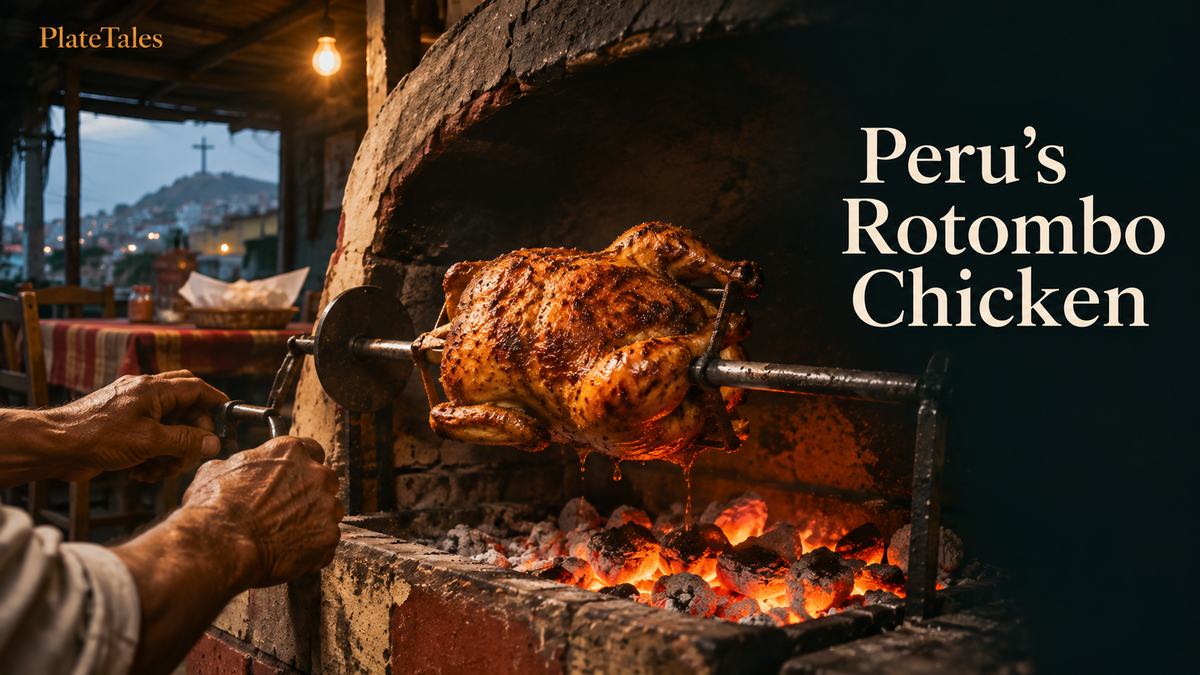
Pollo a la brasa, Peru's charcoal-roasted chicken, was developed around 1950 in Lima by a Swiss immigrant, Roger Schuler, with help from a fellow Swiss countryman and metalworker, Franz Ulrich. Schuler's restaurant, La Granja Azul in Santa Clara, was the first to serve it, and Ulrich built the rotating oven that cooked many birds at once. The details are less settled than the legend suggests.
Who invented pollo a la brasa?
Most histories credit Roger Schuler, a Swiss national who lived in Chaclacayo, east of Lima, and date the dish to 1950. They say he had trouble getting back to Switzerland during World War II and ended up in Lima, where he worked in hotels and restaurants. The idea of cooking chicken on a spit over charcoal, they add, came from his cook's technique.
That last detail matters, because the popular version of the story makes Schuler a lone inventor. The usual account gives the method a kitchen origin first and an engineering one second. Nobody in the sources we opened names the cook.
A tourism blog (Gringo Peru) tells a fuller version, and it admits that "the truth of which is debated." In its telling, Schuler set up a chicken farm in Santa Clara, in the Ate district, in 1946, hoping to sell birds to richer districts such as Miraflores. By 1950 sales had gone sour and unsold chickens were piling up. Cooking them was a way to avoid losing more money.
We could not confirm that account in a second independent source, so treat the farm, the date and the motive as the local telling, not as a documented record.
The metalworker and the rotombo
The usual account says a large catering order pushed Schuler to look for a better way to cook in volume. He turned to Franz Ulrich, another Swiss immigrant and a metalworker, who built an oven that turned many chickens at once. Ulrich called it "El rotombo."
The blog describes the same machine as a mechanised rotisserie fed by algarrobo charcoal, and says the system became known as planetario. Algarrobo is a tree found in Peru, Colombia and Ecuador. Whatever the name, the idea was a spit that turned continuously, so the fat and juices basted the meat as it went round.
Ulrich kept building rotisserie ovens after the first one. The Schuler family still owns La Granja Azul and several other restaurants in Peru.
Salt, fries and eating with your hands
The two accounts disagree on the seasoning. The usual account says the original version used only salt, came with big french fries and was eaten by hand. The blog says the first chickens were marinated in panca pepper, soy sauce, black mint, salt and pepper. Both are plausible for different moments in the first years, and we found nothing that settles it.
What both agree on is the later drift. The usual account lists rosemary, huacatay, black pepper, soy sauce, ají panca and cumin as additions that crept in over time, and notes that a knife and fork eventually became acceptable. The modern plate almost always comes with mayonnaise-based sauces or ají.
The blog adds a vivid piece of marketing. A sign near the central railway line supposedly offered all the chicken you could eat for 5 soles. We could not check that sign, so we pass it along as a local story only. The point the blog makes is easier to believe: a place like La Granja Azul was cheaper than restaurants of its day, which were seen as places of luxury and prestige, and diners could eat with their fingers without anyone frowning.
Why 1949 or 1950?
The date you see depends on who is writing. Most histories say 1950, and the Gringo Peru blog also puts the turn to roasting in 1950, after the farm began in 1946. Some Peruvian outlets print 1949, but we only saw that in a search snippet and did not open the page, so we leave it out of the story.
A one-year gap is normal for a dish that began as a small roadside business. Nobody filed paperwork for the first spit-roasted chicken.
From Santa Clara to everywhere
The blog says another Swiss, named Steinmann, soon opened a restaurant called El Rancho closer to central Lima, using the same kind of mechanised rotisserie. It also says the dish only became widely popular in the 1970s, when many more restaurants opened, each tweaking the seasoning while keeping the method. Other histories agree that pollo a la brasa spread widely from the 1970s.
After that the dish became ordinary. Rotisserie chicken restaurants are said to make up 40% of Peru's domestic fast food industry, and the average Peruvian is said to eat the dish about three times a month. That second figure is stated without a clear source, so read it as a rough claim.
If you want the wider pattern of newcomers reshaping what a country eats, the story of how immigration changed American food runs along similar lines, and the cheap, quick, working-class appeal of fish and chips is a close cousin of what Schuler's place offered Lima. The war that stranded Schuler is covered in wartime foods history.
An official dish, an official day
Peru has put paperwork behind the dish since. The Instituto Nacional de Cultura recognized pollo a la brasa as a Peruvian culinary specialty through a directorial resolution published in the newspaper El Peruano on 27 October 2004, and the dish was declared part of the national cultural heritage that year.
In 2010, Resolución Ministerial N° 0441-2010-AG set the third Sunday of July as the Dia del Pollo a la Brasa. Some accounts credit the culture ministry, though the AG in the resolution's code suggests the agriculture ministry, so even the official record is a little tangled. Also in 2010, the national statistics institute, INEI, began including the dish in its basic family basket.
Ministry of Agriculture figures cited in the same accounts put national production at 44 million chickens a month, with 8 million of them going to restaurants that specialize in pollo a la brasa. The blog gives a different number, 12 million a month sold as pollo a la brasa, so the totals depend on what is being counted.
The oven that Franz Ulrich built for a farm restaurant in Santa Clara in 1950 is now the model for thousands of Peruvian pollerias, and each July a whole country takes a Sunday off to celebrate it.
Questions people ask
What is the difference between pollo a la brasa and ordinary roast chicken?
Pollo a la brasa is cooked on a continuously turning spit over charcoal, a method Roger Schuler and Franz Ulrich developed at La Granja Azul near Lima around 1950. The turning bird bastes itself in its own fat. The Peruvian version is usually served with french fries and creamy sauces or ají.
Who built the first pollo a la brasa oven?
Franz Ulrich, a Swiss metalworker living in Peru, built the first rotisserie oven used for pollo a la brasa. By the usual account, he made it after Roger Schuler had trouble with a large catering order, and he called it "El rotombo." Ulrich went on making rotisserie ovens afterward.
When is Pollo a la Brasa Day in Peru?
Peru celebrates the Dia del Pollo a la Brasa on the third Sunday of July. The date was set in 2010 by Resolución Ministerial N° 0441-2010-AG. One blog still lists 21 July, but the official resolution gives the third Sunday, and that is the date used.
Was the first pollo a la brasa really seasoned only with salt?
The usual account says the original pollo a la brasa used only salt and was served with big french fries and eaten by hand. A Peruvian travel blog says the first chickens were marinated in panca, soy sauce, black mint, salt and pepper. We found no document that settles which is right.
Filed under Origin Stories, Migration Stories
Want more stories like this?
One food history story, every week. No spam, just the stories behind what the world eats.