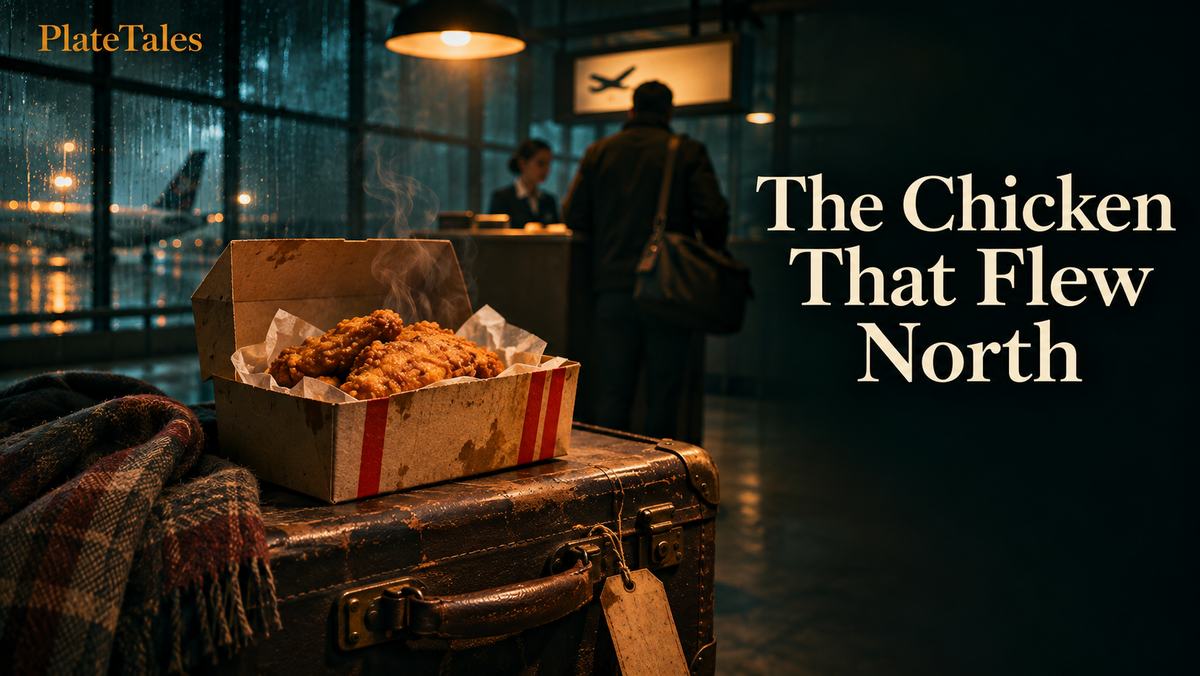
People bring Pollo Campero on planes because the Guatemalan fried chicken chain was, for about thirty years, available only in Central America, and relatives living in the United States wanted a taste of home. Travelers from Guatemala and El Salvador carried boxes of it through airports and onto flights north, so much that the habit helped persuade the company to open its own restaurants in the US in 2002.
That is the short version. The longer one has a family of poultry farmers, a chicken restaurant that opened in April 1971, and a few details that the sources do not agree on.
Where Pollo Campero came from in Guatemala
The chain grew out of the Gutierrez family's poultry and restaurant businesses. By one account, the family opened a fried-chicken restaurant in 1967 and the first official Pollo Campero restaurant opened in Guatemala on April 28, 1971. That account does not name a single founder.
Another account tells it with more names. In it, the company was founded in April 1971 by a group of businesspeople led by Juan Jose Gutierrez Mayorga, and Dionisio Gutierrez is credited with deciding to sell chicken from the poultry farms his father, Juan Bautista Gutierrez, had set up in the 1960s. Francisco Perez de Anton, who had experimented with his wife, Consuelo Gutierrez, is listed among the investors, and together they opened the first restaurant.
So the dates (1967 for a chicken restaurant, 1971 for the brand) and the cast of people depend on which account you read. What the accounts agree on is the shape of the business: farms first, then a restaurant to sell what the farms raised. The name itself means roughly "country chicken" in Spanish. Frying itself is older than the chain by centuries: by one account, Spanish conquistadors introduced new cooking methods such as frying.
From one country to a region
Growth outside Guatemala came early. According to a 2014 case study in the journal Management Decision, the chain expanded to El Salvador in 1972 and Honduras in 1992. Other accounts agree that El Salvador in 1972 was the first restaurant outside Guatemala.
The company also reports that self-service arrived in 1980 and home delivery in 1995. A franchise program supported openings in Panama, Nicaragua, Costa Rica, Ecuador and Mexico, and Campero is described as the first Guatemalan company to franchise. Accounts differ on the year franchising began, and nothing else read here settles it, so this article gives no year.
By 2000 the chain had 143 restaurants and nearly 6,000 employees. Every one of them was in Latin America. If you lived in Los Angeles, Houston or Washington, you could not buy it.
Why people bring Pollo Campero on planes
This is where the planes come in. English-language accounts say the move into the US was driven by the popularity of the chicken among Guatemalan and Salvadoran consumers, and that passengers flying from Central America to the US often carried boxes of it on their flights.
One account adds a detail from the other side of the ticket counter: airlines flying from Guatemala and El Salvador to the US complained about the strong smell of fried chicken in their cabins. A 2002 Christian Science Monitor report backs this up. It says it became so common for flights to the United States to be filled with these fried feasts that pilots and passengers began complaining of the constant smell. The paper also notes that the chain had branches in the Guatemala City and San Salvador airports, so travelers could buy a box on their way out.
The same Monitor story, written in Houston in December 2002, follows one traveler. Zoila Monge visited her native Guatemala that summer, and the only thing her Houston relatives asked her to bring was chicken. She bought 20 pieces at the airport branch in Guatemala City and joined the passengers with boxes under seats, in overhead compartments and on laps. "It's like a taste of home," she said. The article also says some 300 million pieces of chicken were flown back to the US each year, a figure it gives without a stated source.
A 2021 Los Angeles Times story on this was not available to read, so its scenes stay out of this article. The reference still matters. By 2021 the paper was still describing travelers who stepped off flights from Guatemala City with chicken in their carry-on, nearly two decades after the chain had opened restaurants in America. The summary is that people still brought the chicken from Central America even after US locations opened.
Why bother, if you can buy chicken anywhere?
A pound of fried chicken is not hard to find in the United States. The point, as far as the sources suggest, was the particular brand and what it carried. The Washington Post, covering a US opening, described a "mercado de la nostalgia", a nostalgia market, tied to Central American residents. A box from Guatemala City was a message from home that happened to be edible.
There is no sourced motive beyond that. Nobody in the sources read here is quoted explaining why they packed a box, and a box of chicken on a long trip is a stranger gift than it sounds.
April 2002 in Los Angeles
The company followed its customers. The first US restaurant opened in Los Angeles in April 2002. The Management Decision case study reports that it made $1 million in sales in its first 22 days. Another account gives a similar record but says $1 million in 36 days at one US restaurant. The Christian Science Monitor, writing in December 2002, says the first Los Angeles restaurant reached $1 million in sales in seven weeks, and that the company had opened three Los Angeles restaurants by then. The three accounts differ, so treat the exact pace as uncertain; all agree it was extraordinary.
The next US city was Houston, where the Monitor reported lines down the street and waits of up to five hours at the December 2002 opening. Early growth centered on Central American immigrant communities, which is also the logic of the airline smell complaint: the demand was already there and already flying north. See how other food traditions traveled with people in how immigration changed American food, and the wider pattern in the migration stories section.
What the chain looks like now
The numbers keep moving. In the first half of 2024 the company opened 17 US locations and celebrated its 100th US restaurant in Miami Gardens, Florida. In February 2025 it opened its 122nd, inside Penn Station in New York City. By July 2025 it reported more than 130 US restaurants in more than 60 cities across 20 states. These recent figures come from company announcements, so treat them as the company's own count.
Pollo Campero is part of CMI Foods, the food group of Corporacion Multi Inversiones, a Guatemalan family-owned conglomerate. It runs about 400 restaurants worldwide with more than 8,000 employees, in Guatemala, El Salvador, Honduras, the US, Mexico, China, Ecuador and Spain. Pollo Campero International is headquartered in Dallas, Texas. The first restaurant in China, in Shanghai, was scheduled to open on May 24, 2007.
For comparison with other dishes that crossed borders on people rather than on trade ships, see the history of fried-chicken-adjacent street food and soul food, where a regional cooking also became a national one.
Questions people ask
When did Pollo Campero open in the United States?
The first US Pollo Campero restaurant opened in Los Angeles in April 2002, about thirty-one years after the Guatemalan chain's first restaurant opened in April 1971. A 2014 Management Decision case study reports that it made $1 million in sales in its first 22 days.
Where did Pollo Campero start?
Pollo Campero started in Guatemala, where the first official restaurant opened on April 28, 1971. The chain grew from the Gutierrez family's poultry and restaurant businesses. It reached El Salvador in 1972, and now belongs to the Guatemalan conglomerate Corporacion Multi Inversiones.
Did airlines complain about fried chicken on flights from Guatemala?
By one account, airlines flying from Guatemala and El Salvador to the United States complained about the strong smell of fried chicken in their planes. Passengers from Central America often carried boxes of the chicken on those flights.
How many Pollo Campero restaurants are there in the US?
By July 2025 Pollo Campero reported more than 130 restaurants in the United States, in more than 60 cities across 20 states. The chain celebrated its 100th US restaurant in Miami Gardens, Florida, in the first half of 2024. The figures come from company announcements.
Filed under Migration Stories
Want more stories like this?
One food history story, every week. No spam, just the stories behind what the world eats.