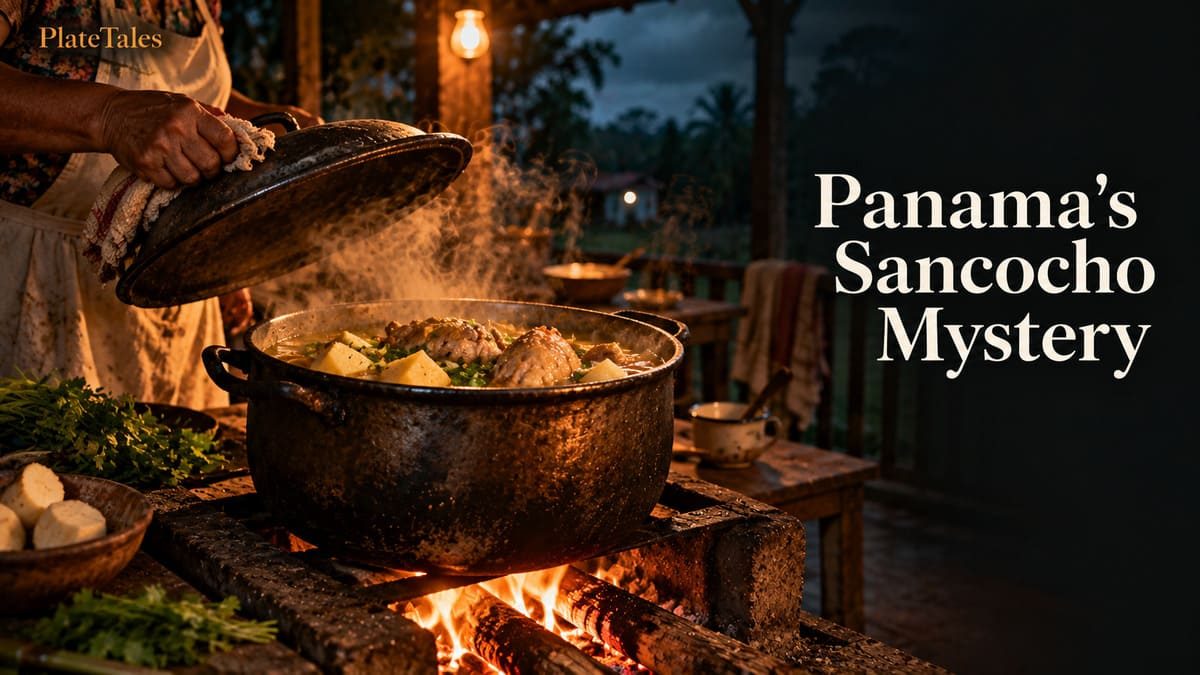
Sancocho in Panama is a thick chicken soup built on ñame (a starchy yam) and culantro, a long-leaved herb that is not cilantro, and it is usually called the country's national dish. Its history is murkier than its popularity. No one has pinned down when the Panamanian version first appeared, and the people who study it say so openly.
What is in a Panamanian sancocho
The core is short. A hen or chicken, ñame, culantro, onion, oregano and salt. The ñame flavors the broth and thickens it, while the culantro supplies most of the taste and a greenish tone. The herb is Eryngium foetidum, and garlic, pepper and ají are among the usual seasonings. White rice goes on the side.
Everything else depends on the province. On the Azuero Peninsula the soup is made only with hen or chicken and ñame as the single tuber, traditionally in iron pails over a wood fire, and served with rice and fried plantain slices. Add other meats there and the name changes to "sopa". Chiriquí and Veraguas pile in more: yuca, otoe, squash, corn, potato, green plantain. A Chiriquí pot in the 2019 reporting below takes potato, carrot and corn. The Bocas del Toro version can include pork tail and beef rib, and coastal towns sometimes use fish.
That range is the first clue to the history. There is no single recipe to trace back, only a family of pots.
Where does the word sancocho come from?
The name is Spanish. It comes from sancochar, which means "to parboil". The Real Academia Espanola defines sancocho as a "vianda cocida a medias", food cooked halfway.
So the word describes a method, not an ingredient list. That is why the same word covers a chicken soup in Panama, a salt-fish dish in the Canaries and a beef-and-root-vegetable pot elsewhere in Latin America.
Sancocho Panama history: cocido, olla podrida, or older?
Writers have tried to connect sancocho to the Taino ajiaco, to the Spanish cocido and olla podrida, and to boiled dinners from Corsica, Ireland, Denmark, Germany, Italy and France. Accounts list all of them, with a sensible caution: making broth is an intuitive thing to do, so each place's version reflects what grew there and what people liked.
The Panama-specific story rests mostly on one source worth knowing about. In November 2019, the EFE news agency reported on a roughly 17-minute documentary called Un sancocho de pelicula, shown at the Museo del Canal Interoceanico during the events marking 500 years since the founding of Panama City. It was made by Neptario Cabrera, a Venezuelan chef who teaches at the Universidad Santa Maria La Antigua and had lived in Panama for 16 years, with Panamanian chef Fifita Bichili and producer Orlando Vanegas.
Cabrera told EFE that the dish might descend from the olla podrida and cocido, or from stews of France, Italy or Germany. He did not claim to have settled it. EFE's report says there is still much to research.
Did the first sancocho use chicken at all?
Here is the most interesting claim in that reporting. According to the EFE piece, Cabrera argues the first sancocho may have been made with beef, not hen. His reasoning: hens arrived with the Spanish around 1519, the year Panama City was founded, and the Spanish treated them as medicine. Cattle were valued for hides and tallow, and the meat was given away, so poorer people probably turned it into soups with vegetables.
That is a hypothesis from a chef-teacher, not a documented finding, and EFE's report presents it that way. But it flips the assumption that the chicken pot is the original and everything else a variation.
The same piece raises a second open question: whether ñame existed in the Americas before contact or came with Africans. The documentary's makers left that undecided too. Treat any tidy account that names a single African, Indigenous or Spanish origin for Panama's pot as more confident than the evidence allows.
The Canary Islands cousin
The Canary Islands have their own sancocho, and it looks nothing like Panama's. It is a salted-fish dish, associated especially with Gran Canaria, cooked with potatoes and sweet potato and served with mojo sauce and a lump of gofio kneaded with the broth. It is traditionally made in Holy Week, on Good Friday, when meat is avoided.
By one account, most authors think the dish spread from the Canaries to South America, but early texts are scarce, so it is unclear whether the dish was carried across or arose in parallel in different places. That origin claim is itself flagged as needing better references. The shared word is solid. The line of descent is not.
A soup for the day after
What Panamanians say about the dish is better documented than where it came from. Bichili told EFE that sancocho is eaten everywhere in the country, as a remedy for a hangover (the word she used was "goma"), after parties and at baptisms, and that this repetition is what made it emblematic. Cabrera went further in the other direction: he called it "iconico y emblematico" but said it is not the core of Panamanian cuisine.
Those are two cooks, one from Panama and one from Venezuela, agreeing that the soup is a symbol first and a cuisine second. For a longer look at how a plate becomes a flag, see how food shaped cultural identity. Another stew with a contested pedigree is feijoada, and the reasons recipes like this one go unrecorded are in lost recipes of our grandmothers.
A pot for the centenary
Panama marked 100 years as a republic in 2003, and the soup was part of it. According to a Panama America article of 30 July 2003, a "sancocho centenario" was cooked and entered in the Guinness World Records as the largest chicken and ñame soup: more than 2,562 gallons in a 1,470-pound pot. Only a summary of that article was read here, not the newspaper itself.
In 2019, Cabrera and Bichili took a smaller version to the Xantar gastronomic tourism fair in Spain: broth, small pieces of ñame and neat portions of chicken. Neither thinks the dish can be reinvented, only "estilizado". Their team won the fair's internationalization prize that year for a pre-Hispanic menu of Panama.
Questions people ask
Is sancocho the national dish of Panama?
Sancocho de gallina is widely described as Panama's national dish. Chef Neptario Cabrera gave a more careful reading in 2019: he called it an emblematic icon of the country while saying it is not the center of Panamanian cooking. The title is common usage, not an official decree.
What is culantro and how is it different from cilantro?
Culantro is Eryngium foetidum, a different herb from cilantro. In Panamanian sancocho it supplies most of the flavor and the greenish color of the broth. It is listed, along with ñame, as one of the two essential ingredients of the Panamanian soup.
Is sancocho really eaten as a hangover cure in Panama?
Panamanian chef Fifita Bichili told the EFE news agency in 2019 that sancocho is eaten across Panama as a remedy for a hangover, called "goma" locally, as well as after parties and at baptisms. That describes custom, and no source here tests whether it works.
Where did sancocho originate?
Nobody has settled it. Sancocho takes its name from the Spanish sancochar, meaning to parboil, and writers link it to Spanish cocido and olla podrida, the Taino ajiaco and the Canary Islands fish dish. Venezuelan chef Neptario Cabrera told EFE in 2019 that much remains to be researched about Panama's version.
Filed under Cultural Identity
Want more stories like this?
One food history story, every week. No spam, just the stories behind what the world eats.