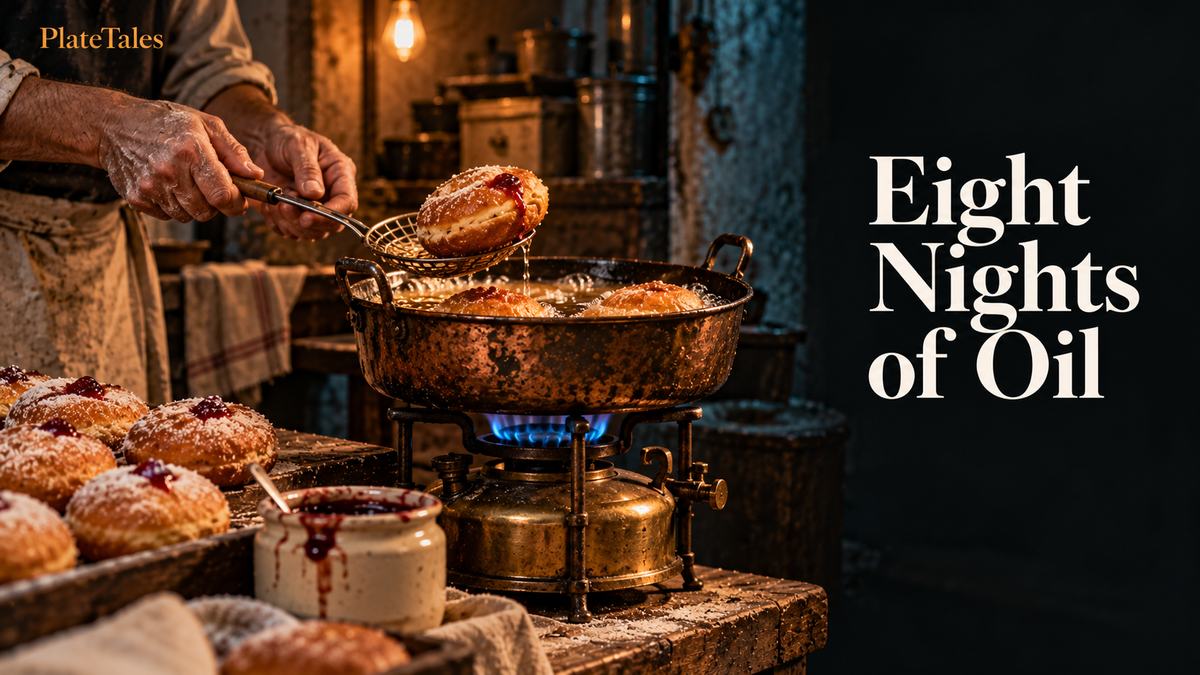
We eat jelly donuts on Hanukkah because the holiday remembers a lamp of oil that burned for eight days, and Jews have marked it with food fried in oil since at least the 12th century. The jam-filled doughnut came much later. It is a Central European Carnival pastry that Jews adopted, and it became Israel's Hanukkah food in the 20th century, possibly with a push from a labor union.
None of that is in the Talmud. Each piece turns up in a different place and century, and a few of the best-known pieces are thinner than the explainers suggest.
Oil in the Talmud, and no food at all
The Talmud's account of Hanukkah, in tractate Shabbat 21b, is about a lamp. When the Hasmoneans retook the Temple, the rabbis say, they "found only one cruse of oil that was placed with the seal of the High Priest," enough for a single day. "A miracle occurred and they lit the candelabrum from it eight days." The sages fixed the holiday around praise and thanksgiving. Nobody in the passage eats anything.
The word that would one day name the doughnut does exist in the same body of literature, attached to a different food. Mishnah Challah 1:4, in a discussion of which doughs owe the priestly portion, lists sufganin, which the Sefaria translation renders as "sponge-cakes," next to honey-cakes and dumplings. The 15th-century commentator Ovadia of Bartenura explained the sufgan as bread made from a soft, sponge-like dough. It had no jam, and nobody connected it with Hanukkah.
Why fried food on Hanukkah? A rabbi in 12th-century Fez
The first person known to tie fried dough to Hanukkah is Rabbi Maimon ben Joseph, a judge from Cordoba, born about 1110, who is mostly remembered as the father of Maimonides. After the Almohad conquest of 1148 the family lived for years as hidden Jews, and around 1160 they moved to Fez.
Maimon wrote treatises on the laws of prayer and festivals, and Chabad.org describes his work on prayer as written in Arabic. His Hanukkah passage survives secondhand: Rabbi Yehuda bar Meir Toledano quoted it in a 1945 Jerusalem collection, Kovetz Sarid Ve-Palit. In the English given by Chabad.org, Maimon writes: "It has become customary to make 'sufganin,' known in Arabic as 'alsfingh.'" He adds that "this is an ancient custom, because they are fried in oil, in remembrance of His blessing."
That sentence is the oldest written answer to the question in the title. The fritter he meant was almost certainly the sfenj, a ring of barely sweetened yeast dough that is still eaten for breakfast across the Maghreb, torn apart and spread with honey. It was a fried sponge, with no jam inside. Maimon already called the custom ancient, and he already gave it the Mishnah's Hebrew name.
Who invented the jelly doughnut? A Nuremberg cookbook, 1485
The jam belongs to a different story. In 1485 the Nuremberg printer Peter Wagner issued the Kuchenmeisterei, the first cookbook printed in German, which kept being reprinted until at least 1674. The Jewish food historian Gil Marks, in his Encyclopedia of Jewish Food (2010), dates the first filled doughnut to a recipe in it for gefullte Krapfen: in his words, "a bit of jam sandwiched between two rounds of yeast bread dough and deep-fried in lard."
Two cautions. The explainers cannot agree on the date: Emelyn Rude, writing in Time in 2015, cites Marks for a "1532 German cookbook," while Jewish Action, also citing Marks, says 1485. The first printing in 1485 is well documented, and with a book reprinted that often, a later edition may explain the 1532. Also, we could not check the Krapfen recipe against a digitized copy of the 1485 text, so the recipe claim rests on Marks.
The reason fruit fillings spread is clearer. Early doughnuts were usually savory, stuffed with cheese, meat or mushrooms, because sugar stayed costly until the 16th century. Imports from Caribbean slave plantations then made it cheaper, a trade told in our history of how sugar fueled slavery and empire, and fruit preserves moved into the dough.
Ponchiks, Berliners and Fat Thursday
The filled doughnut became a pre-Lent and holiday pastry across Christian Central Europe. In Poland, paczki are eaten above all on Fat Thursday, the last Thursday before Ash Wednesday, to use up lard, eggs and sugar before the fast. Jedrzej Kitowicz, describing Polish customs under Augustus III, credited French cooks with making the dough lighter and spongier.
In Germany the Berliner Pfannkuchen gets a printed recipe from Henriette Davidis in 1847. Her light yeast dough is filled with fruit, fried in clarified butter without turning, and dusted with sugar and cinnamon, close to the modern method. Germans still eat Berliners on New Year's Eve and through Carnival. The tale of a Berlin baker who was rejected as a gunner and shaped dough like cannonballs for Frederick the Great has no primary evidence behind it, and a Klagenfurt newspaper was already scoffing at it in 1932.
Jewish cooks in Poland could not use lard under the kosher laws, so they fried their version in oil or schmaltz (rendered poultry fat) and called it ponchik. Rude writes that Polish Jews "began eating them regularly on Hanukkah," which fits the old custom of frying something for the holiday. Ashkenazi Hanukkah tables also held latkes, which only turned into potato pancakes after potatoes took over the Eastern European diet, a shift covered in how the potato changed Europe.
What does sufganiyot mean?
Sufganiyah (plural sufganiyot) is a modern Hebrew word built on the Mishnah's sufgan, from the Hebrew root s-f-g, "to absorb," which also gives sfog, a sponge. Sfenj comes from the Arabic word for sponge, so Maimon was matching two sponge words. Many writers link the Hebrew root to Greek spongos, though the language blog Balashon notes the connection is not settled. A doughnut soaks up oil, so the name fits either way.
Who coined it is less settled. Some histories say David Yellin, the Jerusalem educator who co-founded the Hebrew Language Committee in 1890, "probably" did so in 1896, and gives no source. A Haaretz account quoted by The Takeout tells a better story: in 1897 Yellin was translating Oliver Goldsmith's The Vicar of Wakefield into Hebrew, got stuck on the word shortbread, and "made up a word" for it, sufganiyot, built on the old sufganin. If that is right, the Hebrew word for a jam doughnut began life as a translation of a Scottish biscuit. The year differs by one between the accounts, and neither has been traced here to Yellin's own text.
Then there is the folk etymology, which reads the word as sof gan Yah, "the end of God's garden." In a Bukharian fable, the first sufganiyah was a sweet given to Adam and Eve to make up for their expulsion from Eden. The folklorist Dov Noy, who told the story to the cookbook author Joan Nathan, considered it a 20th-century creation, since the word itself was new. Rude's verdict in Time is fair: "pretty much all scholars agree that the tale has zero basis in the scripture."
Who made jelly donuts the Hanukkah food in Israel?
The Histadrut, the Jewish labor federation, was founded in Haifa in December 1920. The story repeated in nearly every explainer is that in the late 1920s it promoted the bakery doughnut over the home-fried latke to create jobs. The logic is easy to follow. Anyone with a grater and a pan can make latkes at home. The Atlanta Jewish Times, summarizing Marks, says the doughnut dough "had to be kneaded, rolled and cut by hand, then fried in small batches" on a primus, a kerosene stove, which meant paid Jewish bakers.
Here the sources thin out. Every version traced for this article leads back to Marks's 2010 encyclopedia or to Rude's 2015 Time piece, which itself relies on Marks. Neither, as quoted, cites a Histadrut resolution, a newspaper advertisement or a bakery ledger. Accounts differ on a parallel claim, that the union pushed sufganiyot specifically to beat Moroccan sfenj, which is described as "less well-supported." So the Histadrut story is plausible and widely repeated, but for now it is one historian's account, and no one has produced the campaign itself.
The historian John Cooper, in Eat and Be Satisfied, offers a different route: the recipe "came with the wave of German Jews" who fled Hitler for Palestine in the 1930s. Carol Ungar, writing in Jewish Action in 2012, put it bluntly: "Nobody knows who brought the sufganiya to Israel." She found one piece of support for the German line. Buki Ne'eman, whose family runs the Ne'eman bakery chain, told her, "The Germans built the konditori culture here. Before them, there was nothing." His grandfather, Rabbi Yaacov Ne'eman, a Jerusalemite of Persian roots, learned to make sufganiyot at a German-Jewish bakery in Meah She'arim.
The two theories do not exclude each other. Moroccan Jews had brought sfenj as a Hanukkah treat, and by most accounts it faded as the bakery doughnut took over.
Eighteen million a season
Ungar cited a Teleseker survey, reported in 2006, finding that 80 percent of Israelis eat at least one sufganiyah during Hanukkah, more than fast on Yom Kippur. Rude wrote in 2015 that Israelis eat more than 18 million in the weeks around the holiday and that the army buys more than 50,000 a day for soldiers. Angel, the country's largest bakery, has been rumored to fry 25,000 a day at peak, though a spokesperson declined to confirm the number to Ungar.
The fillings have moved on from red jam. Argentine Jewish immigrants in the 1980s brought ribat chalav, the milk caramel better known as dulce de leche, and bakeries now sell halva and cappuccino versions next to the strawberry. In 2012 Ungar found prices from about a dollar for plain jam to almost four for gourmet ones.
The man who first wrote down the custom of Hanukkah fritters, Maimon ben Joseph, left Fez by sea in 1165 with his sons, and a widely accepted tradition places his grave in Tiberias, on the shore of the Sea of Galilee.
Questions people ask
Why do Jews eat fried food on Hanukkah?
Hanukkah remembers a single cruse of oil that, according to the Talmud in tractate Shabbat 21b, burned for eight days in the Temple. Frying in oil recalls that miracle. The earliest known source is Rabbi Maimon ben Joseph, writing in Fez in the 12th century, who called frying sufganin in oil an ancient custom.
What does sufganiyah mean in Hebrew?
Sufganiyah (plural sufganiyot) is a modern Hebrew word built on the Mishnah's sufgan, a spongy dough, from the root s-f-g, "to absorb." The name fits a doughnut that soaks up oil. Some sources credit the educator David Yellin with coining it in the 1890s, but the accounts differ and none is traced to his own text.
Where did the jam-filled doughnut come from?
The filled doughnut is a Central European pastry, not a Middle Eastern one. Gil Marks traces it to a jam-filled fried dough in the Nuremberg Kuchenmeisterei of 1485, and Poland's paczki and Germany's Berliners belong to the same Carnival tradition. Polish Jews fried their version in oil or schmaltz instead of lard and called it ponchik.
Did a labor union make sufganiyot the Hanukkah food in Israel?
Possibly, but it is not proven. The story that the Histadrut promoted bakery doughnuts over home-fried latkes in the late 1920s to create jobs traces back to Gil Marks's 2010 encyclopedia, and no campaign document has been produced. Another theory credits German Jewish immigrants of the 1930s, and both may be partly true.
Filed under Ritual Foods, Cultural Identity
Want more stories like this?
One food history story, every week. No spam, just the stories behind what the world eats.