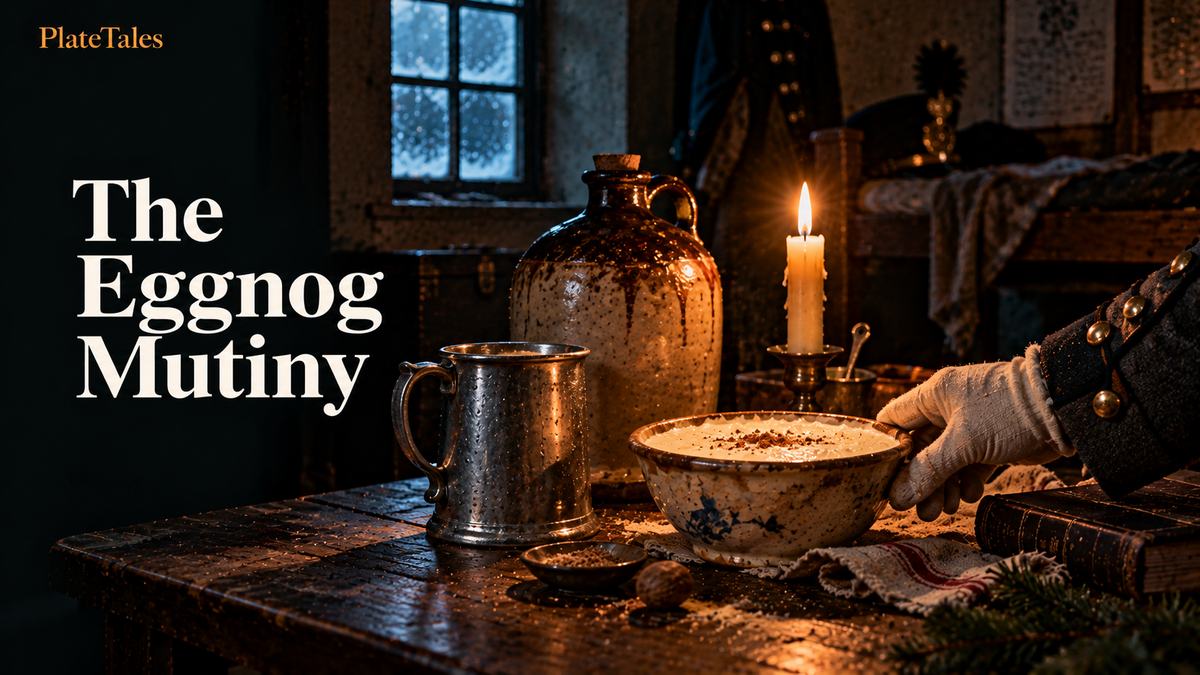
Eggnog came from England by way of colonial America. Its likely ancestor is posset, a medieval English drink of hot milk curdled with ale or wine, but the drink we would recognize (milk, eggs, sugar and rum, beaten together) first appears under the name eggnog in Maryland around 1775. Nobody invented it, and nobody is sure what "nog" means.
That is most of what can be said with confidence. The word is American, and its earliest examples come from the Chesapeake, New Jersey and Philadelphia between the 1770s and the 1790s. The link to Christmas is on paper by 1793. The step from posset to eggnog rests on how alike the two drinks are. Nobody has found a document where one turns into the other. Then, in 1826, a barracks full of cadets at West Point gave eggnog its best documented night, complete with a court of inquiry and 167 witnesses. It now belongs with the other holiday and ritual foods, though its earliest drinkers had it for breakfast.
What is posset? The curdled ancestor
The Oxford English Dictionary traces posset to the 15th century, when Latin word lists glossed terms such as balducta with English spellings like "possyt" and "possot." John Russell's Boke of Nurture, written around 1460, lists "the possate" among the things that "close a mannes stomak." Fifteenth-century cooks boiled milk, poured in ale or wine, let it stand, lifted off the curds and seasoned them with ginger and sugar. One manuscript recipe opens with the brisk instruction "Make a styf Poshote of Milke an Ale."
Posset was what you gave someone with a cold, and it kept that job for centuries. From the 16th century on the recipes grew richer, with cream, citrus juice, sugar and often eggs, sometimes thickened with breadcrumbs. The wealthy drank it from dedicated vessels. Posset sets with spouted pots, bowls and spoons were given as presents, and Hatfield House still displays a set of crystal, gold and enamel that the Spanish ambassador gave Mary Tudor and Philip of Spain in 1554.
Nearly every eggnog page repeats that 13th-century monks drank a posset made with eggs and figs. The versions we found, including a widely quoted TIME piece, name no manuscript, monastery or recipe, so treat it as unconfirmed. The firmer connection is the later egg-and-cream posset of the 1500s and 1600s, which is most of the way to eggnog without the name. Other dishes from that kitchen are in our piece on medieval recipes you can still make.
Who invented eggnog? Nobody on record
No inventor appears in any of the early documents. The drink seems to have assembled itself out of English habits (warm milk, beaten eggs, spirits for a chill) and whatever liquor the colonies had in quantity. In the earliest American descriptions that liquor is rum, distilled from Caribbean molasses, which makes eggnog a small by-product of the sugar trade and the plantations behind it.
Food writers often add that brandy and wine were heavily taxed in the colonies, so rum was the cheap substitute, and that Americans moved to whiskey after the Revolution cut off rum supplies. It may be right, but the pages that tell it cite each other rather than tax records. What the primary sources show is simpler: rum in the 1790s, and brandy and whisky in a cookbook named for the White House a century later.
Why is it called eggnog?
"Egg" is the easy half. "Nog" has four candidate parents, and none has won.
| Theory | What it rests on |
|---|---|
| Nog, a strong beer | In 1693 Humphrey Prideaux wrote from Norfolk of "a bottle of old strong beer, which in this country they call 'nog.'" The OED defines nog as a strong beer brewed in East Anglia. |
| Noggin | A small wooden mug, or a small measure of spirits, long before it was slang for a head. |
| Scottish "nugg" | "Nugged ale," ale warmed with a hot poker. |
| Egg and grog | Frederick Douglass Opie of Babson College has argued for a blend of colonial slang, rum called "grog" served in "noggins." |
The language columnist Ben Zimmer, writing for Vocabulary.com, calls egg-and-grog a myth: the earliest suggestion of it he found was in a 1980 Chicago Tribune article. The East Anglian beer is the only candidate with a dated use older than eggnog itself, which makes it the best supported. Even so, no document bridges a Norfolk beer of 1693 and a Maryland drink of 1775.
Jonathan Boucher rhymes "egg-nogg" in Maryland, 1775
The earliest known use of the word comes from a clergyman with a hobby for odd vocabulary. Jonathan Boucher, born in England in 1738, went to Virginia in 1759 as a tutor, was ordained in England, came back, and served parishes in Virginia and Maryland until he sailed home in the autumn of 1775. Around that year he wrote a poem cataloguing the drinking habits of the Chesapeake:
"Fog-drams i' th' morn, or (better still) egg-nogg, At night hot-suppings, and at mid-day, grogg,"
Boucher died in 1804, and the verses were not printed until 1833, so nobody can be sure exactly when he wrote them. That is why some word historians treat a later newspaper as the first certain date. Boucher spent his last years on a glossary of provincial and archaic English words, which passed to the compilers of Webster's Dictionary in 1831.
Eggnog in print, from Connecticut Farms to a Christmas Eve in Virginia
The word reaches a newspaper on March 26, 1788. The New-Jersey Journal, found by the quotation researcher Fred Shapiro, reports that "A young man with a cormerant appetite, voraciously devoured, last week, at Connecticut farms, thirty raw eggs, a glass of egg nog, and another of brandy sling." That October the Philadelphia Independent Gazetteer complained that "when wine and beer, punch and eggnog meet, instantly ensues a quarrel."
Christmas arrives on January 26, 1793. The Virginia Chronicle of Norfolk, in an item found by the researcher Joel S. Berson, describes gentlemen gathered at Northampton court-house on "Christmas Eve," where "EGG-NOG was the principal Liquor used by the company." It is the earliest known pairing of the drink with the holiday. In 1795 the poet Philip Freneau printed the line "And Bryan O'Bluster made love to egg-nog."
The best description of the period is Isaac Weld's Travels through the States of North America, published in London in 1799. Weld left Baltimore during a hard frost (the thermometer stood at 7 degrees Fahrenheit at daybreak) and stopped at an inn where, at breakfast, the American travellers "took a hearty draught each, according to custom, of egg-nog, a mixture composed of new milk, eggs, rum, and sugar, beat up together." They then wrapped themselves in so many coats, mittens and handkerchiefs "that nothing could be seen excepting their noses and their eyes." Weld found the scene "a subject of diversion." His travellers drank it at breakfast in the middle of December, as fuel for a cold day on the road.
The eggnog riot at West Point, Christmas 1826
By the 1820s cadets at the United States Military Academy wanted eggnog at Christmas, but the superintendent, Sylvanus Thayer, had banned buying, keeping or drinking alcohol at the academy. Eggnog without spirits was not what they had in mind. Thayer held his own Christmas party at his residence on December 23.
The cadets made other arrangements. According to James B. Agnew's 1979 history Eggnog Riot, the main source on the event, cadets William Burnley, Alexander Center and Samuel Roberts crossed the Hudson by boat to a tavern and brought back two gallons of whiskey to room No. 33 of North Barracks. Private James Dougan, on guard, let them go. Cadet T. M. Lewis brought a gallon of rum from Benny Havens's tavern. The party started around ten on Christmas Eve night.
By reveille at 6:05 on Christmas morning, more than a third of the corps was involved. Captain Ethan Allen Hitchcock, the tactics instructor living in North Barracks, tried to break up the drinking, and cadets attacked his door; one fired a pistol shot into his room. Lieutenant William Thornton was knocked out. Windows were smashed, and the quartermaster, Aeneas Mackay, later put the damage at $168.83. Albert E. Church, who missed the night because he was away on Christmas leave, wrote later that "A large number of the cadets got on a spree, and became excessively riotous."
A court of inquiry in January 1827 heard 167 witnesses and found about 70 cadets involved. Nineteen cadets and one soldier were court-martialed between late January and early March, and on March 8 eleven cadets were dismissed. Jefferson Davis, a cadet that year, joined the party, was placed under house arrest and never charged. Robert E. Lee, not involved, testified in two of the cases. Private Dougan got a month of hard labor and forfeited a month of his whiskey ration, a reminder that the Army still issued spirits to its soldiers, as our history of military rations from hardtack to MREs explains.
Egg nog in the White House Cook Book, 1887
By the late 19th century eggnog had a fixed recipe and a place in household manuals. The White House Cook Book of 1887, by Mrs. F. L. Gillette and Hugo Ziemann, gives it in a single sentence on page 468: beat twelve egg yolks with sugar, "pour in gradually one glass of brandy to cook the egg, one glass of old whisky, one grated nutmeg, and three pints of rich milk," then fold in the whites. The rum of Weld's inn is gone. Directly below it sits "Egg Flip, or Mulled Ale," hot ale and beaten eggs poured back and forth to keep them from curdling, an English cousin printed on the same page.
The ancestor is in the book too, though not among the drinks. Fifty-eight pages later, under "Health Suggestions," comes "Molasses Posset," introduced as an "old-fashioned remedy for a cold" and made from a pint of West India molasses, ginger, a quarter pound of butter and the juice of two lemons. More than four hundred years after Russell's Boke of Nurture, posset was still a cold remedy, printed on page 526.
Questions people ask
What is eggnog made of?
Eggnog is made of milk, eggs, sugar and spirits, beaten together. Isaac Weld described the American version in 1799 as "new milk, eggs, rum, and sugar, beat up together." The White House Cook Book of 1887 used twelve egg yolks, brandy, old whisky, nutmeg and three pints of rich milk, with the whites folded in.
What is posset, and how is it related to eggnog?
Posset is a medieval English drink of hot milk curdled with ale or wine, and it was long given to people with colds. By the 1500s and 1600s recipes added cream, sugar and often eggs. That egg-and-cream posset is the likely ancestor of eggnog, though no document shows one turning into the other.
When did people start drinking eggnog at Christmas?
The earliest known link between eggnog and Christmas is a Virginia Chronicle item of January 26, 1793. It describes gentlemen at Northampton court-house on Christmas Eve, where eggnog was the principal liquor. The word itself appears earlier, in a Maryland poem by Jonathan Boucher from around 1775 and in a New Jersey newspaper in 1788.
What was the eggnog riot at West Point?
The eggnog riot was a drunken disturbance among United States Military Academy cadets on Christmas morning 1826. Cadets smuggled in whiskey and rum after the superintendent banned alcohol, and more than a third of the corps joined in. A court of inquiry heard 167 witnesses, and eleven cadets were dismissed on March 8, 1827.
Filed under Origin Stories, Ritual Foods
Want more stories like this?
One food history story, every week. No spam, just the stories behind what the world eats.