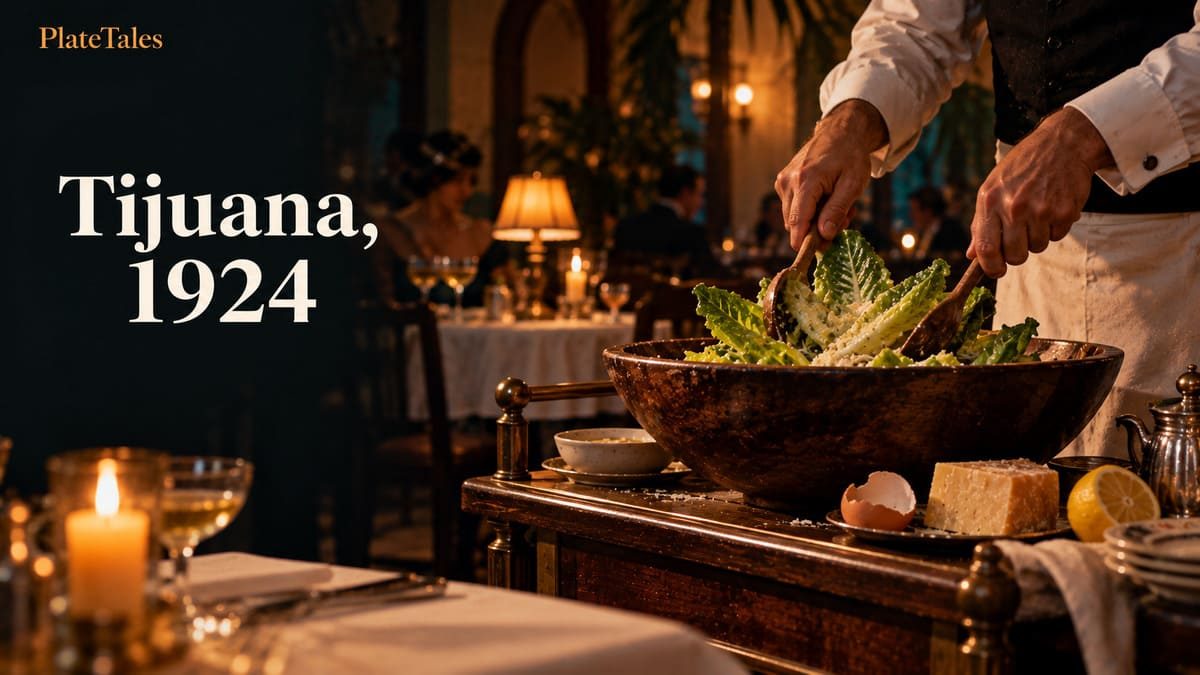
Caesar Cardini, an Italian-born restaurateur working in Tijuana, Mexico, invented the Caesar salad around 1924, or at least he has the strongest claim of the several men who wanted it. The salad has nothing to do with Julius Caesar and was not born in Italy. The birthday everyone quotes, July 4, 1924, comes from a story his daughter told decades later.
No menu or newspaper from 1924 backs that date up. For a dish this famous, the written record starts late, and it starts in the middle of an argument.
The first time anyone printed the words "Caesar salad"
The earliest dated use of the name that researchers have turned up is in Dorothy Kilgallen's syndicated gossip column, "The Voice of Broadway". It ran in the Scranton Times on July 31, 1946, and in other papers over the next few days. Kilgallen called the salad "the big food rage in Hollywood" and reported that it would be introduced to New Yorkers by Gilmore's Steak House.
So in 1946 the salad was a Hollywood fad heading east, and nobody mentioned Tijuana at all. The etymologist Barry Popik, who has done most of the newspaper digging on this subject, has found near misses a little earlier. A Los Angeles restaurant called the House of Murphy listed a "Salad de Murphay" on a menu from about 1942 to 1945 and billed it as "A HOUSE OF MURPHY CREATION," at $1.25.
In March 1945 Sunset magazine printed a recipe from La Avenida Cafe in Coronado, across the bay from San Diego: romaine, garlic oil, Worcestershire sauce, lemon juice, Parmesan, croutons and a raw egg broken over the leaves. It is plainly the same dish. It is not called Caesar.
Then came 1947, and the letters. In April, Gourmet magazine told a reader the salad was "created in Hollywood by the chef of the same name." In July a Los Angeles reader named James Gleason wrote in to correct it. "Paul and Alex's restaurant in Tijuana was far-famed, particularly during the prohibition era," he said, and Caesar, Alex's younger brother, had worked for them before leaving to open his own place.
By November two more readers had written in to argue lemon juice against vinegar. One of them, from La Jolla, said she had met "the gentleman in Tijuana named Caesar" about a dozen years earlier. On New Year's Eve 1949 the New York Herald Tribune offered yet another father for the dish, "Caesar Hermandez, a head waiter at the Coronado Hotel in San Diego." Within three years of first appearing in print, the salad had at least four inventors.
Was the Caesar salad invented in Mexico?
Yes, by every account that takes the Cardini name seriously, and the reason is American law. Cardini was born on February 24, 1896, in Baveno, a town on Lake Maggiore in northern Italy, one of eight children. He reached New York in steerage aboard the RMS Olympic on May 1, 1913, and was back in the United States in 1919. A December 1919 newspaper advertisement places him at Brown's Restaurant in Sacramento, which he ran with a partner named William Brown.
On January 17, 1920, the Volstead Act took effect, and a California restaurant could no longer sell a customer a glass of wine. Tijuana, just over the border from San Diego, had no such rule. The Cardinis lived on the San Diego side and ran a restaurant in Tijuana, where Californians could eat and drink legally and drive home the same night.
His brother Alessandro, called Alex, came to Tijuana too. It is one of the odder chapters in the story of how immigrants built American restaurant food: two Italians, in Mexico, feeding Americans.
The family story of the invention comes from Caesar's daughter Rosa, who was born in 1928 and so was not there. She said a Fourth of July rush in 1924 overwhelmed the restaurant and emptied the kitchen. In a 1987 interview with the Honolulu Star-Bulletin she said her father "simply wasn't prepared for that many people," so he decided "to give the dinner guests a show as well as a meal," assembling the salad in the middle of the dining room.
It belongs on any list of foods said to have been invented by accident, and like most of them it cannot be proved. No 1924 menu, advertisement or newspaper item has turned up. A brass plaque at the Tijuana restaurant, seen by a Christian Science Monitor reporter in 2002, gave a different date altogether: October 24, 1924.
What 1924 does show on paper is a wedding. Caesar married a musician, Camille Stump, in Santa Ana, California, on August 27 of that year.
Why is it called Caesar salad?
Because of the man, or more exactly the name over his door. The dish was served at Caesar's Place and later at the Hotel Caesar on Avenida Revolucion. The 2002 Monitor report says the salad had no name at first, people just asked for "that salad," and it later took the hotel's name. Julius Caesar enters the story only as a guess made by people looking at a menu.
Cardini himself explained how the name spread. In June 1952 he was interviewed by Aline Mosby, a United Press reporter in Los Angeles. He said the salad "didn't become famous until 1937 when a screenwriter, Manny Wolfe," carried the recipe north. At the House of Murphy, "The manager, di Cicco, called it his salad," Cardini said. "But Wolfe took the recipe to the Brown Derby and Chasen's and they called it Caesar salad."
That fits the documents neatly: a house creation at Murphy's in the early 1940s, then a Hollywood rage under Caesar's name by 1946.
The four men who claimed the bowl
None of the rival claims is older in print than Cardini's own, and each surfaced after the salad was famous.
| Claimant | Who he was | The claim | First on record |
|---|---|---|---|
| Caesar Cardini | Owner | Improvised it for a holiday crowd in 1924 | His 1952 interview; the July 4 date from his daughter, later |
| Alex Cardini | Caesar's brother, a former Italian air force pilot | Made it first and called it Aviator's Salad | Newspaper interviews in 1967 and 1972 |
| Paul Maggiora | Said to be a partner in the business | Tossed it for American airmen in 1927 | Later histories; Gleason's 1947 letter names Alex's partner only as "Paul" |
| Livio Santini | A young cook in the kitchen | It was his mother's recipe, made in 1925 when he was 18 | Told later by Santini and his son Aldo |
Alex's version is the best documented of the challengers. Annette Stover of the Chicago Tribune interviewed him in 1967. In 1972 Phyllis Hanes of the Christian Science Monitor reported that "Alex first made the salad when he and his brother Caesar had a restaurant called Alex and Caesar's in Tijuana." It was called Aviator's Salad, she wrote, because he "had been a pilot in the Italian Air Force in 1917." Other tellings say the airmen were American flyers from a San Diego base.
By 2002 the Tijuana restaurant's manager, Jorge Chavez, was giving the Monitor yet another version, in which Cardini's aunt did the cooking. "Really, she is the one who invented it!" he said, laughing.
What tips the scale toward Caesar is that the outside evidence keeps pointing at him. The name is his. Julia Child was taken to the restaurant by her parents as a girl, in 1925 or 1926. In From Julia Child's Kitchen (1975) she remembered that "Caesar himself rolled the big cart up to the table, tossed the romaine in a great wooden bowl."
That is a memory set down fifty years on, by a writer who had by then asked Rosa Cardini for the recipe, so it is not proof. It is still an eyewitness, which is more than the other claimants have. When Cardini died, the Los Angeles Times headline of November 5, 1956, read "Cesar Cardini, Creator of Salad, Dies at 60."
The naming question has the same shape as the Earl of Sandwich and his sandwich. The man whose name is on the dish may only have been the one who made it famous, but nobody else left better evidence.
Does the original Caesar salad have anchovies?
By the Cardini family's account, no. His daughter said the original had no anchovies, and that the faint fishy depth came from Worcestershire sauce, which is itself made with them. Caesar reportedly thought anchovies were too strong.
Child's memory adds the rest. She recalled two one-minute coddled eggs, and whole romaine leaves laid out with the tips to the center and the stems outward, so they could be picked up and eaten with the fingers.
The anchovies are usually pinned on Alex, whose Aviator's Salad is said to have added them. Whoever did it, they arrived early. The Highland House in Los Angeles advertised its Caesar in the Los Angeles Times on January 24, 1948, as "Romaine lettuce, egg, croutons, Parmesan cheese, anchovies," for 50 cents. A Gourmet reader in November 1947 noted that "Some aficionados advocate the tossing in of cut-up anchovies."
The Tijuana restaurant has not been consistent either. In 2002 its manager said Cardini "smoothed the anchovies into a paste and spread it on the croutons," while the "original recipe" printed on the back of his business card left anchovies off.
What happened to Cardini and to Caesar's
Prohibition ended on December 5, 1933, and the main reason to drive to Tijuana for lunch went with it. San Diego newspapers of the time show Cardini giving up his Mexican businesses in 1936 and opening the Caesar Cardini Cafe in San Diego that September. He moved his family to Los Angeles about 1938. The Associated Press, in its 2024 centenary story, put the Los Angeles move in 1935, which does not fit the San Diego advertisements.
In Los Angeles he turned the salad into a product. Demand for the dressing led him to bottle it in 1948, the same year he trademarked it. Cardini died after a stroke at his Los Angeles home on November 3, 1956, aged 60. Rosa took over Caesar Cardini Foods, the line grew to more than a dozen dressings, and the brand now belongs to the T. Marzetti Company. Rosa died in 2003.
The restaurant on Avenida Revolucion closed for a time and reopened in 1995. Like the taco, its salad is now claimed with some pride as a Mexican dish. In July 2024 Tijuana marked the centenary with a three-day food and wine festival and the unveiling of a statue of Cardini, and Caesar's told the Associated Press it still makes as many as 300 Caesar salads a day.
Questions people ask
Is the Caesar salad named after Julius Caesar?
No. The Caesar salad is named for Caesar Cardini, an Italian-born restaurateur who ran a restaurant in Tijuana, Mexico, during Prohibition. The dish was served at Caesar's Place and later at the Hotel Caesar, and it took that name. Julius Caesar has no connection to it.
Did the original Caesar salad have anchovies?
According to the Cardini family, no. Caesar Cardini's daughter Rosa said the original had no anchovies and that its faint savory depth came from Worcestershire sauce, which is made with them. Anchovies appeared early, though, and a Los Angeles restaurant was advertising a Caesar with anchovies by January 1948.
When did the name Caesar salad first appear in print?
The earliest dated use found so far is Dorothy Kilgallen's syndicated gossip column, printed on July 31, 1946. She called the Caesar salad the big food rage in Hollywood. The famous July 4, 1924 invention date comes from a story told decades later by Cardini's daughter, not from a 1924 record.
Who else claimed to have invented the Caesar salad?
Three other men are named. Caesar's brother Alex Cardini said he made it first as Aviator's Salad, and Paul Maggiora and the cook Livio Santini have also been credited. None of these claims is older in print than Caesar's own, and each surfaced after the salad was famous.
Filed under Origin Stories, Accidental Inventions
Want more stories like this?
One food history story, every week. No spam, just the stories behind what the world eats.