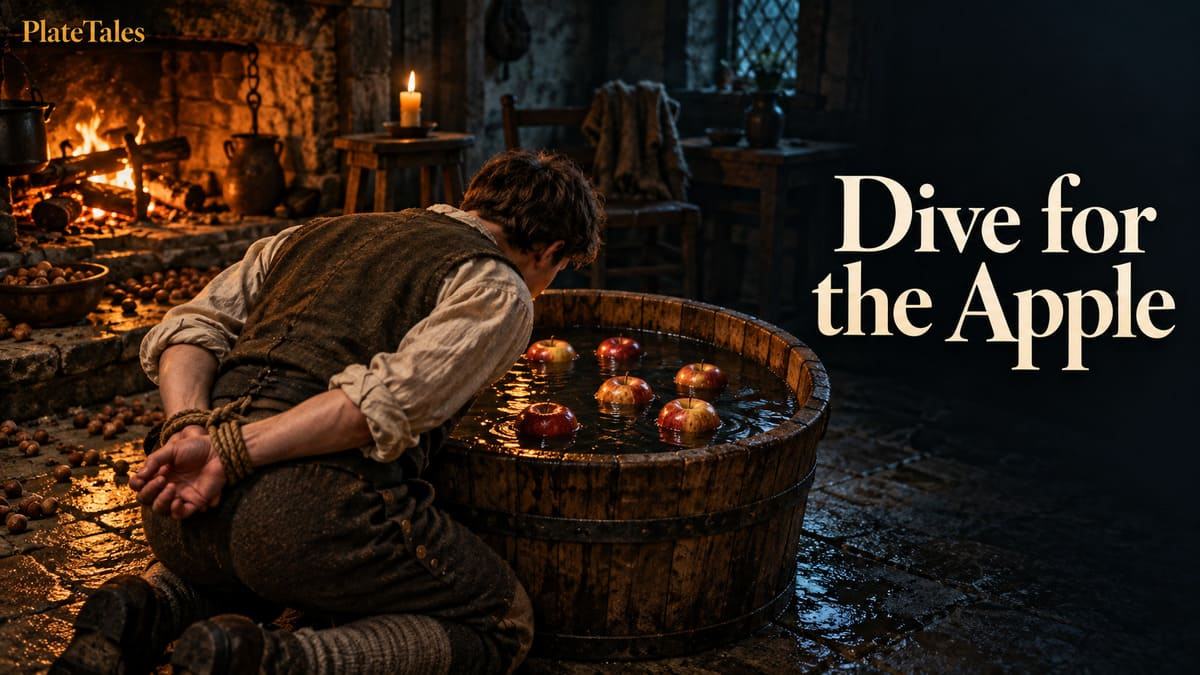
We bob for apples on Halloween because October 31 was, in the north of England, Scotland, Wales and Ireland, a night of apples, nuts and guessing who would marry whom, and the tub of water was the rowdy part of it. The oldest description we could find is by John Brand, an English antiquary, who wrote in 1777 that young people in the north "dive for apples" on Hallow Even.
Notice the verb. Nobody in the early record bobs. They dive, dip and duck, and in the earliest accounts nobody says what catching the apple means.
Where Halloween apple bobbing comes from: a note of 1777
Brand's Observations on Popular Antiquities came out in 1777 as a set of additions to Henry Bourne's older book on folk customs. His entry for Allhallow Even is short and a little sniffy:
It is customary on this night with young people in the north to dive for apples, catch at them when stuck on at one end of a kind of hanging beam, at the other extremity of which is fixed a lighted candle, and that with their mouths only, having their hands tied behind their backs; with many other fooleries.
That single sentence holds two games. One is the tub. The other is the beam with an apple at one end and a burning candle at the other, which later writers call snap apple.
Brand then turns to nuts, which were the real business of the evening. They were thrown on the fire, and he guessed that this was why the north called the night Nutcrack Night.
The same games in Ireland and Wales
In the 1780s the same pair of games turns up across the Irish Sea. Charles Vallancey, a British army officer and surveyor who had made himself an authority on Irish antiquities, described the Irish vigil in volume three of his Collectanea de Rebus Hibernicis.
First come the cabbages pulled up by the root and the hemp seed sown by girls hoping to see a future husband's ghost. Then he gets to the fruit: "they dip for apples in a tub of water, and endeavour to bring one up in the mouth: they suspend a cord with a cross stick, with apples at one point, and candles lighted at the other, and endeavour to catch the apple, while it is in a circular motion, in the mouth."
The enlarged 1813 edition of Brand, prepared after his death by Henry Ellis, adds a Welsh report. In North Wales, after a bonfire and a supper of parsnips, nuts and apples, people went "catching at an apple suspended by a string with the mouth alone, and the same by an apple in a tub of water." So by the early 1800s the game is on paper in England, Ireland and Wales, always on the same night, always beside the hanging version.
| Written | Writer | Where | What they call it |
|---|---|---|---|
| 1777 | John Brand | North of England | "dive for apples" |
| 1780s | Charles Vallancey | Ireland | "dip for apples in a tub of water" |
| 1864 | Chambers's Book of Days | Scotland, England | apples "afloat in a tub of water" |
| 1919 | Ruth Edna Kelley | Scotland, United States | "apple-ducking" |
Did the Romans start it? The Pomona guess
Plenty of pages will tell you the Romans brought the game to Britain as part of a festival for Pomona, goddess of orchards. That idea has an author. William Hutchinson, in his View of Northumberland (two volumes, 1776 to 1778), wrote that the first of November "seems to retain the celebration of a festival to Pomona, when it is supposed the summer stores are opened on the approach of winter." Brand's 1813 edition quotes him.
"Seems" and "it is supposed" are doing the work there. By 1919, when Ruth Edna Kelley published The Book of Hallowe'en in Boston, the hedge had gone. Kelley gave Pomona a whole chapter, a grove near Ostia and a harvest festival held "about November first". Then she wrote that on Pomona's day "doubtless thanks was rendered" for the harvest. Doubtless is not a footnote.
The Roman record is thinner than that. Pomona did have her own priest, the flamen Pomonalis, and William Smith's Dictionary of Greek and Roman Antiquities (1875) ranks him lowest in rank of all the flamens. The same entry mentions no festival for her.
The date usually attached to Pomona is August 13, shared with her husband Vertumnus. Neither Smith nor the modern summaries puts a feast of Pomona in November. The food historian Sarah Wassberg Johnson, who has gone through the old Halloween books, writes that she is "skeptical of the direct connection to Pomona." Her simpler explanation is that apples were in season.
Is bobbing for apples from Samhain?
The date is. November 1 was Samhain in the Irish calendar, and Vallancey says so. He also declared the apple games, along with everything else done that night, "the remains of Druidism." That phrase is the root of most modern claims that Celts bobbed for apples.
It helps to know how Vallancey reasoned. In the same volume he explains the English drink lambswool (roasted apples bruised into ale) as a mangled Irish phrase, La Mas Ubhal, "the day of the apple fruit". Brand's editor, who quotes him at length, opens the passage with the dry remark that "there is a great display of learning" in it.
What the documents support is narrower. The tub appears in print in the 1770s and 1780s. The candle game is older on paper: Brand cites a 1611 book, Stafford's Niobe, in which it is called a Christmas gambol, not a Halloween one. An unbroken line from pre-Christian Ireland to a wooden tub is possible. Nobody has shown it.
Snap Apple Night, the version with fire
In Ireland the candle game could name the whole evening. Kelley records that in the north of England, too, Halloween was called "snap-apple night." She describes the Irish apparatus as a stick "hung parallel to the floor by a twisted cord which whirls the stick rapidly when it is let go", and adds, mildly, that care has to be taken not to bite the candle.
The best picture of it is by Daniel Maclise, born in Cork in 1806. He went to a Halloween party in Blarney in 1832 and painted Snap-Apple Night the following year. The verse printed in the first exhibition catalogue begins "There Peggy was dancing with Dan / While Maureen the lead was melting, / To prove how their fortunes ran".
Lead dropped into water, nuts on the hearth, cards, the whirling apple: the canvas is an inventory of the evening. The painting is in a private collection. A large engraving after it, by James Scott, was published in London in 1845, and a copy is in the Metropolitan Museum of Art.
Kelley noticed something about these games that most writers skip. Sometimes, she says, the snap-apple test "is made easier" by dropping the apples into a tub of water and diving for them. The tub was the safe option.
When did the apple start to mean a husband?
Here the popular story runs ahead of the paper. Brand lists the diving among the fooleries and saves the omens for the nuts. Hutchinson's marriage omens are nuts too. Vallancey gives the tub no meaning. The Book of Days treats it purely as sport and advises forcing an apple to the bottom and seizing it there.
Robert Burns's poem Halloween, written in 1785, works through the love charms of a night in the west of Scotland one by one. As the Book of Days pointed out, it never mentions ducking for apples.
The marriage meaning is explicit by Kelley's time. Of England she writes: "In a tub float stemless apples, to be seized by the teeth of him desirous of having his love returned. If he is successful in bringing up the apple, his love-affair will end happily." Most of the night's other customs were about who would marry whom, as with so many wedding food traditions, so the tub may well have been part of the flirting from the start. The written rules came late.
How apple bobbing reached American parlors
Kelley says Halloween was not much kept in colonial America, though some English settlers held on to "apple-ducking and snapping." The bigger push came with the Irish who arrived in numbers after the famine of the 1840s, part of the larger story of how immigration changed American food. By January 1916 Scribner's Magazine could print Howard Chandler Christy's painting of a smart party with apples floating in a classical fountain.
American hostesses tightened the rules. Kelley describes names tied to the apple stems, one tub for the boys and one for the girls, so that each player would draw out "an apple with a name which will be like that of his future mate." In Massachusetts, she reports, whoever drew the first apple from the tub would be first married.
She thought the old customs were "being forgotten more and more across the ocean" while Americans kept them going. Her book also quotes a verse that opens "The rosy apple's bobbing / Upon the mimic sea", the nearest any of these writers comes to the modern name.
Back in Britain the game had already gone soft, a familiar fate among ritual foods. The Book of Days complains of a new practice, blamed on "tender mammas" afraid of their children catching cold, of dropping a fork from a height to spear the floating apples. Its verdict on the fork: "a very indifferent substitute."
Questions people ask
Did the Romans and the goddess Pomona start apple bobbing?
Probably not. The idea comes from William Hutchinson, who wrote in the 1770s that the first of November "seems to retain" a festival to Pomona. Roman sources do not place a Pomona feast in November, and the date usually attached to her is August 13. Later writers dropped the hedge.
Is bobbing for apples from the Celtic festival of Samhain?
The date matches, since November 1 was Samhain in the Irish calendar. The link to the game rests on Charles Vallancey, who in the 1780s called the Irish apple games "the remains of Druidism." Printed records of the tub begin in the 1770s and 1780s, and nobody has shown an unbroken line from pre-Christian Ireland.
What is snap apple night?
Snap Apple Night was a name for Halloween in parts of Ireland and the north of England. Players tried to bite an apple hanging from one end of a stick or beam that spun on a cord, with a lit candle at the other end. John Brand described the game in 1777, and Daniel Maclise painted it in 1833.
When did bobbing for apples become a love game?
The marriage meaning is written down late. Brand, Vallancey and the Book of Days treat the tub as sport, and the early love omens involve nuts and cabbages. By 1919 Ruth Edna Kelley reported that whoever brought up an apple would see his love returned, and in Massachusetts the first apple meant the first marriage.
Filed under Origin Stories, Ritual Foods
Want more stories like this?
One food history story, every week. No spam, just the stories behind what the world eats.