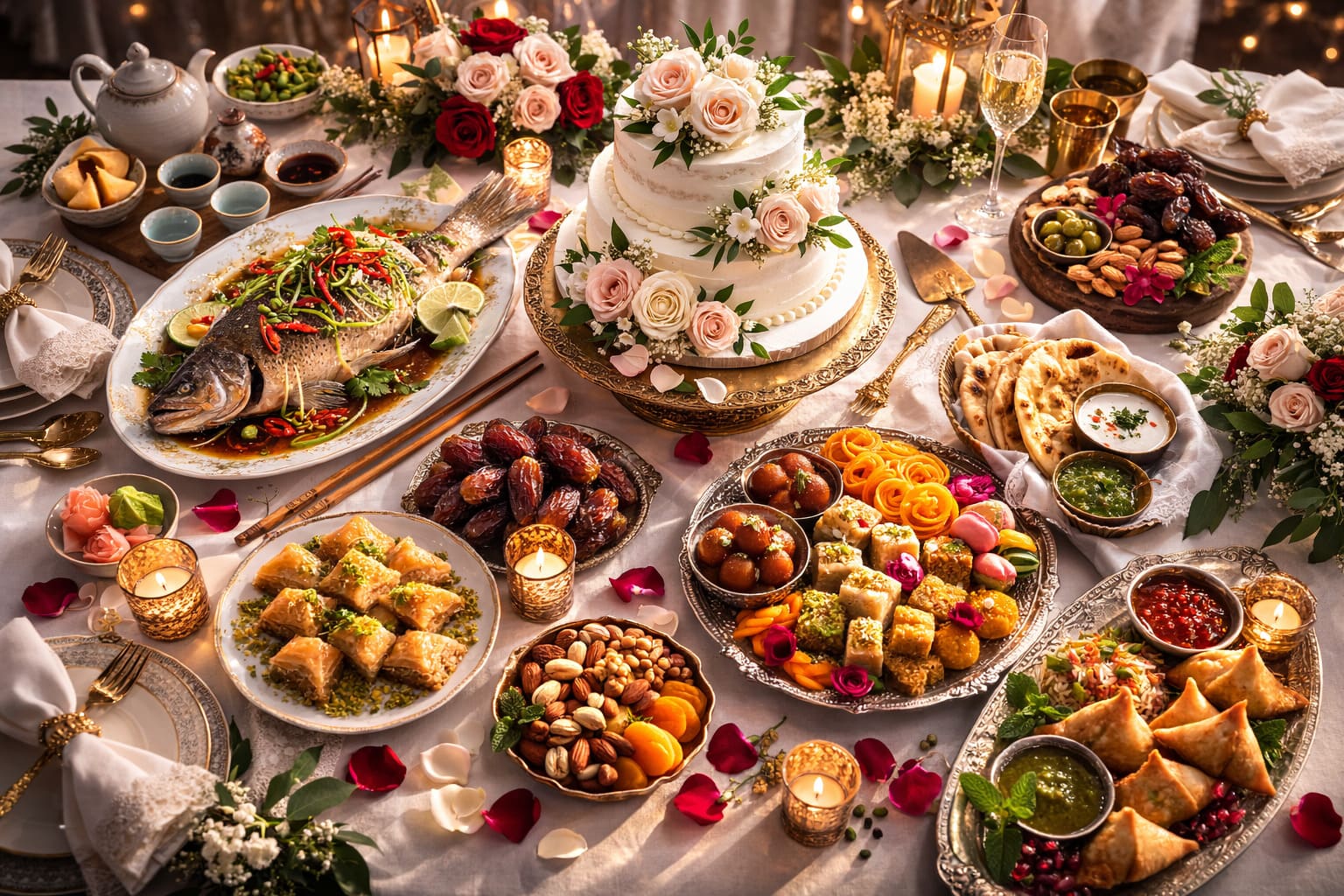
Wedding food traditions around the world differ in the dishes but share a job: the shared meal makes a marriage public and ties two families together. The oldest documented case is Roman, where a marriage rite took its name from a cake of wheat. Later versions run from English stacked buns to Chinese banquets to three cups of sake in Japan.
A Roman marriage named after a cake
Rome had three kinds of marriage, and the most solemn was called confarreatio. The word comes from far, a hulled wheat, and from the cake of it that the couple shared. The Encyclopaedia Britannica describes the rite as a highly solemn ceremony with many witnesses and an animal sacrifice, usually reserved for patrician families. Other sources give the details: ten witnesses, and the chief priest, the pontifex maximus, together with the priest of Jupiter, the flamen Dialis, presiding.
One detail matters for anyone who reads about "spelt". Far is often translated that way, but a scholar of Roman food processing, David Thurmond, identifies the grain as emmer, a different wheat. The cake itself is a plain thing: bread, in effect, eaten in front of witnesses. The legal result was heavy. The bride passed from her father's authority into her husband's.
You will often read that the cake was crumbled over the bride's head and the guests grabbed the pieces, which supposedly became the ancestor of thrown rice and the modern cake. None of the sources opened for this article says so, so treat it as a later embroidery. What the record does support is the plain act of a couple eating a grain cake together as the marriage itself. For more on what Romans actually ate, see ancient Roman recipes, and for the grain at the center of the rite, the history of bread.
Stacked buns and a kiss over the top
In medieval England, according to the account most cake histories repeat, small cakes or sweet rolls were piled high at the wedding. The couple then tried to kiss across the pile. A successful kiss was taken as a promise of a prosperous life. Cake historians link this pile to the French croquembouche, though that link rests on a single secondary source and no medieval document was checked here.
The bride's pye and the bride's cake
The first dish made specifically for English weddings may not have been sweet at all. The Museum of Food and Culture points to the "Bride's Pye", a meat pie, with a recipe in The Accomplisht Cook, a cookbook published in 1685. Alongside it came the bride's cake, a single fruit-studded sweet bread baked on a hearth, later called plum cake. Yorkshire versions hid objects in the batter: a ring, a coin, a thimble and a button.
The earliest sweet wedding cake that scholars can name is the Banbury cake, which became popular in 1655, according to the sociologist Simon Charsley, who wrote the standard study of British wedding cakes. By the middle of the 1700s bakers were putting a layer of almond icing under a layer of white icing, and the decorations on top were often three-dimensional and sometimes not meant to be eaten.
Why the cake turned white
White sugar was scarce. Even after sugar became easier to buy in the early 1800s, the refined kind stayed expensive, and a pure white coat of icing told guests what the family could afford. If you want the longer story of that ingredient, there is a history of sugar.
Queen Victoria's wedding cake is the one everyone cites. The Museum of Food and Culture describes it as a multi-tiered white cake with sugar sculptures on top, dating it to the 1840s and giving its weight as 300 pounds. Cake historians say the white icing on it gave "royal icing" its name, though the sources do not agree on a date for that. In 1882 Prince Leopold, Duke of Albany, had what a trade source calls the first wedding cake that was entirely edible, built from separate densely iced layers that could be stacked. Pillars between tiers came about twenty years later, and the first ones were broomsticks covered in icing.
Saving the top tier for the baby
Fruitcake keeps. In nineteenth-century Europe, christening cakes looked much like wedding cakes, and a first baby often arrived within a year of the wedding. Couples therefore saved the top tier to eat at the christening. Modern couples who freeze the top tier for the first anniversary are following a shifted version of the same habit. The museum records that a slice of Queen Victoria's cake sold at auction in 2016 for about 1,500 pounds.
Wedding food traditions in China: the banquet is the wedding
In a traditional Chinese wedding, the dinner is called xijiu, "joyful wine", and it is sometimes treated as more important than the ceremony itself. Historical banquets ran five to ten courses and could include shark fin, abalone, lobster, squab and sea cucumber, with fish roe in soup or as a garnish for fertility, though the reference used here gives no citation for that last point. The bride's family hosted the main banquet and the bride's father traditionally paid. A smaller dinner followed on the groom's side, and on the third day after the wedding the couple went back to the bride's parents' house for a meal with relatives.
Many popular lists claim that every dish at such a banquet is a pun: fish for abundance, noodles for long life, an even number of courses. Those are widely repeated, but none of the pages opened for this article documents them, so they are left out here as unverified.
Three cups, nine sips, in Japan
At a Shinto wedding in Japan, the central act is san-san-kudo, "three-three-nine times". The embassy of Japan's guide to Japanese weddings says the couple use three lacquered sake cups of different sizes, small, medium and large. Each partner takes three sips from each cup, nine in all. The groom drinks first from the first cup, the bride first from the second, and the groom first again from the third, and the partner follows each time.
The shared sake stands for sharing joys and hardships, and some say the three cups represent heaven, earth and humankind, or a man, a woman and a child. The same guide calls the rite, traditionally, the binding act of the wedding, more so than the exchange of rings. Afterward the families share sake in a separate step called shinzoku-hai. Guests often leave with return gifts, which can include sweets such as baumkuchen.
Questions people ask
What was the first wedding cake?
The earliest wedding food on record is the Roman farreus cake, a plain wheat cake the couple ate before witnesses in the confarreatio rite. The sweet English bride cake came much later, and the Banbury cake became popular in 1655, according to Simon Charsley's research on British wedding cakes.
Why is wedding cake white?
White icing was a sign of wealth. Refined white sugar stayed expensive even after sugar became easier to get in the early 1800s, so a pure white cake showed what a family could pay. Queen Victoria's white-iced wedding cake in the 1840s is often credited with making the style the model.
Why do couples save the top tier of the wedding cake?
Fruitcake keeps well, and in nineteenth-century Europe a first baby often arrived within a year of the wedding. Couples saved the top tier of the wedding cake to eat at the christening. Some modern couples freeze it for the first anniversary instead.
What is san-san-kudo at a Japanese wedding?
San-san-kudo, "three-three-nine times", is the sake ritual at a Shinto wedding in Japan. The couple take turns drinking three sips from each of three lacquered cups, small, medium and large, for nine sips in all. It has traditionally been the binding act of the ceremony.
Filed under Ritual Foods
Want more stories like this?
One food history story, every week. No spam, just the stories behind what the world eats.