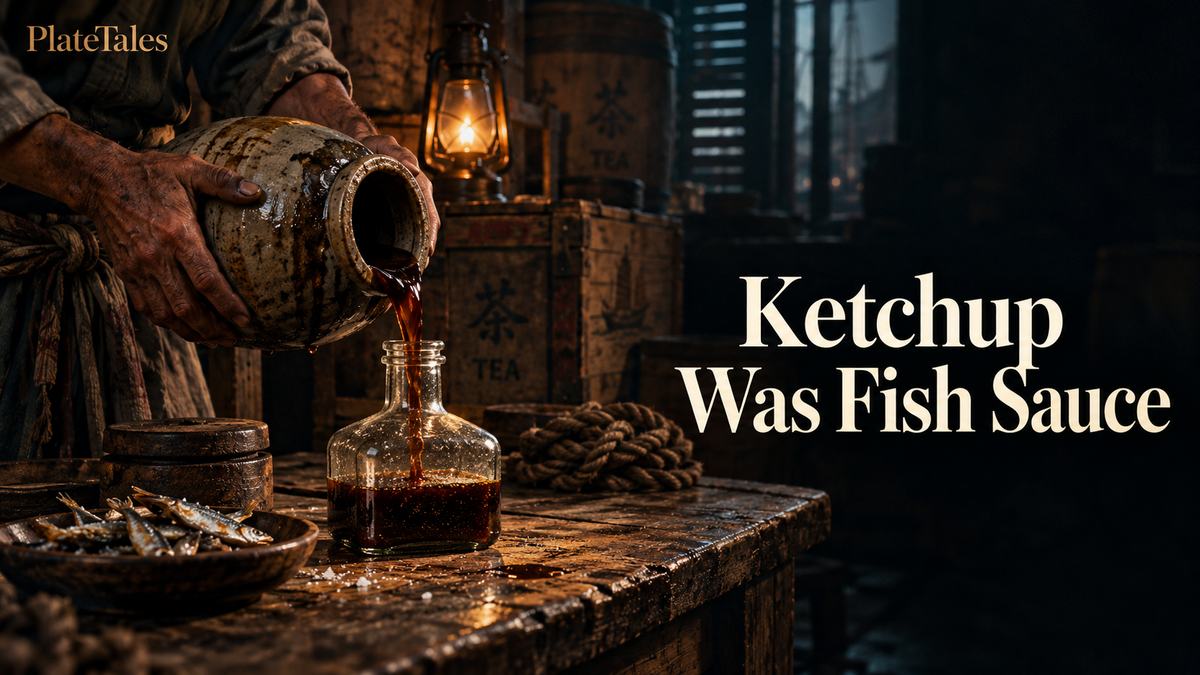
Ketchup is called ketchup because English borrowed the name of a Chinese fish sauce. The earliest English use on record dates from 1682, and the oldest record you can read for free, a London slang dictionary printed in 1699, defines "Catchup" as "a high East-India Sauce." The Asian word behind it, koe-chiap or ke-chiap in Hokkien, meant the brine of pickled fish.
Tomatoes arrived about 130 years after the word did. For more than a century an English bottle of ketchup held mushrooms, walnuts, oysters or anchovies, and the first known tomato recipe was published by a Philadelphia doctor in 1812. So the real puzzle is the word, and four candidates have been put forward for it.
The slang dictionary that defined ketchup
The book is A New Dictionary of the Terms Ancient and Modern of the Canting Crew, compiled by someone known only as B. E. and "Printed for W. Hawes at the Rose in Ludgate-street." It is a glossary of the language of beggars, thieves and cheats, which makes it an odd home for a condiment. Ketchup turns up a few lines after "Catch-fart, a Foot-Boy" and "Catch-pole, a Serjeant, or Bayliff that Arrests People," with no recipe and no fuss: "Catchup, a high East-India Sauce." The very next entry is "Caterwauling."
The book carries no date on its title page, and it is sometimes placed around 1690. Its own text settles the matter: the entry for "Punchable" describes "old passable Money, Anno 1695," so it was compiled after 1695. Project Gutenberg gives the London printing as 1699.
A merchant's handbook pins down where the good stuff came from. In 1711 Charles Lockyer published An Account of the Trade in India, with this shopping advice: "Soy comes in Tubs from Jappan, and the best Ketchup from Tonqueen." Tonqueen is Tonkin, northern Vietnam. To an English trader, then, ketchup was an Asian import in the same class as soy sauce, something you bought in a port.
Why is ketchup called ketchup? It was a Hokkien fish sauce
The strongest claimant is Hokkien, the Southern Min speech of Fujian province, whose traders worked ports across Southeast Asia. The primary record is a book with a long title: the Chinese-English Dictionary of the Vernacular or Spoken Language of Amoy, with the Principal Variations of the Chang-chew and Chin-chew Dialects, published in London in 1873 by the Rev. Carstairs Douglas, a missionary of the Presbyterian Church in England stationed in Amoy (now Xiamen).
Douglas defines koe as "salted or pickled fish or shell-fish," notes that in Chang-chew (Zhangzhou) it is said "ke," and then gives the compound: "koe-chiap, brine of pickled fish or shell-fish." Elsewhere in the same dictionary chiap turns up in "bah-chiap, gravy; sauce from the meat." Douglas glosses chiap on its own as "juice, sap, gravy." It is written with the character for juice, read zhi in Mandarin.
That is close to a perfect match for the English sound: ke plus chiap, said quickly, gives you something very like "ketchup." The linguist Dan Jurafsky, who has written the most careful popular account of the word, credits James Murray with first working out this etymology when he wrote the OED entry in 1889. Jurafsky calls ke-chiap "an archaic word for 'fish sauce'" in the Zhangzhou region, and points to a 1982 Mandarin to Southern Min dictionary that confirms the missionary's evidence. Fermented sauces themselves are far older in southern China: Jurafsky finds them in the Elegies of Chu, poems from before 300 BC. The broader habit of salting fish until it turns to liquor is covered in our story on why every culture ferments.
Where did ketchup come from? The Malay kicap route
The second claimant is less a rival than a route. Malay has kicap and Indonesian has kecap, and Wiktionary describes kecap as any dark, clear sauce, made from soybeans, fish or similar ingredients. Wiktionary marks the link between the Malay word and English ketchup as uncertain, though kicap itself derives from Chinese.
The Chinese thread runs through the Indonesian evidence too. Jurafsky cites research by Anita van Velzen showing that until the 1950s these sauces were made only by ethnic Chinese families. And the English recipes point to the islands. An English recipe from 1732 is titled "Ketchup, in Paste. From Bencoulin in the East Indies." Bencoulin is Bengkulu, on the west coast of Sumatra.
So English traders may well have learned the word in Malay or Indonesian ports, from Hokkien speakers or from their neighbors. Either way, the word starts in Chinese. The same trading ports, and the Chinese cooks who settled in them, run through our history of street food in Southeast Asia.
The Cantonese "tomato juice" theory
The third story turns up even in some dictionaries: ketchup comes from a Cantonese word, written with the characters for eggplant and juice, that today means tomato sauce. The tomato in Chinese is a "foreign eggplant," so the explanation looks tidy.
It fails on dates. English had the word by 1682 and printed tomato ketchup only in 1812. The tomato is an American plant that reached Europe after Columbus (the long version is in how tomatoes came to Italy), and there is no record of a Cantonese tomato sauce for English sailors to name in the 1680s. The idea is folk etymology. Jurafsky calls it "obviously incorrect" for the same reason: the sauce and its name were borrowed long before anyone put tomatoes in it. The modern Cantonese name for tomato sauce happens to sound like ketchup, and that coincidence is the whole case.
Escabeche and the vinegar pickle
The fourth claimant is European with an Arabic root. The anthropologist E. N. Anderson, relying on the cookery writer Elizabeth David, linked ketchup to French escaveche, food in a sauce. The food historian Karen Hess traced Spanish and Portuguese escabeche back to the Arabic kabees, pickling with vinegar. English did borrow that word as "caveach," first recorded in the late 17th century, the same decades as ketchup.
The timing is real, and the two sauces sat side by side in English kitchens. But caveach was its own word, spelled its own way, and nothing in the escabeche family explains the "-chup" ending. The Hokkien chiap does, and it comes with a dictionary definition that means exactly the right thing. This theory has a respectable pedigree and no document.
Mushroom, walnut and oyster ketchup in England
Once the word arrived, English cooks applied it to almost any dark, salty, keeping sauce. A recipe from a 1742 London cookbook is headed "To Make KATCH-UP that will keep good Twenty Years" and calls for stale beer, anchovies, mace, cloves, pepper, ginger, shallots and mushrooms. One oyster ketchup from the 1700s called for 100 oysters and three pints of white wine. Jonathan Swift rhymed it in A Panegyrick on the Dean (1730): "And, for our homebred British cheer, / Botargo, catsup, and caviare."
Mushroom and walnut ketchups lasted longest. Martha Lloyd's household book, kept while she lived with Jane Austen's family at Chawton, includes a walnut ketchup. Across the Atlantic, Harriott Pinckney Horry's manuscript cookbook from Charleston, South Carolina, written in 1770, clarified its mushroom ketchup with two egg whites. Richard Briggs's The English Art of Cookery (1788) wanted "mushrooms gathered dry." British firms still bottle mushroom ketchup today.
When was tomato ketchup invented?
The first known tomato ketchup recipe came from James Mease, a Philadelphia doctor and horticulturist, in 1812. He called tomatoes "love apples," and his version used pulp, spices and brandy, with no vinegar and no sugar. An 1817 recipe for "Tomata Catsup" told the cook to "Gather a gallon of fine, red, and full ripe tomatas." It still called for anchovies, a reminder of where the sauce had come from. Mary Randolph printed one in The Virginia Housewife in 1824. Jonas Yerkes is credited as the first American to sell tomato ketchup in a bottle and was distributing it nationally by 1837.
Bottled ketchup had a quality problem. In 1866 the French cookbook writer Pierre Blot called the commercial stuff "filthy, decomposed and putrid." Some makers added coal tar for color and sodium benzoate to slow spoilage. Dr. Harvey Washington Wiley argued that preservatives were unnecessary "if high quality ingredients were used and handled properly." He found a partner in Henry J. Heinz of Pittsburgh, who had started making ketchup in 1876 and now sold a preservative-free version made with ripe tomatoes and far more vinegar. Katherine Bitting's 1909 research showed that extra sugar and vinegar would keep it sound. Jurafsky dates the big rise in sugar to American makers around 1890, which is roughly when the sweet red sauce we know took shape.
Ketchup vs catsup: three spellings of one word
The spellings arrived in a neat row: ketchup in 1682, catchup in the 1699 slang dictionary, catsup with Swift in 1730. All three are attempts to write down one foreign word, and none is more correct than the others. Heinz first marketed its sauce as "catsup" in 1876. Webster's dictionary of 1913 still defined catsup as a "table sauce made from mushrooms, tomatoes, walnuts, etc.," and a Sears catalog of 1897 noted "hundreds of brands of Catsup on the market, a few of them good." Today ketchup is the dominant spelling, with catsup hanging on in parts of the American South.
| Claim | Evidence | Verdict |
|---|---|---|
| Hokkien ke-chiap, fish brine | Douglas, 1873: "brine of pickled fish or shell-fish" | Best supported |
| Malay kicap, Indonesian kecap | Words exist, made by Chinese families, 1732 Sumatra recipe | Likely route, Chinese origin |
| Cantonese tomato juice | Tomato sauce postdates the English word by 130 years | Wrong |
| Escabeche, Arabic kabees | Caveach appears at the same time | Unsupported |
Heinz was slow to put the fruit on the bottle. From December 1890 its ketchup label showed a pickle, and a tomato replaced it only in January 2009.
Questions people ask
Was ketchup originally made from fish?
Yes. The word ketchup comes from Hokkien ke-chiap, which a missionary dictionary of Amoy printed in 1873 defines as the brine of pickled fish or shell-fish. English cooks of the 1600s and 1700s bought it as an Asian import, and early English ketchups held mushrooms, walnuts, oysters or anchovies rather than tomatoes.
When was tomato ketchup invented?
The first known tomato ketchup recipe was published in 1812 by James Mease, a Philadelphia doctor and horticulturist. His version used tomato pulp, spices and brandy, with no vinegar and no sugar. That is about 130 years after English first recorded the word ketchup, which had nothing to do with tomatoes.
Is ketchup the same as catsup?
Yes, they are the same word spelled differently. Ketchup appeared in English in 1682, catchup in a London slang dictionary of 1699, and catsup in Jonathan Swift's poem of 1730. All three are English attempts to write down one foreign word. Today ketchup is the dominant spelling, and catsup survives in parts of the American South.
Does ketchup come from a Cantonese word for tomato sauce?
No. That theory fails on dates, because English had the word ketchup by 1682 and printed its first tomato ketchup recipe only in 1812. The linguist Dan Jurafsky calls the Cantonese tomato theory obviously incorrect, and it is folk etymology. The modern Cantonese name for tomato sauce merely sounds like ketchup.
Filed under Origin Stories, Trade Routes
Want more stories like this?
One food history story, every week. No spam, just the stories behind what the world eats.