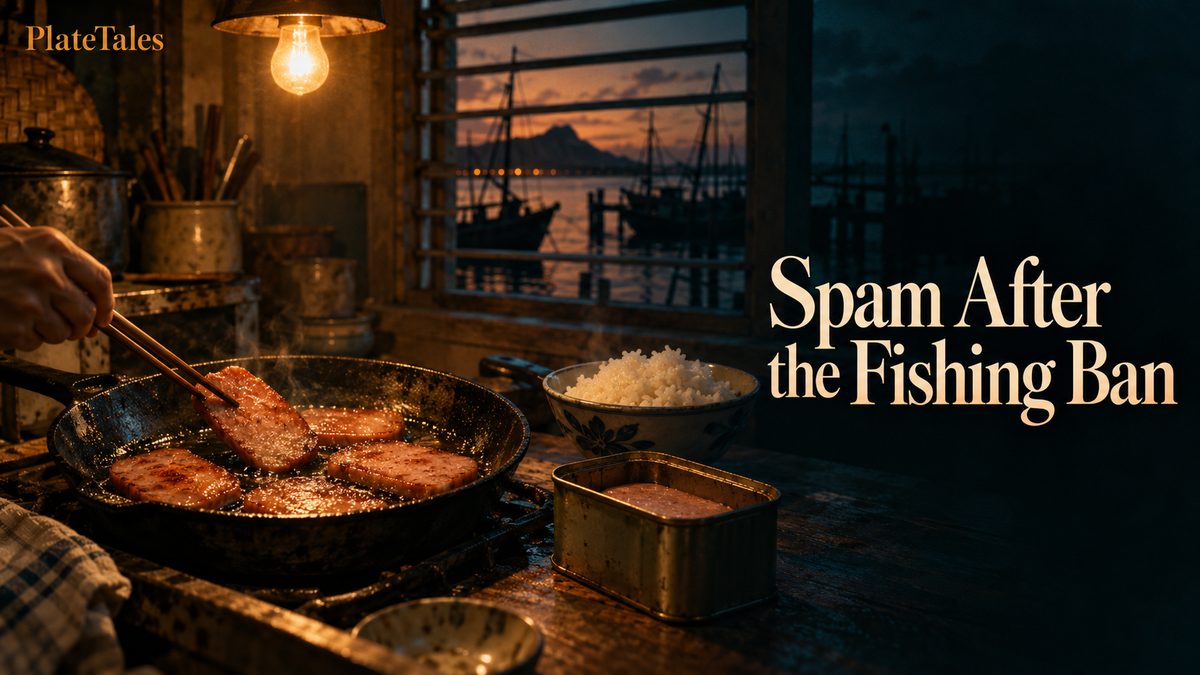
Spam is popular in Hawaii because World War II put it on every shelf at the moment the islands lost much of their fresh fish, and because it fit a way of eating, rice with a little salty meat on the side, that plantation families already had. The usual answer is that GIs brought it. They did, but from December 1941 the Army also kept Hawaii's Japanese fishermen off the water.
Hormel says the state buys about 7 million cans a year, and Hawaii eats more Spam per person than any other state. The snack most people picture, the Spam musubi, came about forty years after the soldiers left.
Spam history in World War II: a Minnesota can goes to war
Hormel put Spam on sale in 1937 in Austin, Minnesota. The idea was to sell more pork shoulder, a cut that did not sell well, by grinding it with ham, salting it and sealing it in a can. The name came out of a contest with a $100 prize, won by the brother of a company executive. What the four letters stand for, Hormel says, is "known by only a small circle of former Hormel Foods executives." Everyone else guesses "spiced ham" and moves on.
The launch slogan called it "The Meat of Many Uses." The war supplied the uses. By the usual count, more than 150 million pounds went out to American forces and Allied aid shipments before the fighting ended, including shipments to Britain and the Soviet Union. Nikita Khrushchev later wrote, "Without Spam, we wouldn't have been able to feed our army."
American soldiers were less grateful. Jay Hormel kept their angry letters in what he called a "scurrilous file," as he told the New Yorker in 1945. The wider story of how the war filled the American cupboard is in our history of wartime foods, and the tins themselves are in the story of military rations from hardtack to MREs.
Did the GIs bring Spam to Hawaii?
This is the answer Hormel gives. The company's own explanation is that the islands' love of Spam "goes back to World War II, when the luncheon meat was served to GIs." Nobody disputes that. Hawaii was a territory, not a state, until 1959, and in 1941 it was the forward base of the Pacific war, crowded with servicemen and supplied by ship.
The trouble is that GIs carried Spam everywhere. Britain got it. The Philippines got it and still eats it fried with garlic rice and eggs for breakfast. Korea got it a few years later from American bases during the Korean War, and put it in budae jjigae, the "army base stew" covered in the story of how Korean food went global.
So soldiers explain how Spam arrived. They do not explain why Hawaii, out of all those places, kept buying it at this rate.
Why Spam caught on in Hawaii: the boats stayed in port
At 3:30 in the afternoon of December 7, 1941, a few hours after the attack on Pearl Harbor, Territorial Governor Joseph Poindexter placed Hawaii under martial law. The Army took control of civilian life, food sales included. According to Densho's encyclopedia of Japanese American history, "Japanese fishermen were forbidden to go to sea lest they commit espionage."
Many of those men lost their living. Fishermen were among the groups later sent to camps on the mainland between November 1942 and March 1943. Martial law itself did not end until October 24, 1944.
Fishing was a big part of how Japanese Americans in Hawaii earned money, and a big part of what the islands ate. Rachel Laudan, a food historian who moved to Hawaii in the late 1980s and wrote about its local food, says it plainly: "In World War II, when offshore fishing was prohibited in Hawaii, SPAM helped fill the gap." She told NBC News, "Being able to have a can of Spam on your shelf meant that you could always make a meal."
The sources differ on how wide the ban was. Densho says Japanese fishermen were barred. The Takeout says the government cut off the deep-sea fishing industry. Densho documents the Army's orders, so it is the better source here. Neither says when every boat went back out.
Why do Hawaiians eat Spam with rice and eggs?
Spam did not land in an empty cupboard. Japanese contract workers started arriving for the sugar and pineapple plantations on February 8, 1885, and by 1920 people of Japanese ancestry made up 43 percent of Hawaii's population.
Laudan's account is that Spam "joined and then overtook sardines, luncheon meat, corned beef, and Vienna sausages as a favorite." Of all of them she writes, "All keep well, are quick and easy to prepare, can be stretched with vegetables, and taste good with rice."
Replying to a reader who found Spam mostly salty, Laudan wrote that many people in Hawaii "still had very heavy laboring jobs as plantation workers in a hot climate," so the extra salt may have been welcome. She also points out how it was eaten. The slices were small, "more like a relish than the big pieces of meat that mainlanders eat," and rice came with it every time. Canned goods also carried a little prestige, a sign of "affluence and keeping up with the times."
Samuel Yamashita, a historian at Pomona College who grew up in Kailua, describes the breakfast: "We'd have fried Spam and fried eggs and rice for breakfast." He credits its staying power to "the Americanization of ethnic communities." Spam let families eat something American without giving up the rice bowl.
How much Spam does Hawaii eat?
Hormel's figure is 7 million cans a year. NBC News, citing the Spam website, wrote 7 million pounds. The company's own page says cans, so this article uses cans.
When Laudan arrived, she found that "SPAM was everywhere." Ann Kondo Corum's Hawaii's SPAM Cookbook, published by Bess Press in 1987, ran with the line "It Must Be A Local Delicacy." Spam is on the McDonald's breakfast menu in Hawaii, and Burger King's Hawaii restaurants added it in 2007 to keep up. Waikiki holds a Spam Jam every spring, with about twenty restaurants serving their own versions.
In 1999 L&L Drive-Inn opened its first mainland restaurant, in the food court of the Puente Hills Mall near Los Angeles, under the name L&L Hawaiian Barbecue. The owner, Eddie Flores, told the Honolulu Star-Bulletin that the menu was the same as at home, and that "Spam and rice is big."
Mainland Americans have often found all this funny. Laudan once offered a reason, quoted by The Takeout from an interview with Eater: "Perhaps it was because [mainland Americans] saw themselves as unloading Spam on 'those people over there.'"
Who invented Spam musubi?
Musubi is a rice ball, Hawaii's version of Japanese onigiri. The Spam kind is a block of rice topped with a slice of fried Spam, usually glazed with shoyu and sugar, and belted with a strip of nori. There are three claims. The Honolulu Star-Bulletin summed up the evidence in 2002: "There is no definitive history for this aberration."
The internment camps
The food historian Arnold Hiura says Japanese Americans he met in California believe they invented it. "They actually trace it to the internment camps," he told Hawaii Magazine. There, Spam slices were seasoned and laid on white rice in a baking pan. "They'd cut it, serve it and that was the forerunner to what we know as the Spam musubi." This rests on memory, not on a dated menu or recipe.
Mitsuko Kaneshiro, Honolulu
The same 2002 Star-Bulletin piece, drawing on Ann Kondo Corum's Hawaii's 2nd Spam Cookbook (2001), says the creator "may have been Mitsuko Kaneshiro." She started selling them out of City Pharmacy on Pensacola Street in Honolulu. By the early 1980s she was selling 500 a day from her own shop, Michan's Musubi. No date is given for her first one.
Barbara Funamura, Kauai
Barbara Funamura had a degree in food science and nutrition from Colorado State. Her shop was Joni-Hana, in the Kukui Grove Center on Kauai, and a musubi truck owner interviewed by the Star-Advertiser in 2022 put the invention there in 1982. The Garden Island covered it in 1983: "Spam and rice, two local favorites, are combined in an enormous musubi."
Her husband Dan later said the first ones were triangular, with the Spam inside. The rectangle came when a worker, Matsuno Matsumoto-Kaohi, brought in a box mold, first "a flimsy thing made out of quarter-inch plywood." Within a year, he said, the musubi was all over the state, and people who had laughed at it were buying it.
Funamura's claim has the best paper trail, because a newspaper printed it at the time. Kaneshiro may have been earlier, but her story was written down in 2001. Either way the familiar musubi is a product of the 1980s, decades after Spam was already a habit. Its rice-ball ancestry runs back to how sushi traveled.
In 2021 L&L declared August 8 National Spam Musubi Day, and Governor David Ige signed a proclamation recognizing it. Barbara Funamura did not see it. She died at home on May 12, 2016, at 78, and her celebration of life was held at the West Kauai Hongwanji Mission in Hanapepe.
Questions people ask
What does the name Spam stand for?
Hormel, which first sold Spam in 1937 in Austin, Minnesota, says the meaning is known only by a small circle of former Hormel Foods executives. The name came from a contest with a $100 prize. Most people guess "spiced ham," but the company has never confirmed that.
How did martial law affect fishing in Hawaii?
Hawaii was placed under martial law on December 7, 1941, and Densho's encyclopedia says Japanese fishermen were forbidden to go to sea, in case they committed espionage. Many lost their living. Martial law lasted until October 24, 1944, and canned Spam helped fill the gap in the islands' food supply.
How do people in Hawaii usually eat Spam?
A common Hawaii breakfast is fried Spam with fried eggs and rice. The slices are small, more like a relish than a big piece of meat, and rice comes with them every time. Spam is also eaten as musubi, a block of rice topped with fried Spam and wrapped in nori.
Where did Spam musubi come from?
Nobody has settled it. Three claims exist: Japanese American internment camps, Mitsuko Kaneshiro of Honolulu, and Barbara Funamura of Kauai, whose musubi was covered in a 1983 newspaper. The familiar rectangle dates to the 1980s, decades after Spam became a habit in Hawaii.
How much Spam does Hawaii buy?
Hormel says Hawaii buys about 7 million cans of Spam a year, and that the state eats more Spam per person than any other. NBC News reported 7 million pounds instead, citing the Spam website, but the company's own page says cans.
Filed under War & Famine, Cultural Identity
Want more stories like this?
One food history story, every week. No spam, just the stories behind what the world eats.