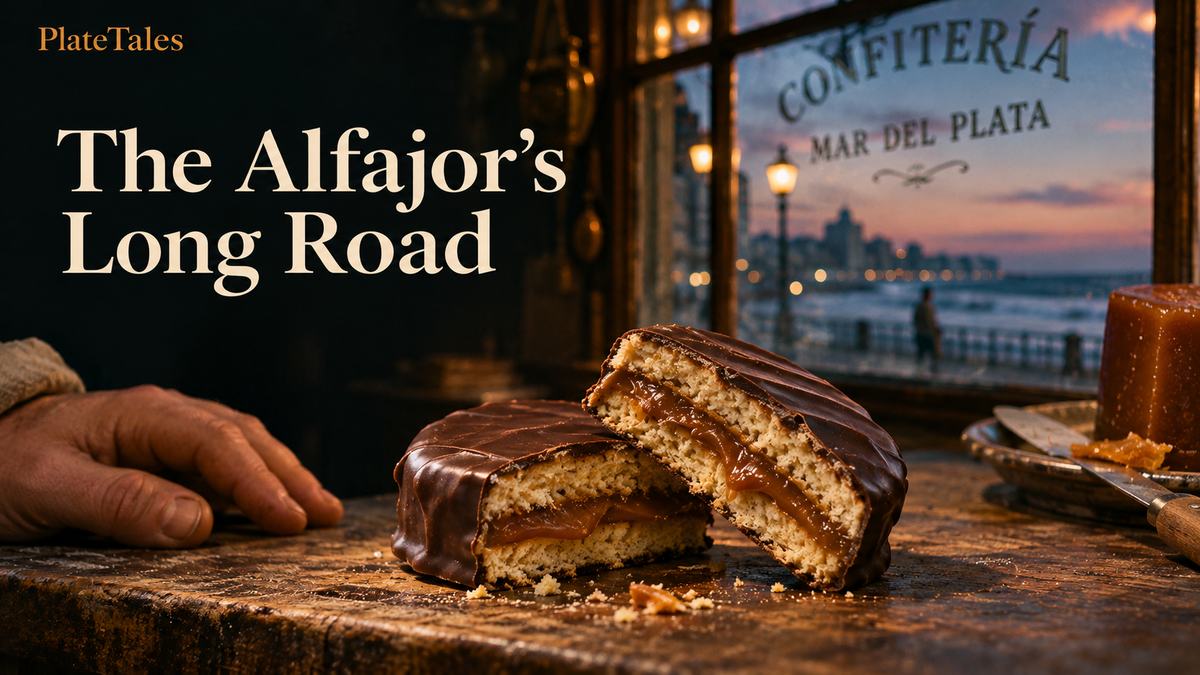
The alfajor began as a dense Andalusian sweet of honey, nuts and spices made under Muslim rule in medieval Spain, and it was not the sandwich cookie most people picture today. The version filled with dulce de leche took shape in the Americas, and the chocolate-coated factory kind that Argentines eat by the million came out of 1940s Mar del Plata. Same name, three different foods, one very long relay.
Which alfajor are we talking about?
Ask for an alfajor in Medina Sidonia, a town in Cadiz province, and you get a cylinder of honey and nuts. Ask in Buenos Aires and you get two soft cookies glued with dulce de leche and dipped in chocolate. They are two separate subjects: the Spanish sweet, and the Spanish American one that originated from the Spanish sweet of the same name.
So the alfajor history people want has two halves. One is a medieval sweet that kept well. The other is a nineteenth and twentieth century Argentine invention that borrowed the name.
The word, and why nobody agrees on it
The philologist Manuel Alvar Lopez described alfajor as an Andalusian form of the Castilian alaju, and traced it to the Arabic al-fakhir, meaning "luxurious." Another proposal is the Hispano-Arabic fasur, "nectar," credited to a writer named Raimundo Martin. A tourism page from Andalucia.org instead links the word to an Arabic term meaning "filled." Three guesses, no winner.
The first written trace is firmer. Antonio de Nebrija's 1495 dictionary records the word as alfaxor or alaxur. That is three years after the fall of Granada, so the sweet was already familiar enough to need a dictionary entry.
A related sweet, alau, is said to appear in the anonymous Arabic-Hispanic cookbook Kitab al-Tabikh, though that claim is unsourced, so treat it as a lead rather than a fact.
Medina Sidonia and the sweet that kept for weeks
The old recipe is still made in Medina Sidonia, where it is called alaju. Andalucia.org describes honey and nuts with cloves, anise, sesame, coriander and cinnamon, and says the sweet keeps well, which made it a travel food in the Middle Ages. Andalucia.org says the recipe has barely changed since then and passes from parents to children.
There is a paper trail, thin but real. The writer Mariano Pardo de Figueroa, who published as "Thebussem," reported that on 2 July 1487 Enrique de Guzman, second count of Medina Sidonia, ordered the district to send alaju to Malaga along with livestock. Artisans today say they follow a recipe Pardo de Figueroa recorded in 1786.
The modern rules are strict. Andalusia ratified a protected geographical indication on 15 September 2004, and the EU Official Journal published "Alfajor de Medina Sidonia" on 6 March 2007. A legal alfajor must be cylindrical, weigh at least 30 grams and not come in plastic packaging. Output is about 45,000 kilograms a year, mostly sold in Cadiz province.
The claim that the sweet was "born in Iberia during the rule of al-Andalus" is the standard line, and it comes with no citation. The 1487 order and the 1495 dictionary prove the sweet is old. They do not prove who first made it.
How the alfajor reached the Rio de la Plata
The alfajor has been made and eaten in what is now Argentina since colonial times, by one account. Another account, oddly, says the word itself was not known in the Americas until the nineteenth century. Both can be true if early versions went by other names, but neither account settles it, and the sources behind them were not checked here.
What the record does give is a date for the Argentine version. In 1851, in Santa Fe, Hermenegildo Zuviria, nicknamed "Merengo," began producing alfajores in a shop at San Jeronimo and 3 de Febrero, near the Cabildo. He is credited with help from the sisters Maria Andrea and Sinforosa Piedrabuena. Their original was salty-dough cookies filled with dulce de leche and coated in Italian meringue. No chocolate yet.
Politics did the marketing. Colonel Nestor Fernandez took alfajores to the Battle of Caseros in 1851, and General Urquiza later received a shipment each week at his estate in Entre Rios. After the 1853 Constitutional Convention, the delegates carried alfajores home as souvenirs.
Sugar is what made any of this possible, and its long road to Spain is told in the history of sugar.
Cordoba, Trujillo and the other cousins
The Santa Fe model was not the last. The Cordoba alfajor, with quince jelly, is attributed to the French chef Auguste Chammas in 1869, with no detail beyond the name and year. Chile has chilenitos made with corn flour. The Trujillo alfajor in Peru has several layers, and Dulceria Castaneda has made them since 1925. Tucuman has the clarita, with molasses jelly.
Uruguay produced the record. Guinness recognized an alfajor of 464 kilograms made on 11 December 2010 in Minas, Lavalleja.
Havanna and the chocolate coat
Mass production is the third chapter. It began on Argentina's Atlantic coast in the 1950s, with Havanna and Balcarce as early brands.
Havanna's story has more detail. Benjamin Sisterna had worked in bakeries in Santa Fe and Buenos Aires before moving to Mar del Plata, where he partnered with Demetrio Eliades, who owned a Cuban-style restaurant downtown. The Alfajores Havanna brand was registered in 1947, the restaurant became a factory, and the first products went on sale in January 1948. Luis Sbaraglini is named as the third founder. Accounts differ on the year, 1947 or 1948, depending on whether you count registration or the first sale.
Cacao has its own long story in the history of chocolate. At Havanna, the chocolate-flavored versions were especially popular, and the chocolate-covered alfajor filled with dulce de leche followed. The name is said to honor Havana, and nobody knows why it has a double n. By the 1950s Havanna had eight stores in the city and was popular with tourists. In the 1960s it bought a rival, Gran Casino. Sbaraglini died in 1963 and Eliades in 1966.
Havanna's own website now says it has almost 500 branches and a presence in more than 12 countries.
Questions people ask
Where do alfajores come from?
The alfajor comes from Spain. A honey-and-nut sweet of that name was made in Andalusia, and Antonio de Nebrija's 1495 dictionary records the word. The Argentine alfajor, a pair of cookies joined with dulce de leche, is a later American variation that appeared in Santa Fe in 1851.
Who made the first Argentine alfajor?
Hermenegildo Zuviria, nicknamed "Merengo," is credited with beginning to produce alfajores in Santa Fe, Argentina, in 1851. Sisters Maria Andrea and Sinforosa Piedrabuena are named as helpers. His version used salty-dough cookies, dulce de leche and Italian meringue.
What does the word alfajor mean?
Nobody is sure. The philologist Manuel Alvar Lopez traced it to the Arabic al-fakhir, "luxurious," while another proposal, credited to Raimundo Martin, derives it from the Hispano-Arabic fasur, "nectar." The first dictionary record is Nebrija's 1495 alfaxor or alaxur.
When was Havanna founded?
Havanna, the alfajor company of Mar del Plata, Argentina, registered its brand in 1947, and its first products went on sale in January 1948. Benjamin Sisterna, Demetrio Eliades and Luis Sbaraglini founded it, so accounts give either year.
Is the Spanish alfajor the same as the Argentine one?
No. In Medina Sidonia, Spain, the alfajor is a cylinder made with honey, nuts and spices, and its name is protected under a 2004 geographical indication. The Argentine alfajor is two soft cookies with a dulce de leche filling, usually coated in chocolate.
Filed under Trade Routes
Want more stories like this?
One food history story, every week. No spam, just the stories behind what the world eats.