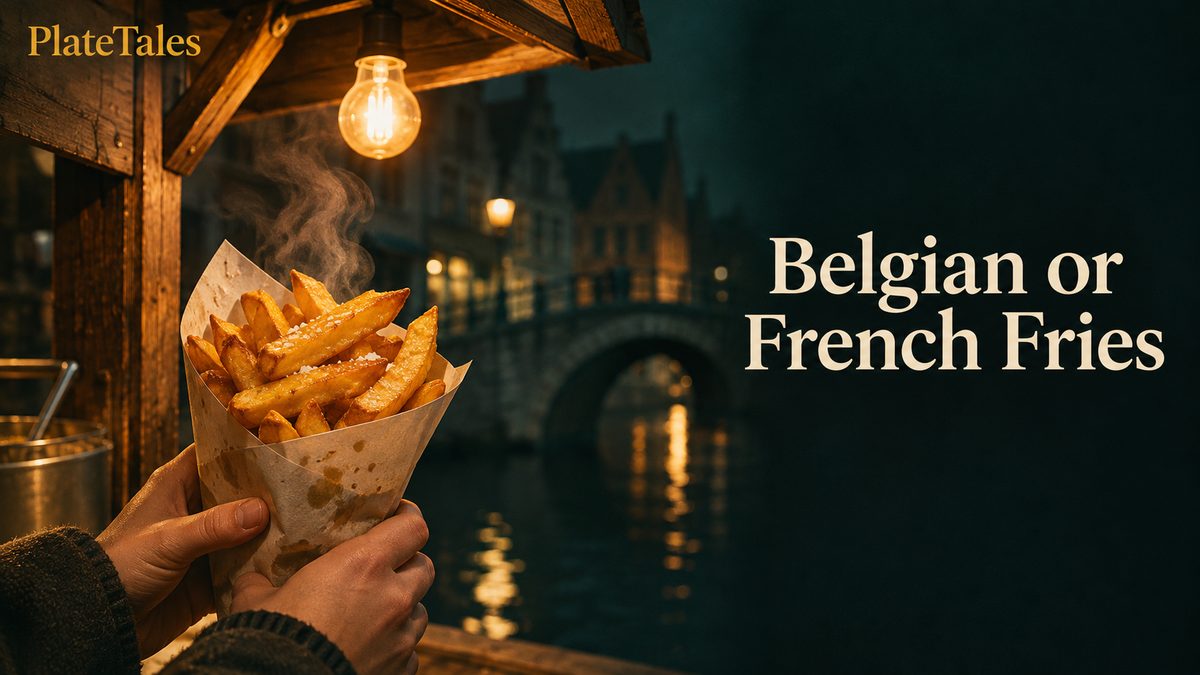
Are French fries Belgian or French? The documents point to Paris. Fried potato slices were sold on the streets of the French capital by the late 1700s, and the man who opened Belgium's first known fry stand in the 1840s had learned his trade in Paris. The Belgian claim rests on a family manuscript that nobody has ever seen.
That does not make Belgians wrong to love fries. It makes the story more interesting than a simple win for either side.
The 1680 story from the frozen Meuse
The Belgian case has one famous document. The journalist Jo Gerard said a family manuscript, dated 1781, described villagers in the Meuse valley frying potatoes before 1680. In winter the river froze and the fishing stopped, so the story goes, and people cut potatoes into the shape of small fish and fried them instead.
It is a lovely tale. Gerard never produced the manuscript, and French-language sources say it has never been found. The idea reached a wider Belgian audience through a 1985 magazine article by Christian Souris, which repeated Gerard's claim.
Why the potato dates do not work
The trouble is the potato itself. Historians cited by Belgian Smaak say potatoes were still unknown around Namur in 1680, and the Belgian historian Pierre Leclercq puts their arrival in the Namur area at about 1735. Frying could not have started before roughly 1739.
There is a second problem. Deep-frying takes a lot of fat, and peasants of the period could hardly have spared it. A poor household did not have a cauldron of lard to throw away on an experiment. (For the wider story of how the tuber crossed Europe, see how potatoes changed Europe.)
Could someone have fried a potato earlier?
Almost certainly, somewhere. A 1673 book, Cautiverio feliz by the soldier Francisco Nunez de Pineda y Bascunan, describing potatoes "cuites et frites" served to two Indigenous leaders in Chile in 1629. There is also a Spanish claim tied to Saint Teresa of Avila. Neither tells us anything about the stick or the street stall. Frying a potato is an easy idea. Turning it into a trade, with a seller, a price and customers who come back, is the part that needs a city.
What Paris was frying
Leclercq, himself Belgian, concludes that "it is clear that fries are of French origin." He traces the dish to Paris street sellers of the 18th century. Belgian Smaak reports that donut vendors on the Pont-Neuf, the bridge across the Seine, were reportedly selling potatoes cooked in fat in the late 1700s. The date 1789 is often attached to the legend. A French reference to fried potatoes from 1775 is cited too, which would be earlier still.
What they sold was not what we picture. The Pont-Neuf potatoes were thin slices, not sticks. Recipes of the time agree: La Cuisiniere republicaine of 1794 has "pommes de terre en friture" in a batter made from potato flour, and Audot's 1823 recipe calls for slices. The long stick is a later shape.
Fried potatoes then climbed from the bridge into bourgeois kitchens. Thomas Jefferson is a handy witness. He had "potatoes served in the French manner" at a White House dinner in 1802, and a note in his hand reads "Pommes de terre frites a cru, en petites tranches." It most likely came from his French chef, Honore Julien.
The Bavarian musician who sold them in Belgium
Belgium enters the story in the 1840s, through a German. Frederic Krieger (Belgian sources give Jean Frederic), a Bavarian musician, learned to make fried potatoes in Paris. Belgian Smaak says he worked as a clerk at the Chez Pelerin rotisserie. Another account says he learned the craft at a roaster on rue Montmartre in 1842.
He then moved north. The sources differ on the exact year, with 1842, 1844 and 1845 all appearing in them, but all agree on the order of events: Paris first, Belgium after. Krieger's business was called Fritz, and he sold "la pomme de terre frite a l'instar de Paris," which means potatoes fried in the Paris manner. Belgian Smaak says that from 1845 he travelled across Flanders and Wallonia selling fries, and that he founded the first known Belgian frietkot, the fry stand that still dots Belgian towns.
Belgians did not merely copy him. A French Empire survey of 1813, as reported by Belgian Smaak, found that Belgians ate about eight times as many potatoes as people in what is now France. A country that already lived on the tuber was ready for a fried one.
The stick shape appears in print in Belgium by 1861, when Philippe Edouard Cauderlier's Economie culinaire described cutting potatoes into sticks. Leclercq credits the Krieger brothers' mobile fryers with selling sticks before 1862. So the shape we call Belgian may well have been refined there, even if the idea was Parisian.
Why are they called French fries?
The word "French" has little to do with a border. In English, the earliest print use of "French Fried Potatoes" on record is Eliza Warren's Cookery for Maids of All Work in 1856, which told cooks to cut new potatoes in thin slices and put them in boiling fat. By the late 1800s American cooks used "French fried" for deep-fried food generally, so the name described a method before it described a vegetable.
The 1917 soldiers story
A popular tale says American troops in Belgium in 1917 heard French spoken around them and named the fries accordingly. It does not hold. The term was in use in the United States before the war, and a 1910 Manual for Army Cooks. Belgian Smaak adds that Peter Scholliers, a food historian, notes Belgium was well known in the United States at the time, so soldiers would have known where they were.
Does "frenching" explain it?
Another theory says the name comes from "frenching," a way of cutting food into strips. Leclercq reverses it. According to Belgian Smaak, he says the verb came from the adjective, "Not the other way around."
A Belgian national dish by the 20th century
Belgians did not always claim fries as their own. Belgian Smaak reports that the belief in a Belgian invention spread inside Belgium mainly after the Second World War.
The Belgian argument today is less about the first fry than about who made them a national food. Some Belgians say the name "French fries" reflects French gastronomic hegemony, which absorbed Belgian cooking under its own label. That is a defensible complaint about naming, and it has nothing to do with who fried first.
For the French side of the table, see the longer account in the history of French cuisine. For the British cousin, with its own origin dispute, read the history of fish and chips.
The Parisian attribution is itself fairly young. The food writer Curnonsky named the Pont-Neuf as the birthplace in 1927. By then the 1910 Manual for Army Cooks had already been telling American cooks how to French fry.
Questions people ask
Who opened the first fry stand in Belgium?
Frederic Krieger, a Bavarian musician who learned to make fried potatoes in Paris, is reported by Belgian Smaak to have founded the first known Belgian frietkot. From 1845 he travelled across Flanders and Wallonia selling potatoes fried in the Paris manner. Sources give 1842, 1844 or 1845 for his move north.
Did fries really start with fishermen on the frozen Meuse?
The story comes from journalist Jo Gerard, who cited a family manuscript said to describe Meuse villagers frying potatoes before 1680. The manuscript has never been produced. Historians also say potatoes were unknown around Namur in 1680 and arrived at about 1735, so frying there could not have begun before roughly 1739.
Were the first Paris fries cut into sticks?
No. The potatoes sold near the Pont-Neuf in the late 1700s were thin slices, and French recipes such as Audot's of 1823 still call for slices. The stick shape appears in print in Belgium in 1861, when Cauderlier's Economie culinaire described cutting potatoes into sticks.
Did American soldiers in Belgium name them French fries in 1917?
No. The term "French fried" was already in use in the United States before the war, and a 1910 Manual for Army Cooks used it. The earliest print use cited in English is Eliza Warren's 1856 cookbook, so the name described a way of frying long before 1917.
Filed under Origin Stories
Want more stories like this?
One food history story, every week. No spam, just the stories behind what the world eats.