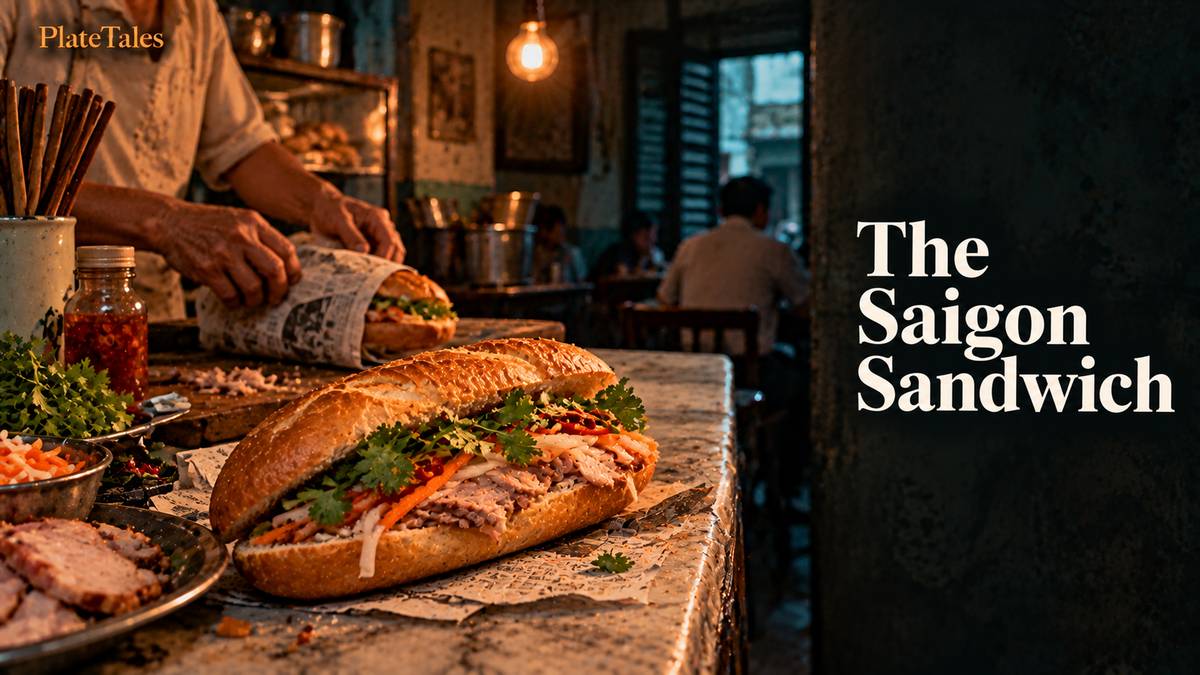
Banh mi history begins with French bread in 1860s Vietnam, but the sandwich itself was built in Saigon in the late 1950s, mostly by refugees from the north. A shop called Hoa Ma, opened in 1958 by a couple from Hanoi, is the best-documented early seller. The bread is French. Putting pickles, herbs and cheap cold cuts inside it was a Saigon idea.
The usual short version runs: France conquered Vietnam, brought the baguette, the Vietnamese stuffed it, and refugees carried it to California. Each step is roughly true. What the short version skips is how long each step took, and who did the work.
Is banh mi French or Vietnamese?
Start with the name, because a stubborn piece of folklore lives there. Plenty of French-language writing, including a 2016 AFP report in Les Nouvelles Caledoniennes, says "banh mi" is a mangled form of the French pain de mie, sandwich bread. It is not.
Banh is an old Vietnamese word for a whole family of cakes and pastries, rice cakes included, and it shows up in writing from around 1300. Mi means wheat. Put together, banh mi means wheat bread, any wheat bread.
The term is older than the conquest, too. It already appears in Jean-Louis Taberd's Latin-Vietnamese dictionary, printed in 1838, under the Latin panis. French forces did not take Saigon until 1859. The word was in print two decades before the army arrived.
So the word is Vietnamese and the loaf is French. In the north, people called it banh tay, "Western cake", which says how foreign it felt.
Bread and butter under French rule
The French brought the baguette in the 1860s, along with pate chaud, a small meat-filled pastry. By 1861 the poet Nguyen Dinh Chieu mentioned bread in his elegy for the volunteers who died fighting the French at Can Giuoc. It is an odd place for a baguette to make its literary debut.
Bread was expensive for a plain reason. Wheat will not grow in Vietnam's climate, so flour had to be shipped in. Simon Stanley, writing for Roads & Kingdoms in 2016, quotes an adage of the period: "Bread and meat make us strong, rice and fish keep them weak."
The French snack was the casse-croute: bread served with ham, cold cuts, pate, cheese and butter. Vietnamese borrowed the words along with the food. Casse-croute became cat-cut, beurre became bo, and fromage became pho mai.
It is easy to assume bread stayed a colonial luxury until the 1950s. The record is messier. The historian Erica J. Peters, who studies food in colonial Vietnam, told the same 2016 AFP report that French expatriates did not want low-paid baking jobs, so Chinese and Vietnamese bakers made the bread. From 1910, she said, small baguettes were sold on the street to people on their way to work, which meant Vietnamese people.
How did they eat it? Mostly for breakfast, with butter and sugar, according to Vu Hong Lien's food history Rice and Baguette.
Why is banh mi bread so light?
The First World War produced a claim that still shows up on menus. In 1914 French authorities seized the two largest import companies in Indochina, which were German-owned. With European wheat production in chaos, two scientists, Abel Lahille and Edouard Maurel, persuaded the authorities to approve rice flour in bread. Once the war was over, the rules were quickly revoked.
From this comes the story that banh mi is light and crackly because of rice flour. The Oxford English Dictionary repeats it. According to Saigon's SGGP newspaper, the 2011 entry describes a baguette "traditionally baked with both rice and wheat flour."
Andrea Nguyen, a Vietnam-born food writer and chef, disagrees. "Rice flour does not rise due to a lack of gluten," she told Roads & Kingdoms. Recipes with a lot of rice flour, she said, "produce nunchucks that you could hurt someone with."
The same report puts the airiness down to dough improvers, commonly ascorbic acid, which is vitamin C. A wartime rule explains why people think of rice in the loaf. Gluten explains why the rice did not stay.
Banh mi Saigon 1954: who invented banh mi?
In 1954 France agreed to leave, and Vietnam was split in two. More than a million people moved south. In Saigon they were called the Bac 54, the northerners of '54. Among them was a couple named Le.
Mrs. Le had worked in Hanoi for a French-owned company that supplied European-style hams and processed meats to French restaurants. In 1958 the couple opened a small snack bar called Hoa Ma at 511 Nguyen Dinh Chieu Street in Saigon's District 3. In 1960 it moved to 53 Cao Thang Street nearby.
The most popular banh mi shop in Saigon then was Vinh Loi, and it served the wealthy. Their daughter Hanh told Roads & Kingdoms what her father did differently. "He reduced the size of the traditional baguette to around 20 centimeters," she said. "He also reduced the amount of meat, adding vegetables instead."
Many of his customers were students, laborers and office workers with no time to sit down. "So he began placing the cat-cut ingredients inside the bread," Hanh said. They could eat it on the way to wherever they were going.
Was Hoa Ma really first?
The names are not settled. Vietnamese press accounts name the founders as Le Minh Ngoc and Nguyen Thi Tinh, and call Hoa Ma one of the first shops to sell banh mi thit, the meat sandwich, in 1958. Roads & Kingdoms gives only "Mr. and Mrs. Le". The year and the street match across sources. Nobody has a receipt proving no one did it sooner, so "among the first" is the honest claim.
Hoa Ma also had company. Around the same time another northern migrant sold sandwiches of cha, a Vietnamese pork sausage, from a basket on a moped. A stand in Gia Dinh, now Phu Nhuan District, filled bread with pha lau, a braised offal dish. Vu Hong Lien adds that some shops used cheese from French food aid that northern migrants had turned down.
Where did banh mi originate, and how did it leave Vietnam?
The sandwich originated in Saigon, and for twenty years it stayed a southern street food. After the Fall of Saigon in 1975 it became a luxury again. In the 1980s the Doi Moi market reforms brought it back, mostly as street food, which is where it has stayed.
Refugees who left after 1975 took it with them. In Northern California, Le Van Ba and his sons ran a food-truck supply business and, from the 1980s, the chain Lee's Sandwiches, which did a great deal to put banh mi in American strip malls. In London, Vietnamese canteens in Shoreditch made it a lunch staple from the 1990s.
It is the same pattern as how immigration built American food culture: a dish travels with people who need to earn a living, and it gets renamed for local ears. In 2009 a "Vietnamese po' boy" won best po' boy at the Oak Street Po-Boy Festival in New Orleans.
The Oxford English Dictionary added the word in 2011, in the same batch as kleftiko, chermoula and gremolata. SGGP reported it as part of the February update. The date is given as 24 March 2011, and on 24 March 2020 Google marked the date with a doodle.
A banh mi timeline, 1838 to 2011
| Year | What the record shows |
|---|---|
| 1838 | Taberd's dictionary lists banh mi for bread |
| 1860s | The French bring the baguette to southern Vietnam |
| 1910 | Small baguettes sold on the street to Vietnamese workers (Peters) |
| 1914-1918 | Wartime rules allow rice flour in bread, revoked after the war |
| 1954 | Partition; more than a million northerners move south |
| 1958 | Hoa Ma opens on Nguyen Dinh Chieu Street |
| 1980s | Lee's Sandwiches grows in California |
| 2011 | Oxford English Dictionary entry |
The sandwich shares its parents with pho, the other French-Vietnamese collision, and its habitat with the carts in the 500-year story of Southeast Asian street food. For nearly a hundred years the French ate their bread with ham and butter, and many Vietnamese ate it with sugar. Nobody in the record put the cold cuts, pickled daikon and chili in one loaf until the Les did it on Nguyen Dinh Chieu Street.
Hoa Ma still opens at 6 a.m. at 53 Cao Thang Street, and it usually runs out by ten.
Questions people ask
Does banh mi mean French bread?
No. In Vietnamese, banh mi means wheat bread, from banh for cakes and pastries and mi for wheat. The word appears in Taberd's Latin-Vietnamese dictionary of 1838, before French forces took Saigon in 1859. The claim that it comes from the French pain de mie is folklore.
Who invented the banh mi sandwich?
No single inventor is proven. The best-documented early seller is Hoa Ma, a snack bar opened in Saigon in 1958 by a couple from Hanoi. Their daughter says her father shrank the baguette to about 20 centimeters and put the fillings inside. Other northern migrants sold similar sandwiches around the same time.
Is rice flour why banh mi bread is so light?
Probably not. During the First World War, French authorities in Indochina approved rice flour in bread, and the rule was revoked after the war. The food writer Andrea Nguyen says rice flour lacks gluten and does not rise. The airy crumb of banh mi is put down to dough improvers such as vitamin C.
How did banh mi get to America?
Refugees who left Vietnam after 1975 carried it with them. In Northern California, Le Van Ba and his sons ran a food-truck supply business and, from the 1980s, the sandwich chain Lee's Sandwiches, which helped put banh mi in American strip malls. The Oxford English Dictionary added the word in 2011.
Filed under Migration Stories, Street Food
Want more stories like this?
One food history story, every week. No spam, just the stories behind what the world eats.