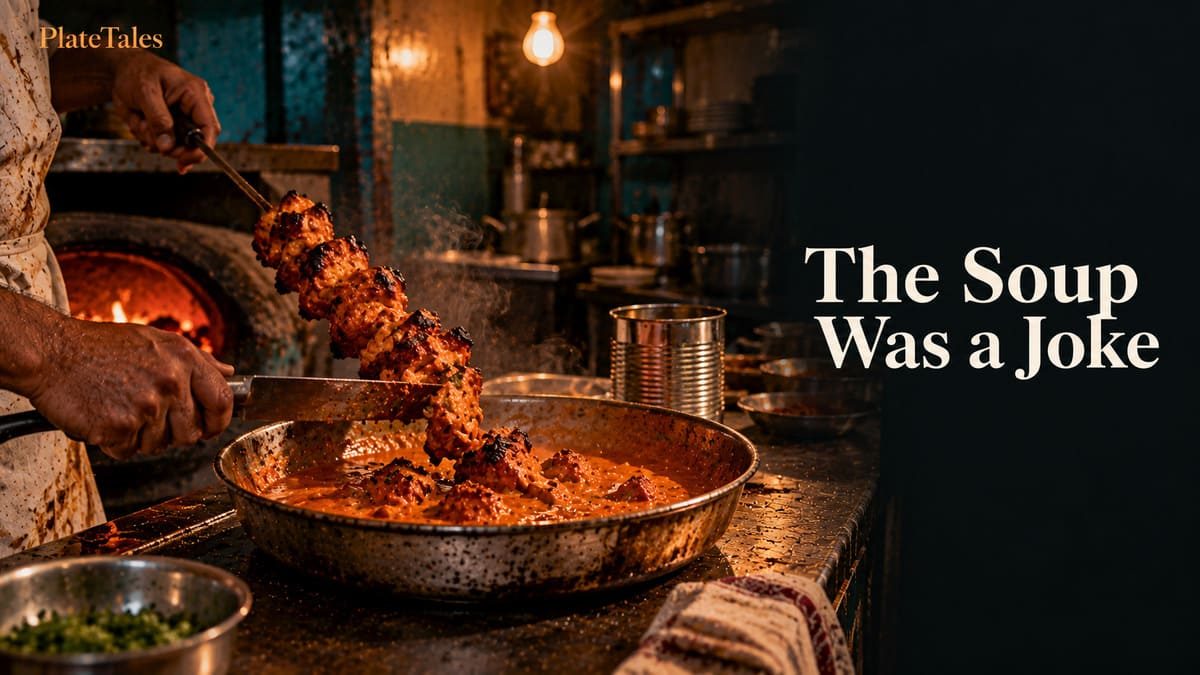
Chicken tikka masala comes from Britain's Indian restaurants, most likely in the 1970s, not from India, though the grilled tikka in it is north Indian. Nobody can prove who cooked it first. The best-known claimant is Ali Ahmed Aslam of the Shish Mahal in Glasgow, who said he added a sauce of yogurt, cream and spices when a customer called his chicken tikka dry. The famous tin of tomato soup was a joke told to journalists.
Tikka came first: Delhi in 1947, London in 1959
The tikka half is the old half. Chicken tikka is boneless pieces marinated in yogurt and chili and blackened on skewers in a clay oven, the tandoor, and it has long been street food in Pakistan and northern India. The sauce half needed restaurants.
Peter and Colleen Grove, British curry historians who fielded reporters' questions about this dish for years, start the clock at Moti Mahal in Delhi. Kundan Lal Gujral had been cooking in Peshawar since about 1920 and moved to Delhi at Partition in 1947, where he opened Moti Mahal in Daryaganj. In the Groves' account his cooks, during the 1950s, took the chicken juices left in the marinade trays, added butter and tomato, and tossed tandoor-cooked chicken in the result. That was murgh makhani, butter chicken, and it is the nearest relative chicken tikka masala has. Gujral's grandson Monish told NPR in 2022 that his grandfather was serving chicken tikka masala itself to Indian heads of state as early as 1947. No menu or other record has been offered for it.
Britain got its ovens later. According to the Groves, archived documents at Veeraswamy in London show a tandoor in use there in 1959. Seven years on, the Gaylord in Mortimer Street advertised its tandoor dishes in the programme for the London Palladium's 1966 Cinderella, starring Cliff Richard. The longer story of how the curry house itself reached Britain is in how curry spread around the world.
The 1961 cookbook with a Shahi Chicken Masala
The oldest printed recipe anyone points to is in Mrs Balbir Singh's Indian Cookery, published in 1961. It is called Shahi Chicken Masala, and the Groves, who reprint its ingredient list, say it may have been "the shape of things to come". The list has a chicken of a pound and a half, sliced onions, ginger, nine cloves of garlic, three tomatoes, yogurt, a quarter pint of cream and four ounces of khoa, which is milk cooked down until it is nearly solid.
So a creamy chicken curry with tomatoes in it was in print, in English, before the Shish Mahal existed. What it lacks is the tikka. The spice company her granddaughter Pallavi Sitlani started in 2017 publishes a version of it as recipe number 226, and in that version the cubed chicken goes straight into the frying onions and spices. Its headline calls the dish "The Original Chicken Tikka Masala?", question mark included.
Who invented chicken tikka masala? Glasgow's Shish Mahal, in Aslam's words
Ali Ahmed Aslam was born in Punjab, in what became Pakistan, and came to Glasgow as a boy. His father, Noor Mohammed, opened the Green Gates in Bank Street in 1959, which the Glasgow Herald describes as the city's first proper Indian restaurant. In 1964 Aslam, still a teenager, opened the Shish Mahal nearby in Gibson Street. By the mid-1960s the street had enough of them to be nicknamed Curry Canyon.
His account of the invention comes from an interview with the news agency AFP in the summer of 2009, when he was 64:
"Chicken tikka masala was invented in this restaurant, we used to make chicken tikka, and one day a customer said, 'I'd take some sauce with that, this is a bit dry'. We thought we'd better cook the chicken with some sauce. So from here we cooked chicken tikka with the sauce that contains yogurt, cream, spices."
The account has a dry tikka and a customer. It has no date beyond the family's "the 1970s", no name for the customer, and no soup.
Others claim it too.
| Claimant | Where | When | What supports it |
|---|---|---|---|
| Sultan Ahmed Ansari, Taj Mahal | Glasgow | 1950s | His descendants' word. The Groves found no other trace of the dish, or of a tandoor, in Glasgow that early |
| Kundan Lal Gujral, Moti Mahal | Delhi | 1947 | His grandson's word |
| Ali Ahmed Aslam, Shish Mahal | Glasgow | 1970s | His own account, given in 2009 |
| An unnamed Bangladeshi chef | London or "up north" | 1970s | The tomato soup story |
| Zaeemuddin Ahmad's family, Karim's | Delhi | Long before any of them | Family tradition of a Mughlai dish |
Two people who were not claiming the dish tell us more. Amin Ali, later the owner of the Red Fort in Soho, told the Groves he was serving chicken tikka masala as a waiter when he arrived in London in 1974, and wondering what on earth it was. Rahul Verma, a Delhi street food writer, says he ate it in Uttar Pradesh or Punjab early in the 1970s. A dish already on tables in London and northern India by about 1974 is hard to square with one improvised plate in Glasgow sometime that decade.
The Groves' essay concludes that the dish "was most certainly invented in Britain", probably by a Bangladeshi chef. In 2014 Peter Grove was blunter with the writer Mark Hay: whoever did it, "it was certainly not Ali Ahmed Aslam of Shish Mahal", partly because Ansari had claimed first. That argument is weaker than it sounds, since Grove himself had waved the Ansari claim away for lack of evidence. His better line to Hay was that the dish was "one of those things that evolved when conditions were right". It reads less like one of the foods said to be invented by accident and more like the same obvious idea occurring in many kitchens.
How it became Britain's national dish: Waitrose in 1983, Robin Cook in 2001
Waitrose put a ready-made chicken tikka masala on sale in 1983. Later the Groves recorded that Marks & Spencer claimed to sell 18 tonnes of it a week, while Indian restaurants served 23 million portions a year. Hay counted almost 50 different recipes circulating in Britain by 2009, "sharing only chicken in common".
On 19 April 2001 the Foreign Secretary, Robin Cook, gave a speech on British identity to the Social Market Foundation in London. These are the three sentences people still quote:
"Chicken Tikka Massala is now a true British national dish, not only because it is the most popular, but because it is a perfect illustration of the way Britain absorbs and adapts external influences. Chicken Tikka is an Indian dish. The Massala sauce was added to satisfy the desire of British people to have their meat served in gravy."
The spelling is the Guardian's. The older holder of the national-dish title has much the same background, as the story of fish and chips and the immigrants who brought it shows.
Is chicken tikka masala Indian or British? The 2009 argument
In July 2009 Mohammad Sarwar, the Labour MP for Glasgow Central, tabled an early day motion in the House of Commons asking for chicken tikka masala to get the European Union's Protected Designation of Origin, the status that guards Champagne and Parma ham. Glasgow City Council backed him. "Glaswegians loved the flavour of Asian spices but still wanted a bit of gravy on their meat," Sarwar said. Aslam told AFP he meant the dish as a gift to his adopted city and would not stop anyone else using the name: "We don't mind if other people use it. Everyone should enjoy that."
Delhi minded. Verma dismissed the Shish Mahal story, the food writer Hemanshu Kumar pointed to Mrs Balbir Singh's 1961 book, and Zaeemuddin Ahmad of Karim's said his family had been making the dish long before. The bid went nowhere, and the Guardian later noted that restaurants elsewhere in Britain had put in their own claims.
The two sides are arguing about different parts of the plate. The tikka, the tandoor and the buttery tomato sauce of Moti Mahal are north Indian. Grove's view is that the dish under this name, mild and with plenty of gravy, took shape in Britain in the hands of Indian, Bangladeshi and Pakistani chefs, each adjusting it for local customers. It is one more case of food carrying national identity for two countries at once.
The tin of tomato soup was a joke
Now the soup. In a blog post dated 5 December 2011 the London restaurateur Iqbal Wahhab wrote that when he launched a trade magazine called Tandoori in the mid-1990s he invented a set of unverifiable claims about the curry business, knowing reporters would not check them. One was that the dish was born in "a restaurant up north in the 70s" when a chef whirled a sauceless tikka round a pan with Campbell's tomato soup and cream. "I made it up," he wrote, "and I love the fact that people to this day quote this story back to me as if they've unearthed some great revelation."
Peter Grove claimed a share of the credit in 2014. "Along with Iqbal Wahhab, now of Roast Restaurant, I started the urban myth of CTM being tikka with added Campbell's tomato soup and spices for a joke," he told Hay. Reporters kept asking where the dish came from and, he said, "did not seem happy with the truth". He added: "I have to admit a couple of bottles of wine urged us on."
The two confessions do not quite match (Wahhab's has no Grove in it, and the Groves' own essay credits the tale to Wahhab alone), but they agree on the point that matters. Wahhab's story named no city and no chef. Neither did the Hindustan Times in October 2007, which gave the soup to an anonymous Sylheti chef and an angry customer shouting "Where's the gravy?". By July 2009 the soup was attached to Aslam's name, in BBC coverage of the Sarwar campaign: he "is said to have prepared a sauce using spices soaked in a tin of condensed tomato soup". By 2017 a Herald columnist had the can as Heinz Cream of Tomato.
The Shish Mahal did stand by the story. Its manager, Ali Asif, affirmed it to Hay in 2014. Still, the only account we have in Aslam's own words is the soup-free one, and that one may be perfectly true as far as it goes. Somebody at the Shish may well have sauced a dry tikka. By the 1970s, cooks in London and northern India were doing the same.
Mr Ali's lunch
The Gibson Street restaurant where it would have happened is gone. It closed in the 1980s after the building began to subside. The site later became the new Hillhead Primary School, and the Shish Mahal carried on nearby in Park Road.
Aslam died on Monday 19 December 2022, aged 77. The restaurant shut for 48 hours and his funeral was held the next day at Glasgow Central Mosque. His nephew Andleeb Ahmed told NPR that he had been serving customers until the end of his life, and that he rated his famous dish fairly low. The chefs made him a traditional curry, which he ate at lunch every day. "He'd only have chicken tikka masala when guests were over."
Questions people ask
Is chicken tikka masala Indian or British?
Both countries have a claim to parts of it. Chicken tikka, the tandoor and the buttery tomato sauce of Moti Mahal in Delhi are north Indian. The dish under this name, mild and with plenty of gravy, most likely took shape in Britain's Indian restaurants, where Indian, Bangladeshi and Pakistani chefs adjusted it for local customers.
Who claims to have invented chicken tikka masala?
The best-known claimant is Ali Ahmed Aslam of the Shish Mahal in Glasgow, who said a customer found his chicken tikka dry. Others claim it too, including the family of Sultan Ahmed Ansari of Glasgow's Taj Mahal and the grandson of Kundan Lal Gujral of Moti Mahal in Delhi. Nobody has proved a first cook.
Was chicken tikka masala really made with tomato soup?
Probably not. The tin of Campbell's tomato soup began as a joke. London restaurateur Iqbal Wahhab wrote in 2011 that he invented it in the mid-1990s for his trade magazine Tandoori, and Peter Grove said he helped start the tale. Aslam's own account to AFP in 2009 mentions yogurt, cream and spices, with no soup.
When did chicken tikka masala become Britain's national dish?
Waitrose put a ready-made version on sale in 1983. On 19 April 2001 the Foreign Secretary, Robin Cook, called it a true British national dish in a speech in London, because it showed how Britain absorbs and adapts outside influences. Indian chefs in Britain had tikka, and customers wanted it in gravy.
Filed under Origin Stories, Cultural Identity
Want more stories like this?
One food history story, every week. No spam, just the stories behind what the world eats.