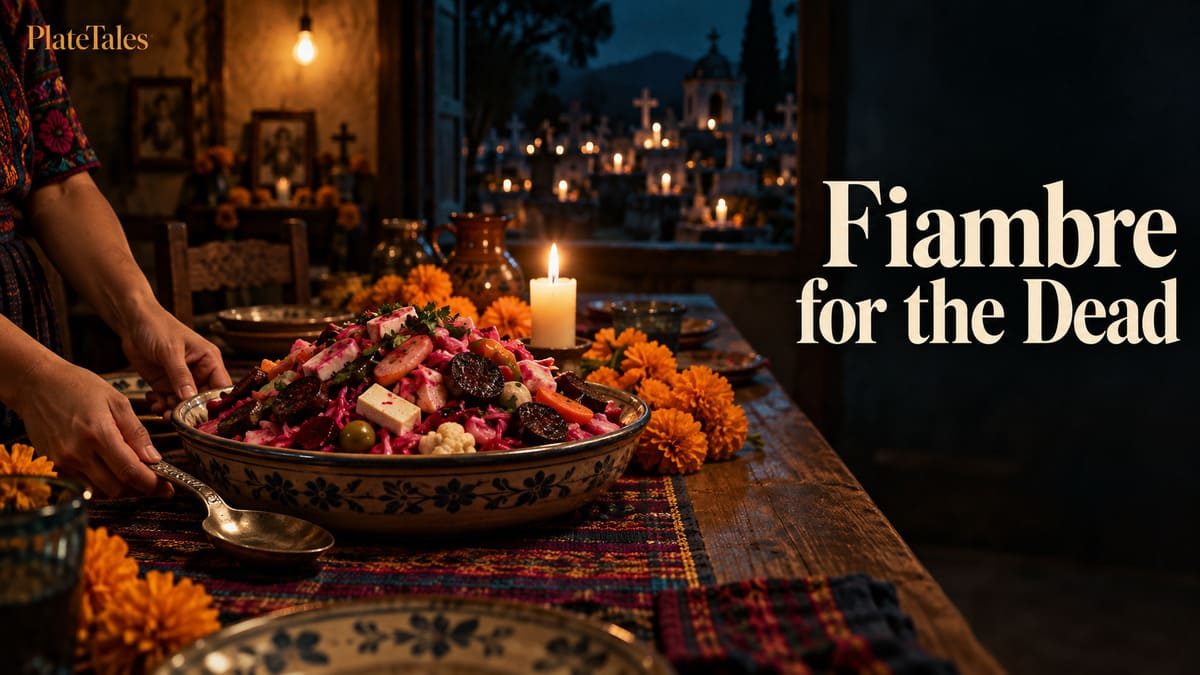
Fiambre is a cold Guatemalan salad of pickled vegetables, cured meats, sausages and cheeses, made once a year for All Saints' Day on 1 November and often for All Souls' Day on 2 November. Its history is thinner than its fame: no single cook, year or kitchen is on record, and the stories about where it came from disagree. What can be said is that it grew from Spanish and Mesoamerican habits meeting at the table, and that Guatemala now treats it as national heritage.
What is fiambre, exactly?
The word is Spanish for a food served cold. The Guatelaria food site quotes an 1888 cookbook, the Nuevo Cocinero Americano, which defines fiambre as cooked or roasted foods that are left to cool before eating. The Guatemalan dish took that general idea and stretched it. Descriptions range from a chilled salad made with dozens of ingredients to one that can pass fifty.
There is no single recipe. Typical lists include pickled carrots, green beans, peas, cauliflower, tender pacaya (a palm flower), cabbage, small onions, hearts of palm and baby corn. Then come sausages and meats: black and red chorizo, longaniza, butifarra, salchichon, ham, morcilla, hen, pork loin, salted beef and beef tongue. Cheeses, hard-boiled eggs, Sevillian olives, capers, strips of chile and a radish cut into a flower finish the plate. The vegetables sit in their own seasoned pickling liquid, which is left to mature for a day or two before serving.
Red, white, green and the rest
Families sort the dish by color. Fiambre rojo gets its red from beets, fiambre blanco leaves the beets out, and fiambre verde drops the cold cuts and is vegetarian. The white and green kinds differ in their use of mustard and parsley. There is also fiambre desarmado, traditional in the department of Jalapa, and a version from Antigua Guatemala, though details on either are thin.
Each household keeps its own version and hands it down. Guatelaria's author writes about learning the dish from her mother-in-law, her father and her grandmother, and argues that every ingredient has a history behind its place on the plate. Two of them are easy to trace in outline. Butifarra is a sausage of Catalan origin, flavored, Guatelaria says, with bacon, white wine, anise, clove, thyme and onion stems. Black chorizo gets its dark color from roasted, ground plantain peel.
The history of fiambre in Guatemala: three origin stories
Three explanations circulate, and none has a document behind it that anyone has produced.
The cemetery story
The version most often repeated says Guatemalan families carried the dead's favorite foods to the cemetery on the Day of the Dead. Different families brought different dishes, and over time these were combined into one mixed salad. That is the account usually given. It makes a good story and fits the custom: families share fiambre with relatives and neighbors, and it is made only for this holiday. But no citation backs the account, so the chain from picnic basket to salad bowl is an inference, not a record.
The surprise-guest story
Guatelaria reports a popular legend of a different kind. Unexpected visitors arrived, the cooks had little ready, and they improvised a salad from what the pantry held cold: pickles and cured meats. Guatelaria does not give a date, a family or a town. It does make a practical point. Refrigerators belong to the last century, so older kitchens leaned on preserved food, and pickles and sausages are still the base of fiambre.
The Catalan salad
The most specific claim is that the dish goes back to the colonial period, when Catalans living in Guatemala made Catalan salad at home. The Spanish are credited with the cheeses and sausages, traced further back to the Arabs, and the Mesoamerican side with the pickled vegetables. The dish itself is attributed to anonymous Guatemalan cooks. Several of these statements carry no source.
The honest summary is that the ingredients point to Spain and the Americas, while the moment of invention stays unrecorded. One study of the dish is a 1998 paper by Luis Lujan Munoz in the journal Tradiciones de Guatemala, titled "El fiambre de Guatemala: Sincretismo alimentario, memoria funeraria y comensalidad mestiza". Its title alone tells you how scholars read the dish: food mixing, memory of the dead, and shared meals.
A November table for the living and the dead
The holiday around the dish has its own mixed ancestry. Day of the Dead has roots in both Indigenous Mesoamerican beliefs and Spanish Catholic tradition. Some scholars connect pre-Columbian rites for the dead with All Saints' Day and All Souls' Day as they were introduced under colonial rule, while other historians see the modern holiday as more directly European, and Mexican academics disagree among themselves.
In Guatemala the day centers on 1 November. Families visit tombs and decorate them with flowers, candles and food, and some towns repaint their cemeteries and hold picnics there. Giant kites are flown, said to help spirits find their way back, and some carry notes for the dead. The salad is said to carry a bond between the living and the dead, which is why some people eat it at home and others at the graveside.
For a story about leftovers and improvisation, the dish is oddly formal. Making it takes days of pickling and shopping, which suits an occasion built around remembering people. Compare the way other food cultures attach slow, shared dishes to a calendar date in our look at ritual and wedding foods, or how a plate becomes a marker of belonging in how food shaped cultural identity.
Pickles, sausages and the problem of keeping food
Strip away the ceremony and fiambre is a catalog of preservation. Vinegar pickling, salted meat and cured sausage all existed to carry food past the day it was made. Guatelaria points to cecina, salted meat soaked in a sour-orange brine, as one example. This is the same logic that runs through the history of fermentation and through the cheeses covered in the history of cheese: people kept what they could and then found reasons to celebrate it.
That also explains why the dish is cold. A salad of cured and pickled things needs no cooking on the day, which frees the cook for the cemetery.
Heritage status in 2019
Fiambre now has an official standing. It was declared Intangible Cultural Heritage of the Nation by Ministerial Agreement 880-2019, following a technical opinion from Guatemala's Ministry of Culture and Sports. The declaration does not settle the origin question, and the dish itself remains a blend of influences rather than a single inventor. It does confirm what any family with a bowl of red fiambre on 1 November already knows: the dish belongs to everyone who makes it.
Questions people ask
What is fiambre made of in Guatemala?
Guatemalan fiambre is a cold salad of pickled vegetables such as beets, carrots, green beans, cauliflower and pacaya, mixed with cured meats, sausages like chorizo and butifarra, cheeses, eggs, olives and capers. It can include more than 50 ingredients, and no single recipe exists.
Why do Guatemalans eat fiambre on 1 November?
Fiambre is eaten around All Saints' Day on 1 November and All Souls' Day on 2 November, when Guatemalan families visit cemeteries. The most common explanation is that families once brought the dead's favorite foods to the graves and the dishes merged, though the claim has no firm documentary source.
What is the difference between red and white fiambre?
Fiambre rojo, the red version, gets its color from beets. Fiambre blanco leaves the beets out. A third kind, fiambre verde, has no cold cuts and is vegetarian. The white and green versions differ in their use of mustard and parsley.
Is fiambre a national heritage dish?
Yes. Guatemala declared fiambre Intangible Cultural Heritage of the Nation through Ministerial Agreement 880-2019, after a technical opinion from the Ministry of Culture and Sports. The declaration recognizes the dish as a tradition, not a recipe with a single known inventor.
Filed under Ritual Foods
Want more stories like this?
One food history story, every week. No spam, just the stories behind what the world eats.