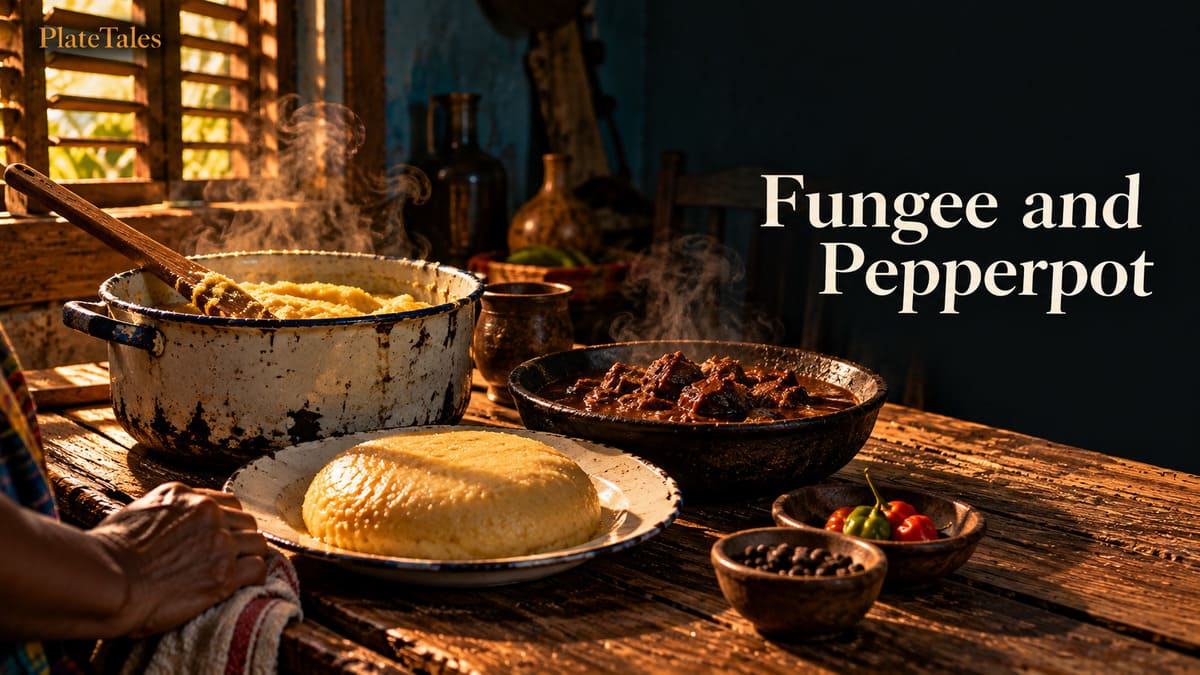
Fungee and pepperpot together make up the national dish of Antigua and Barbuda: fungee is a firm ball of cornmeal and okra, pepperpot is a slow stew eaten beside it. The pairing is old in spirit and thin on paper. Almost nobody wrote down who first cooked it, so what follows is what can be shown, and a clear note on what cannot.
Fungee and pepperpot history starts with what is on the plate
Fungee (pronounced "foon-jee") is a dish similar to Italian polenta, made mostly with cornmeal. A travel-food site describes it as a bread ball of cornmeal and okra, close to polenta in texture. The Antigua Observer, reporting in May 2024 on a competition run by the Antigua and Barbuda Tourism Authority, quotes the event's organiser saying "Pepperpot and Fungee is our national dish" and calling it a key part of the country's cultural heritage. Okra is what gives the cornmeal its slippery, cohesive body, and the stirring is done with a stick until the mass pulls together.
Pepperpot is the other half. That same site describes it as a one-pot stew of pork, beef or fish, usually eaten for breakfast or dinner. Cooks on different islands make pepperpot differently, and the recipe for the Antiguan version is not documented in any source open to us, so this article does not say what goes into it.
Where the word fungee comes from
The name is not unique to Antigua. The cornmeal-and-okra dish is called cou-cou in Barbados and in the Windward Islands, and fungee in the Leeward Islands and Dominica. It is listed as a national dish of Antigua and Barbuda, Barbados, the British Virgin Islands and the U.S. Virgin Islands. So fungee is one local name for a food that circles the eastern Caribbean.
The word itself points across the Atlantic. In Angola, funge is a staple stiff porridge, and it is traditionally made from cassava flour stirred into boiling water, though sorghum, maize or millet can also be used. It is eaten by pinching off a small ball with the fingers and dipping it in a stew or sauce. In the Lesser Antilles a similar food is called fungi or cou-cou. Whether the Antiguan name descends directly from the Angolan one is not proven by anything checked, but the resemblance in both word and method is hard to dismiss.
A relative of fufu, with a caveat
Fufu, the pounded and stirred swallow foods of West and Central Africa, is the wider family. Fufu is believed to have started in what is now Ghana, and that before Portuguese traders brought cassava from Brazil in the 16th century it was made mainly from cocoyam, plantain and yam. In Ghana, a version called banku is made from fermented ground corn, sometimes mixed with grated cassava, and is eaten with okra stew and fish.
Across the Caribbean the family splits into local forms. Cuba keeps the name fufu. Haiti has a breadfruit version. Puerto Rico has mofongo, made from fried plantains. Barbados has cou-cou, cornmeal-based like fungee. Accounts draw an explicit link to enslaved Africans for only one of them, the Puerto Rican funche, which can probably be traced back to African slaves on the island. For fungee itself, it makes no such claim. The link is plausible, and the people who cooked it for centuries would likely say so, but a documented chain from a named kitchen in Africa to a named kitchen in Antigua does not seem to exist in the sources checked.
Why corn, and why okra
Maize is an American crop. It reached Antigua long before Europeans did: the pre-Columbian Saladoid people introduced farming there, including corn, sweet potatoes and chillies. Okra, by contrast, is an African and Middle Eastern plant. Its origin is placed in East Africa, in Ethiopia, Eritrea and eastern Sudan, and an account from 1216 records people in Ayyubid Egypt eating the young pods. It was recorded in Brazil by 1658 and in Suriname in 1686.
So fungee joins two food histories. A New World grain meets an Old World pod, stirred in a way that echoes African swallow foods. That combination is the part of the story that holds up under checking.
Sugar, and who did the cooking
Antigua's history explains why the dish exists at all. After tobacco, sugar became the main crop, and enslaved people brought from West Africa did the work and soon far outnumbered European settlers. Revolts took place in 1701 and 1729, and a planned revolt in 1736, led by Prince Klaas, was discovered before it began. Slavery was abolished across the British Empire in 1833, and emancipation in Antigua followed in 1834.
The Cou-cou article makes the economic point plainly: cheap ingredients made the dish common among many residents in early colonial Barbados. Cornmeal and okra were inexpensive and easy to find, with okra grown in home gardens and sold in markets. A food that stretches a small amount of cornmeal into a meal, backed by a pot of whatever stew was available, suits people living on provision grounds and short allowances. The sugar economy that shaped Antigua is told in more detail in our history of sugar.
From kitchen staple to national dish
The title of national dish is a modern thing. Antigua and Barbuda became fully independent on 1 November 1981, after being an associated state of the United Kingdom with full internal autonomy since 27 February 1967. No source checked says when or by whom fungee and pepperpot were named the national dish, and no official decree. The label appears in tourism and reference writing, such as the pages quoted above, and the only reference found for it in writing on the cuisine is a recipe website.
That does not make the claim false. It means the title grew by usage, the way most national dishes do, rather than by law. Other dishes of African-descended cooks in the Americas have had a similar path, as in our story on the history of soul food, and the way a plate of food can stand for a people is the subject of how food shaped cultural identity. A cousin from the other side of the Atlantic is the subject of the story of jollof rice.
What nobody has pinned down
Several things people say about this dish are repeated more often than they are sourced. That it is eaten on Saturdays, a claim that comes up in popular accounts, did not appear in any page checked, so it stays out. That it came straight from Angola, or from Ghana, is a reasonable guess without a paper trail. Whether Antiguan pepperpot uses cassareep, as Guyanese pepperpot does, is not confirmed by any page checked, so it is left open. Guyanese pepperpot, by comparison, has a better record: it is described as a Guyanese variation of a slow-cooked stew found across the Caribbean, mentions an original Amerindian version, and cassareep is said to work as a preservative so leftovers can be reheated over several days.
What is firmly on the record is smaller and sturdier: a cornmeal and okra dish with African cousins, a name shared across the Leeward Islands, a sugar island whose population was overwhelmingly of West African descent, and an independence day, 1 November 1981, that gives the dish its present standing.
Questions people ask
What is Antigua's national dish made of?
Antigua and Barbuda's national dish is fungee and pepperpot. Fungee is a ball of cornmeal and okra, close to Italian polenta in texture, according to a travel-food site, and the Antigua Observer quotes a tourism organiser calling pepperpot and fungee the national dish. Pepperpot is a one-pot stew of pork, beef or fish, according to that site.
What does fungee mean in the Caribbean?
Fungee is the name used in the Leeward Islands and Dominica for a cornmeal and okra dish called cou-cou in Barbados and the Windward Islands. Angola has a related staple called funge, a stiff porridge usually made from cassava flour, and the Lesser Antillean names fungi and cou-cou are noted as similar foods.
Is fungee related to fufu?
Fungee belongs to the wider family of stirred, dough-like starches eaten across West and Central Africa and the Caribbean, which includes fufu, banku, cou-cou and mofongo. Only the Puerto Rican funche is explicitly linked to enslaved Africans, so a documented line from fufu to Antiguan fungee is not established.
Where does pepperpot come from?
Pepperpot is most firmly documented in Guyana, where it is described as a slow-cooked stew made with cassareep, meat and hot peppers, with an original Amerindian version. How it reached Antigua and Barbuda is not documented in the sources checked.
Filed under Migration Stories, Cultural Identity
Want more stories like this?
One food history story, every week. No spam, just the stories behind what the world eats.