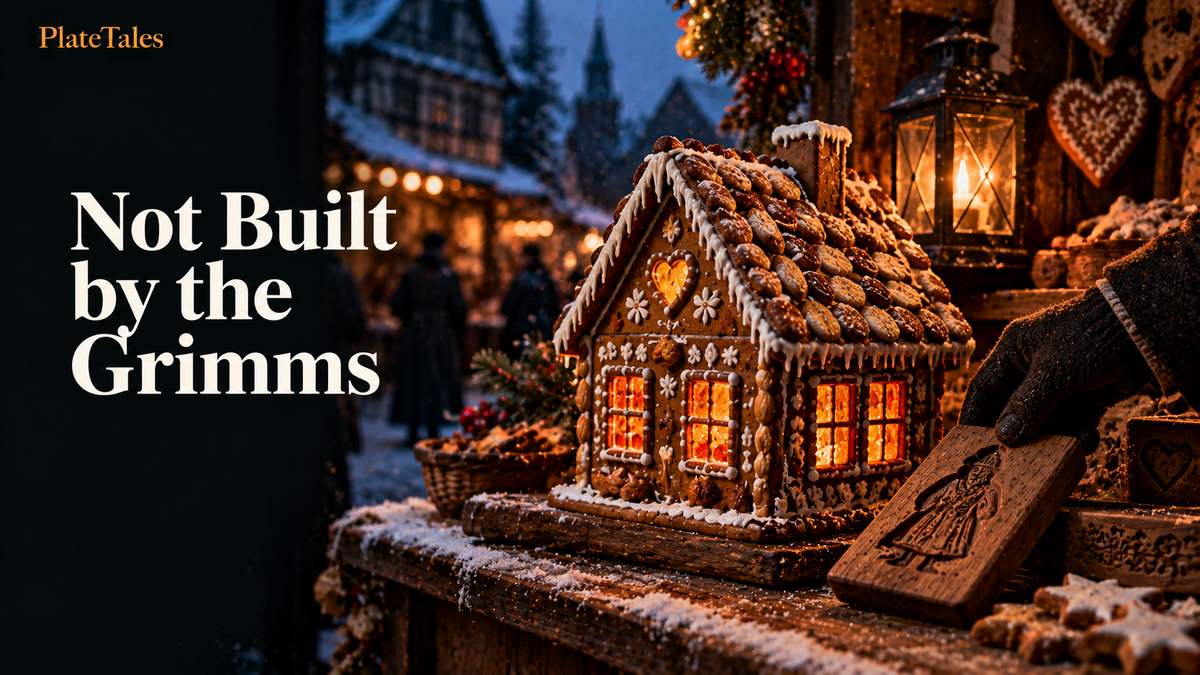
The history of gingerbread houses begins in German-speaking Europe around 1800. The earliest one found in print is a "Pfefferkuchen-Haus" (gingerbread house) in a verse published in 1795 by Georg Gustav Fülleborn, a teacher in Breslau. Hansel and Gretel did not invent it. The cottage in the Brothers Grimm's 1812 tale is built of bread, roofed with cake and fitted with sugar windows, and it stays that way in every edition they published.
So the fairy tale everyone credits describes the wrong building material, and the gingerbread house was already in print seventeen years before it. What fills the gap is a handful of half-forgotten texts: a Latvian folktale translated into German, two passing remarks by other writers, a magazine report from a Christmas market, and an opera libretto written by a composer's sister.
Did Hansel and Gretel invent gingerbread houses?
No, and the text is easy to check. Jacob and Wilhelm Grimm printed the story as number 15 in the first volume of their Children's and Household Tales, Berlin, 1812. The children follow a white bird to "a little house built entirely from bread with a roof made of cake, and the windows were made of clear sugar," in D. L. Ashliman's translation.
The German says "ganz aus Brod gebaut." Bread. Not Lebkuchen, not Pfefferkuchen, not ginger in any form.
The witch's rhyme is there in 1812: "knuper, knuper, kneischen," roughly "nibble, nibble, little mouse, who is nibbling at my house?" The children's famous answer, "the wind, the wind, the heavenly child," is not. The Grimms wrote it into their own copy in 1813, and it is printed in the second edition of 1819. The brothers kept revising the tale until 1857, and the seventh edition of that year still has a house "aus Brot gebaut," with a cake roof.
English Heritage, in a piece adapted from the food historian Sam Bilton, puts it plainly: the gingerbread came with later retellings. National Geographic told readers in 2015 that in the Grimms' story "the whole thing is made out of gingerbread." It is not, and that sentence shows how the legend travels.
Where did gingerbread houses originate?
The best archive work on this comes from Klaus Graf, a German archivist. In December 2023 he searched digitized German books on his blog Archivalia for the earliest gingerbread houses in print. His results take the story away from the Grimms and hand it to a crowd.
| Year | Source | What it says |
|---|---|---|
| 1795 | Georg Gustav Fülleborn, verse (reprinted 1797) | "Weg ist Herr Blaubart, weg sein Pfefferkuchen-Haus" (gone is Mister Bluebeard, gone his gingerbread house) |
| 1808 | A. L. Grimm | Alludes to a tale of the "Lebkuchenhäuschen," the little gingerbread house |
| 1812 | Jacob and Wilhelm Grimm | A house of bread, cake and sugar |
| 1817 | Karoline Stahl, a Latvian tale in German | Two children nibble at a little house "ganz aus Pfefferkuchen," entirely of gingerbread |
| 1822 | Willibald Alexis | Mentions the "Mährchen vom Lebkuchenhäuschen" |
| 1864 | Die Grenzboten | "unsre Lebkuchenhäuschen am Weihnachtsmarkte," our little gingerbread houses at the Christmas market |
| 1893 | Engelbert Humperdinck's opera | A gingerbread house on stage, fenced with gingerbread children |
The 1808 writer was Albert Ludwig Grimm, a teacher and author from Baden who later became mayor of Weinheim. He was no relation to Jacob and Wilhelm, and he knew a gingerbread house tale four years before they printed theirs.
Fülleborn's Bluebeard line is the odder one. Graf could find no Bluebeard story with a gingerbread house in it. He is careful about what the verse proves: the idea of an edible gingerbread house existed before 1800, not that bakers were building them.
So the honest answer to "where" is Germany, probably in the late 18th century, and as a story idea first. The earliest printed tale Graf found in which the house really is gingerbread is Karoline Stahl's Latvian story of 1817.
What about the 1500s?
Bakery websites often date gingerbread houses to the 16th century. Graf traced the likely source: poems about the Land of Cockaigne, a fantasy country of edible buildings, probably starting with Hans Sachs in 1530. A daydream about edible walls is not a baking tradition. Real gingerbread houses in the 16th century are, in Graf's words, "keinesfalls erwiesen," by no means proven.
Physical houses are harder to date than the stories. The physician Johann Peter Frank, in his long treatise on public health, described special children's markets before Christmas in "many Catholic towns." The sweets came in the shape of dolls, Lebkuchen, riders, animals and houses. He does not say what the houses were made of. By 1864 the Grenzboten could take the gingerbread version for granted.
Who invented gingerbread?
Nobody, in the sense of one person. The German word is old: Grimm's great German dictionary records the Middle High German forms "lebekuoche" and "lebkuoche" from the 13th century. A "Pfefferkuchen" is said to be mentioned in Ulm in 1296, though that claim usually travels without a footnote. The first named Lebkuchen baker in Nuremberg turns up in an account book of 1395.
Nuremberg sat on the trade routes that brought spices north, and the city did especially well between about 1470 and 1530. Pepper was one of those imports, as the long history of black pepper explains. In 1487, during an imperial assembly in the city, Emperor Friedrich III had children gathered and handed out small Lebkuchen stamped with his likeness. Nuremberg bakers kept making these "Kaiserlein," little emperors, for centuries.
There is also a French claim that an Armenian monk, Gregory of Nicopolis, brought gingerbread to Europe in 992 and taught it to Christians near Pithiviers before his death in 999. Accounts treat it as a claim and nothing more, and nothing ties it to the German tradition.
Was gingerbread only allowed at Christmas?
Here a popular claim runs into trouble. The story goes that the gingerbread guild held a monopoly, so ordinary people could bake gingerbread only at Christmas. Lynne Olver's Food Timeline says only professional gingerbread bakers could make it, except at Christmas and Easter.
None of the sources we read names the ordinance, the year or the city council behind that rule. Treat it as unconfirmed.
The guild itself is real, and later than people assume. Fourteen Nuremberg Lebkuchen bakers first joined together as a guild in 1643. That is two and a half centuries after the first named baker, and still long before anyone was building houses.
Easter matters too. A University of Regensburg exhibition says medieval Lebkuchen was given and eaten at Easter and on other occasions, as well as at Christmas.
Why is gingerbread a Christmas food?
Mostly because of the winter markets. Frank's children's markets sold Lebkuchen in the weeks before Christmas, and by 1864 the gingerbread house was a standard item at the German Christmas market. Spices were expensive imports, which made a spiced cake a treat for a feast, the same way cinnamon stayed on the tables of the rich for centuries.
England had its own version at the fairs. English Heritage describes 17th-century "fairings," gingerbread pressed in wooden molds into kings, queens and other figures. Eating gingerbread bought at a fair was thought to bring good luck. Some was decorated with "Dutch gold," a copper and zinc mixture that looked like the real thing.
At fourteen, the future Queen Victoria gave her spaniel Dash "two bits of gingerbread surrounded with branches of holly and candles" at Christmas.
What is the history of gingerbread men?
Gingerbread figures are older than the houses. Shaped biscuits were being made in the 16th century, and Shakespeare's audience knew gingerbread as something a penny would buy. In Love's Labour's Lost the clown Costard says, "An I had but one penny in the world, thou shouldst have it to buy gingerbread."
The usual story credits Queen Elizabeth, the Tudor one, and the details shift with the teller. English Heritage says she served dinner guests "miniature gingerbread forms of themselves." National Geographic says she was the first known person to hand out gingerbread men, to visiting diplomats. Neither points to a document from her court, so it belongs in the "widely told" column. Friedrich III's stamped Lebkuchen of 1487 is the better-documented edible portrait.
Early English gingerbread often had no ginger at all. The earliest recorded English recipe was grated bread mixed with boiled honey, saffron and pepper into a stiff paste, close kin to the medieval recipes that still work today.
The 1893 opera that fenced the house with gingerbread children
On 23 December 1893 Engelbert Humperdinck's opera Hansel and Gretel opened at the court theater in Weimar, with Richard Strauss conducting. The libretto was by the composer's sister, Adelheid Wette.
Her witch lives in a gingerbread house surrounded by a fence of gingerbread children. The children push the witch into her own oven, which explodes, and Hansel and Gretel free the children from the spell. The witch is pulled out of the ruins turned into gingerbread herself.
Graf thinks the opera, more than the Grimms, made "Knusperhäuschen" (the crunchy little house) a household word; he found hardly any use of the term before 1893. The opera reached New York on 8 October 1895. By 1909 Good Housekeeping was suggesting a miniature gingerbread house for a Hansel and Gretel children's party.
In England, Thomas Hardy put edible architecture in Jude the Obscure, published in 1895. At the spring fair in Kennetbridge, Sue keeps a little stall of "cakes and ginger-breads," baked at home by Jude, a stonemason laid up after catching a chill on a job. Arabella, who once married him, picks one up and finds "windows and towers, and pinnacles!" Sue explains: "We call them Christminster cakes." They are the colleges of Christminster, Hardy's Oxford, the university Jude spent his life trying and failing to enter.
Questions people ask
Was the witch's house in Hansel and Gretel really made of gingerbread?
No. In the Brothers Grimm's 1812 tale the cottage is built of bread, roofed with cake and fitted with windows of clear sugar. The seventh edition of 1857 still says bread. Gingerbread entered the story in later retellings, and in Engelbert Humperdinck's 1893 opera, where the witch's house is made of it.
What is the earliest gingerbread house in print?
The earliest one archivist Klaus Graf found is a "Pfefferkuchen-Haus" in a verse by Georg Gustav Fülleborn, published in 1795. It shows the idea of an edible gingerbread house existed in German before 1800. The earliest tale he found where children actually nibble a gingerbread house is Karoline Stahl's Latvian story of 1817.
Did people build gingerbread houses in the 1500s?
This is not proven. Bakery websites often claim it, but Graf traced the claim to poems about the Land of Cockaigne, a fantasy country of edible buildings, probably starting with Hans Sachs in 1530. A daydream about edible walls is not a baking tradition. By 1864 a German magazine took gingerbread houses at the Christmas market for granted.
Who made gingerbread houses famous?
Graf thinks Humperdinck's opera Hansel and Gretel did more than the Grimms. It opened in Weimar on 23 December 1893, with a libretto by the composer's sister, Adelheid Wette, and a gingerbread house fenced with gingerbread children. Graf found hardly any use of the word "Knusperhäuschen" before 1893.
Filed under Origin Stories, Ritual Foods
Want more stories like this?
One food history story, every week. No spam, just the stories behind what the world eats.