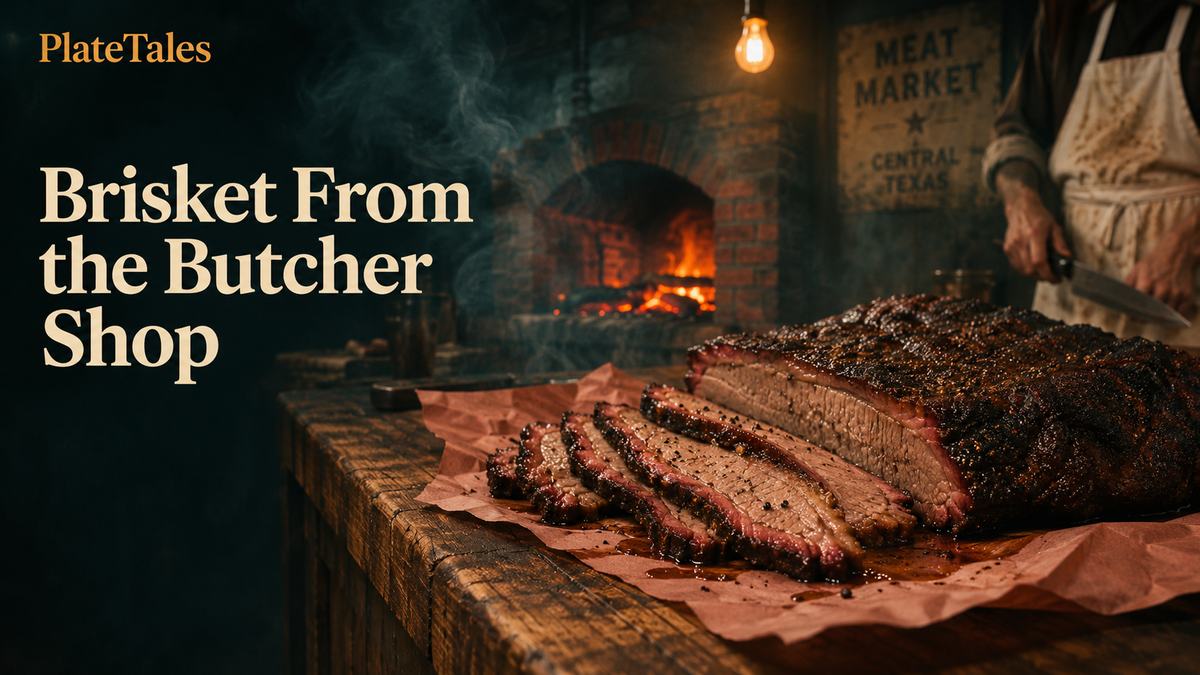
Texas brisket starts in the meat markets that German butchers ran in small Central Texas towns around 1900, where meat that had not sold during the week was smoked and handed over the counter by the pound. Brisket itself came late to that counter. It became the cut Texas is judged by only after big packers began selling boxed beef in the early 1970s, and the real boom waited until Austin pitmasters of the 2000s made it famous.
Texas brisket history begins with leftover meat
The best-documented starting point is Kreuz Market in Lockhart. The Texas Historical Commission, in an article first printed in its magazine The Medallion in July/August 2005, says Kreuz has served barbecue since 1900, when the family opened it as a grocery and butcher shop. Keith Schmidt, the general manager at the time, told the writer that the market still prepared and served its meat almost the way it had a century earlier.
The logic was plain. Before home refrigeration, a butcher who could not sell a cut either lost it or smoked it. Wyatt McSpadden, writing in Texas Co-op Power in March 2015, describes early markets smoking meat to stop spoilage, then watching barbecue income pass what the fresh counter earned. In time the smoked meat became the business, and the butcher counter faded.
The surviving names show how long this took. Kreuz and City Market in Luling and Giddings still carry "market" in their names, McSpadden notes, though they no longer butcher fresh meat.
Who ate it, and why it came on butcher paper
The Commission's article leans on the food writer Robb Walsh, who argued that modern Texas barbecue was shaped mainly by southern African American cooking customs and German meat markets. Walsh's account of the lunch plate is specific: African American and Mexican American cotton pickers bought sausage and ribs from German butcher shops in small Central Texas towns.
Many of those workers were barred from restaurants in the early 1900s. So after payday they bought smoked meat wrapped in butcher paper and ate it at the market, with their hands. Customers ordered by the pound and took crackers or bread with a pickle or an onion from the grocery shelves. Walsh noted that the workers called what they bought "barbecue," not German sausage fare.
Kreuz kept that style. The Commission reports that it used no silverware and no sauce, with Schmidt arguing that sauce can hide the flavor of the meat. In a 2007 oral history for the Southern Foodways Alliance, recorded by Eric Covey, Rick Schmidt, born in 1945 and raised in his father's market, put it more simply for customers who ask for sauce: "You taste it and see if you need it."
Czech names on the courthouse square
Why do Czech butchers belong in this story? The record in these sources is thinner than the popular version. The Commission's article names German meat markets and does not mention Czechs at all.
What McSpadden saw in La Grange is suggestive rather than conclusive. Prause Meat Market, on the Fayette County courthouse square, was founded in 1904 by Arnold Prause, who was born in Prussia, and moved to its present side of the square in 1953. McSpadden lists customer surnames there, Wanjura, Machicek, Dvorak and Schmidt, and suggests they belong to descendants of early German, Polish and Czech settlers. That is the community that bought the meat, though, not proof of who first smoked it.
The bigger story is migration. Families who left central Europe in the 1800s brought butchery with them. For the wider pattern, see how immigration changed American food, or browse the migration stories section.
Texas brisket was not the star yet
Anyone who assumes brisket was always the point is reading the present backward. The Commission, again drawing on Walsh, says Texas had abundant cattle after the Civil War and that cooks reached for cheaper beef. West Texans used lesser cuts over open pits, a method called cowboy style. East Texas cooks sometimes swapped beef in for the pork they would otherwise have smoked, because beef was cheaper.
Brisket gets only a modest mention. The Commission says it was thought to be somewhat self-basting.
A 2021 Marketplace report gives a date for the change. Tootsie Tomanetz started making barbecue at Snow's BBQ in Lexington in the 1960s, and in those years, the report says, brisket was seldom discussed and was mostly ground into hamburger. In the early 1970s the big meat packers began selling individual boxed cuts instead of whole carcasses, which made brisket easy to buy. Walter Jetton, Lyndon Johnson's barbecue man, told customers to buy boxes of briskets, calling it the self-basting cut for its fat cap.
Even then it took decades. Marketplace credits Daniel Vaughn, barbecue editor of Texas Monthly, with the explanation: Aaron Franklin began selling brisket in Austin about 2009, and the spread of photographs of its moist slices lifted the cut's reputation. So the boxed-beef story is only half true. Packaging made brisket cheap and available. It did not make it famous.
The Jewish brisket question
Brisket has a second history, in Jewish cooking, and the two may have touched in Texas. Moment Magazine reported in November 2021 that Vaughn had found intriguing evidence that smoked brisket in the early twentieth century came about in part when Texas butchers began offering it to Jewish customers. The article gives no towns or menus, so treat the claim as a lead rather than a settled fact.
What the evidence does not support is a single clean line from one kitchen to the next. German markets, African American cooking customs and Jewish customers all seem to have had a hand, and the sources do not rank them.
Price, and a different market
The cut that was once ground into burger meat is expensive now. In 2021, Marketplace reported, Franklin Barbecue charged $34 a pound for the brisket that helped it win a James Beard Award, and the owner said normal margins would put it nearer $80. In Cameron, pitmaster Jamie Galvan started at $16 a pound and found customers balked.
Pork barbecue followed other paths. For ribs, see the history of barbecue ribs, and for another smoked meat, pulled pork. The American steakhouse is the other place where beef became a restaurant business.
Prause Meat Market was still on the La Grange square when McSpadden wrote about it in 2015, run by the fourth generation of the family.
Questions people ask
Why is Texas known for brisket?
Texas barbecue grew out of German butcher shops in Central Texas that smoked unsold beef around 1900. Brisket became the signature cut later, once packers sold boxed cuts in the early 1970s and Austin pitmaster Aaron Franklin made it famous from about 2009, according to Marketplace.
Who started Central Texas barbecue?
German meat market owners did, according to the Texas Historical Commission, citing food writer Robb Walsh. Kreuz Market in Lockhart has served barbecue since 1900. African American and Mexican American cotton pickers were early customers, buying smoked meat on butcher paper after payday.
Were Czech butchers part of it?
Czech families lived in the same Central Texas towns, and customers at Prause Meat Market in La Grange carry surnames such as Dvorak and Machicek. The Texas Historical Commission's account, however, credits German meat markets and does not name Czech butchers.
Did Jewish cooks influence Texas smoked brisket?
Possibly. Moment Magazine reported in 2021 that Daniel Vaughn of Texas Monthly found evidence that early twentieth century smoked brisket partly came from Texas butchers serving Jewish customers. The article gives no specific towns or menus, so the link is not settled.
Filed under Migration Stories
Want more stories like this?
One food history story, every week. No spam, just the stories behind what the world eats.