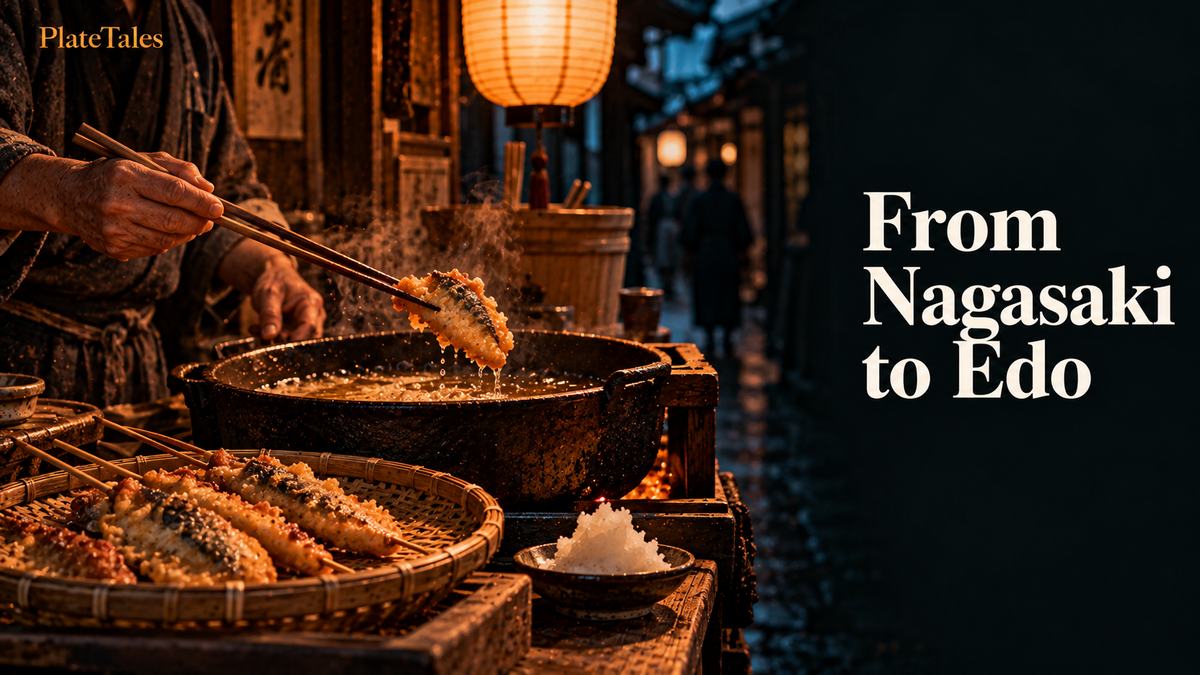
Tempura is both Portuguese and Japanese, in that order. In the late 16th century, in the port of Nagasaki, Portuguese sailors or missionaries showed Japanese cooks how to coat food in wheat-flour batter and fry it, and the word itself most likely comes from Portuguese. The thin, crackling tempura you dip in sauce today was worked out later, by street cooks in Edo, the city now called Tokyo.
Several of the best-known parts of the story, including the Lenten green beans and the shogun killed by fried fish, hold up less well than the outline.
Where does tempura come from? Japanese frying before the Portuguese
Japan did not need Europeans to discover hot oil. Fried dishes reached Japan from China between the Nara and Heian periods, roughly the 8th to the 12th centuries, and their coatings were made from rice flour. The claim that early Japanese fried food went into the oil bare is unsourced, so treat it with care.
What Japan did not have was a wheat batter of the kind Portuguese cooks used. That is the specific thing that arrived by sea.
1543: who brought tempura to Japan?
The first Portuguese to reach Japan came by accident. According to the Teppoki, a chronicle written in 1606, a ship with about a hundred people aboard drifted onto Tanegashima, an island off the southern tip of Kyushu, in 1543. Nobody on the island could speak with the crew. A local official managed it by writing Chinese characters back and forth with a Ming Chinese scholar on board called Goho. Among the passengers were Portuguese traders carrying guns, which is why the landing is remembered.
The Japanese called these newcomers Nanban, "southern barbarians". The word was borrowed from Chinese and had been used for centuries for peoples to the south; now it was pinned on the Portuguese and Spanish. The Portuguese were in Asian waters for spices, the trade told in our story of how black pepper built empires. From 1571, Nagasaki was their main port in Japan, and the base of the Jesuit mission.
So who carried the batter? The usual accounts of peixinhos da horta name two sailors, Antonio da Mota and Francisco Zeimoto. Those are the names usually given for the Portuguese castaways of 1543, men remembered for guns, decades before Nagasaki opened to Portuguese ships. Nothing in the early cookbook record links them to frying.
The Michelin Guide's history credits Portuguese Catholic missionaries. Other accounts, more cautiously, say sailors or missionaries. Nobody wrote down the name of the first cook, and "the Portuguese in Nagasaki" is as precise as the evidence allows.
Peixinhos da horta, the Portuguese tempura
The Portuguese dish usually offered as tempura's ancestor is peixinhos da horta: green beans dipped in a wheat-flour batter and fried, sometimes with bell peppers or squash instead. The name means "little fish from the vegetable garden", because the battered pods look like small, bright fish.
The popular story adds a religious motive. Catholics gave up meat during Lent and on the Ember Days, four sets of fast days a year that Latin called the quattuor tempora, the "four times". Fried vegetables that looked like fish made sense on a day without meat.
The link is plausible and widely repeated. It is also mostly inference. No surviving 16th-century document shows a Portuguese cook frying green beans for a Japanese one. What the record does show is that batter-frying came to Japan with the Portuguese, and that the earliest Japanese version used ingredients that look European.
Battered fish went west from the Iberian Peninsula too. Spanish and Portuguese Jews who settled in England are credited with the fried fish that became half of fish and chips.
Nagasaki tempura, sweet and fried in lard
The Michelin Guide puts the first Nagasaki tempura in the late 16th century, the Azuchi-Momoyama period. It was not the tempura of a modern Tokyo counter. Sugar went into the flour and sake into a thick batter, and the pieces were fried in lard. Because the batter was already seasoned, it was eaten as it came.
From Nagasaki the method moved east in the 17th century to Kamigata, the Kyoto and Osaka region. There, Michelin says, battered fried food was called tsukeage. Kyoto was a Buddhist city, so the cooks fried vegetables in sesame and other plant oils, and the result was called shojin tempura, after the meatless cooking of Buddhist temples.
The word also wandered. In western Japan, "tempura" can still mean fried fish paste with no batter at all, the thing Tokyo calls satsuma-age. The food historian Naomichi Ishige's The History and Culture of Japanese Food records this.
1616: did tempura kill Tokugawa Ieyasu?
The most famous tempura story is about a death. The Tokugawa Jikki, the official chronicle of the shogun's family, tells it like this. On the 21st day of the first month of 1616 (by the Japanese calendar), the retired shogun Tokugawa Ieyasu was out hawking at Tanaka in Suruga province. He asked the merchant Chaya Shirojiro what people were eating in Kyoto and Osaka.
Chaya described sea bream fried in kaya oil, pressed from the nuts of the Japanese torreya tree, with grated garlic chives on top. A retainer, Sakakibara Kiyohisa, had just presented a sea bream, so Ieyasu ordered it cooked that way and ate it. That night he had stomach pains.
He died at Sunpu Castle on the 17th day of the fourth month, June 1, 1616 in the Western calendar, almost three months later. That is far too long for food poisoning. The same chronicle records that he grew thin fast, vomited blood, passed black stools and had a lump in his belly you could feel by hand. His chief physician, Katayama Sotetsu, diagnosed stomach cancer. Ieyasu decided he had a tapeworm, refused the doctor's medicine and dosed himself. Stomach cancer is the usual modern reading.
There is a second problem. Some accounts of Ieyasu say the Tanaka fish, though remembered as tempura, had no batter and was closer to karaage, plain fried fish. So tempura probably did not kill Tokugawa Ieyasu, and what he ate may not have been tempura.
The story had a long life anyway. Cooking tempura was later banned inside Edo Castle, and the ban was sometimes explained as a taboo born of Ieyasu's death. A duller reason is also given: a maid in the women's quarters nearly started a fire frying it.
Why is tempura called tempura?
The word shows up in Japanese writing in 1669, as "tenpura", in a book called the Shokudoki. In 1671 the Ryori Kondate-sho describes a method close to today's. In 1693 a samurai's diary, the Omu Rochu-ki, lists tempura as a dish to go with drinks, without saying what it was.
Where the word came from is a longer list:
| Theory | Source word | Meaning |
|---|---|---|
| Fast days | tempora (Latin), temporas (Spanish) | "times", the Ember Days |
| Seasoning | tempero (Portuguese) | seasoning, the Oxford English Dictionary's choice |
| To season | temperar (Portuguese) | to season or temper |
| Temple food | templo (Portuguese) | temple, as in vegetarian temple cooking |
The Ember Days theory is the favorite of travel features, and it fits the green-bean story neatly. The Oxford English Dictionary prefers tempero: "Japanese, probably < Portuguese tempêro seasoning." Both point to Portuguese, the part nearly everyone agrees on. Neither comes with a document showing a Japanese speaker borrowing the word, so the OED hedges with "probably", and so should we.
Edo writers had their own explanation. The author Santo Kyoden credited a ronin, a masterless samurai, who drifted into Edo from Tenjiku, the old name for India, and started frying. "Tenjiku ronin" was a pun on chikuden ronin, a ronin who has run off. It is generally filed as an invented origin story.
Edo stalls and the batter that won
When tempura reached Edo is another place where the sources disagree. Some histories date it to the early 17th century, around Tokyo Bay. Michelin says the late 18th. Another account says that after the shogunate was founded in Edo, fish from the Nihonbashi market was fried in sesame oil and sold to ordinary people.
The dated record fills in later. Recipes appear in the Kokubyaku Seimishu of 1746 and the Kasen no Kumiito of 1748. Between 1804 and 1806 the artist Kuwagata Keisai drew a tempura stall.
What Edo did to the dish is clearer. Edo was built of wood and paper, and hot oil was hard to control and harder to put out once it caught. So tempura was mostly fried at outdoor stalls. Customers stood and ate it off skewers, which kept their fingers clean, dipping it in a shared sauce with grated daikon.
Cooks used sesame oil to cover the smell of fish, and seafood from the bay was the main ingredient. The batter lost its sugar and sake, and Michelin credits Edo with mixing the flour with water. Tempura sat beside soba and sushi as the fast food of the city, a street culture you can read more about in our history of sushi.
Tempura shops with their own premises appeared shortly before the end of the shogunate in 1868. In the Meiji years that followed, the stall snack moved upmarket. After the 1923 Kanto earthquake, out-of-work Tokyo cooks spread Edo-style tempura around the country, and Kansai cooks who came to Tokyo brought their habit of eating vegetable tempura with salt.
That split survives. Kanto batter uses egg, and the tempura goes into hot sesame oil and then a dipping sauce. Kansai batter has no egg, is fried slowly in salad oil and is eaten with salt.
English picked up the word in the travel books. Basil Hall Chamberlain's Handbook for Travellers in Japan of 1894 lists "sakana no tempura, fish fritter" among the foods most foreigners find palatable. The Oxford English Dictionary's first citation is from the Japan Advertiser on August 22, 1920, which explained it as "dipping in thin wheat-flour batter and frying in deep oil."
Questions people ask
Why is tempura called tempura?
The word most likely comes from Portuguese, but scholars disagree on which word. The Oxford English Dictionary prefers tempero, "seasoning". Other theories point to the Latin tempora, the Ember Days of Catholic fasting, or to templo, "temple". Tempura first appears in Japanese writing in 1669, and no document shows how the word was borrowed.
Who brought tempura to Japan?
Portuguese sailors or missionaries brought wheat-flour batter frying to Nagasaki in the late 16th century. Nobody recorded the name of the first cook. Michelin credits Catholic missionaries, while other accounts say sailors or missionaries. The Portuguese had reached Japan in 1543, and Nagasaki became their main port from 1571.
Did tempura kill Tokugawa Ieyasu?
Probably not. In 1616 the retired shogun ate fried sea bream and fell ill that night, but he died almost three months later. His physician diagnosed stomach cancer, which is the usual modern reading. Some accounts also say the fish he ate had no batter and was closer to plain fried fish than to tempura.
What is the Portuguese dish that tempura came from?
The usual candidate is peixinhos da horta, "little fish from the vegetable garden", which is green beans dipped in wheat-flour batter and fried. The link to tempura is plausible and widely repeated, but it is mostly inference. No surviving 16th-century document shows a Portuguese cook frying green beans for a Japanese one.
How is Edo-style tempura different from Nagasaki tempura?
Nagasaki tempura of the late 1500s had sugar and sake in a thick batter and was fried in lard, so it was eaten without a sauce. Edo cooks dropped the sugar and sake, mixed the flour with water and fried seafood from Tokyo Bay in sesame oil at street stalls, serving it with a dipping sauce and grated daikon.
Filed under Origin Stories, Trade Routes
Want more stories like this?
One food history story, every week. No spam, just the stories behind what the world eats.