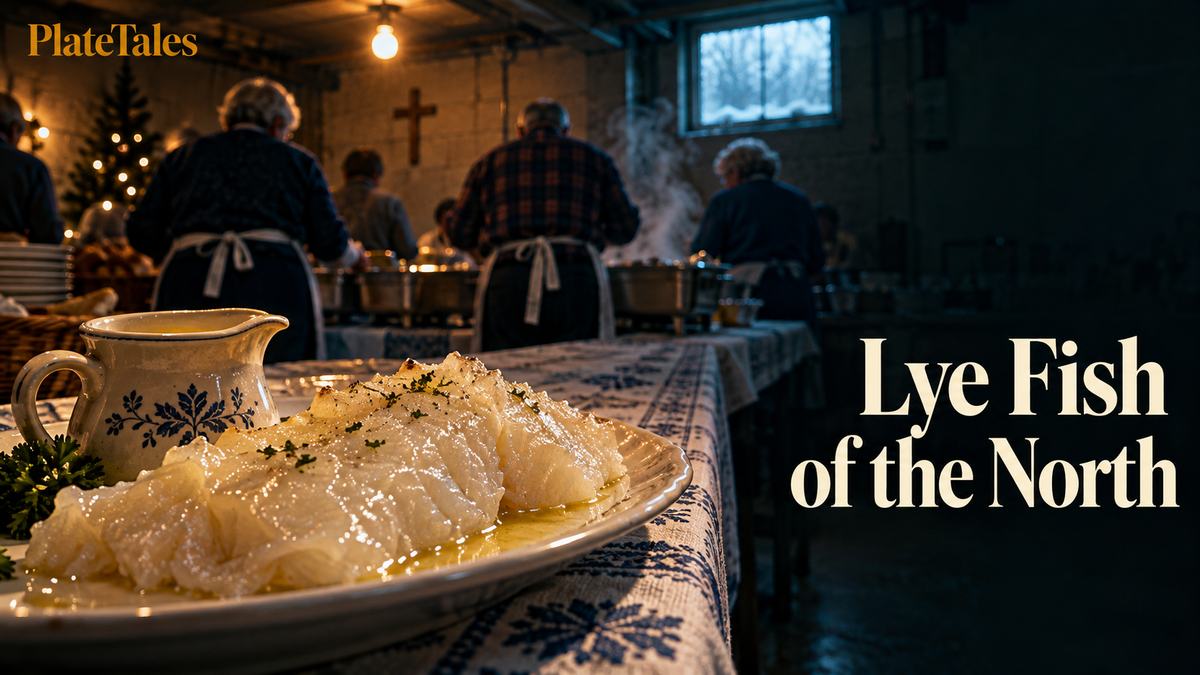
Lutefisk history goes back at least to 1555, when Olaus Magnus, the exiled Catholic archbishop of Uppsala, described dried stockfish soaked in strong lye, rinsed and served with butter. The name is plain Norwegian: lut means lye and fisk means fish. Nobody knows who first did it, and Scandinavians were eating it for centuries before any Norwegian reached Minnesota.
The fish itself is dried cod (in Sweden more often ling or saithe), soaked in water, then in a lye solution, then in water again until it turns soft and almost clear. In the version most Americans have heard, it was a poverty food that Norway dropped while its emigrants in the Midwest held on, so that more of it is now eaten in church basements than in Scandinavia. Parts of that hold up. The headline claim does not.
What is lutefisk, and why is it soaked in lye?
Start with the fish. Norway has dried cod on outdoor racks since at least the Viking Age, with no salt, only cold air and wind. The 13th-century Icelandic Egil's Saga has the chieftain Thorolf Kveldulfsson shipping stockfish from Helgeland to Britain in 875. Stockfish stayed Norway's great export through the Middle Ages.
Properly dried, a cod becomes a board. It keeps for years, and it is very hard to eat. Lye softens it. The alkali breaks down protein and swells the flesh.
The modern method runs like this: five or six days in cold water changed daily, two days in water with lye, then about ten more days in cold water to wash the lye out. Straight from the lye bath the fish has a pH of 11 to 12 and is poisonous. That is why the last rinse takes longest.
Cooks have never agreed on the lye time. Hanna Winsnes, whose household manual first came out in 1845 and was reprinted for decades, called for six to eight days in the 1860 Christiania edition. Henriette Schønberg Erken's Stor kokebok of 1949 called for two or three. Nineteenth-century lutefisk was probably a good deal softer than the modern kind.
The Viking fire story, tested
Ask how lye and fish first met and someone will mention Vikings. The version Erika Janik told in Smithsonian in 2011 has Viking fishermen hanging cod on birch racks and raiders from a neighboring village setting the racks alight. A rainstorm puts out the fire, and the fish lies for months in rainwater and birch ash until hungry villagers rinse it, cook it and find it edible.
Store norske leksikon, the Norwegian national encyclopedia, gives a shorter cousin of the tale: a birch rack catches fire, someone throws water on it, and the ash turns to lye. No document backs either version. It has the shape of every accidental-discovery story (compare the cases in our piece on foods invented by accident).
The duller explanation is wood ash. Ash steeped in water makes lye, and ash was within reach of every hearth. The oldest printed Danish cookbook, the Koge Bog of 1616, notes that a handful of ash in the cooking water will shorten the cooking of dried fish that has not soaked long enough.
Store norske leksikon adds a second practical theory. Lye may have been used to wash poor stockfish that was infested with fly larvae and microbes. The encyclopedia itself says that theory has nothing to do with how lutefisk is made today, and neither idea is proven.
The earliest records of lutefisk, from a bishop's table to a king's
The oldest Swedish trace comes from Linköping. Hans Brask, bishop there from 1513 to 1527, is said to have eaten lutfisk during Lent with almonds, raisins and peas. It is a story handed down, not a document, but the setting is telling: a fast-day dish on a prelate's table.
The first description in print is the one by Olaus Magnus. He was named archbishop in 1544, though only in title, since Sweden had turned Lutheran and he lived in Rome. His History of the Northern Peoples was printed there in 1555. It has the stockfish lying two days in strong lye and a day in fresh water before it is cooked and served with salted butter. By one account he added that it could be served even to kings.
Later Swedish records keep it near the top of the table. The court of Gustav III, who reigned in the late 1700s, ate the soaked fish all through the spring. At peasant weddings in Skåne, which ran for a week, it was served every day.
So where did it begin? Accounts differ. One view is that the dish probably came from the Netherlands and northern Germany. Store norske leksikon says only that the origin is disputed, and that lutefisk has no provable home region inside Norway. The second position is the safer one. The Low Countries claim comes with no evidence attached, while the records that do exist, from Brask to the 1616 Danish book to Iceland's oldest cookbook of 1800, are all Nordic. (The Icelandic recipe was itself borrowed from Norway.)
Why do Norwegians eat lutefisk at Christmas?
The church once told them to eat fish. Store norske leksikon explains that before the Reformation reached Norway in 1536, a fast ran from 1 December until Christmas Day, and only fish was allowed. Stockfish was the fish a household could store through the winter, and lye made it soft enough to cook.
The fast ended with the Lutheran church, but the Christmas fish stayed. Lutefisk, cod and halibut are still the Christmas Eve fish in many Norwegian families. Many Norwegians also hold lutefisk dinners in the weeks before Christmas, in a season that starts in early November.
That is the same calendar the Midwest keeps. The American church supper did not have to be invented; it came over with the people, like a good deal of what is covered in how immigration built American food culture.
Lutefisk history in America: Minneapolis, Northfield and Madison
More than 800,000 Norwegians emigrated to North America between 1825 and 1925, about a third of Norway's population, mostly to the United States. The 950,000 figure that circulates online is higher than the standard count.
Settlement moved northwest. Illinois and Wisconsin came first, Iowa and Minnesota in the 1850s and the Dakotas by the 1870s. In 1910, almost 80 percent of the million or so Norwegian Americans lived in the Upper Midwest.
The American dates are specific:
| Year | What happened |
|---|---|
| 1910 | Olaf Olsen and John Norberg, both from Norway, found Olsen Fish Company on the north side of Minneapolis, processing pickled herring and lutefisk |
| 1912 | St. Olaf College in Northfield, Minnesota, holds its first lutefisk dinner |
| 1929 | Mount Olivet Lutheran Church in Minneapolis starts its dinner, at 29 cents a plate |
| 1982 | Madison, Minnesota, pushes to be named "Lutefisk Capital of the United States" |
Madison has since put up a 25-foot fiberglass cod named Lou T. Fisk, paid for by its chamber of commerce. Up in Canada, the hamlet of Kingman's welcome sign calls it the lutefisk capital of Alberta.
The supper is where the dish became a ritual. Tove Danovich, reporting for NPR in 2016, found that Mount Olivet's dinner on the first Friday in December fed about 1,500 people. It took 1,200 pounds of lutefisk, 400 pounds of ground beef for meatballs, 50 pounds of lingonberries and more than 1,000 pounds of potatoes and rutabagas.
Toppings split along old lines. In Norway they run to bacon, peas, sauce, syrup and even goat cheese. At American dinners, NPR found, Norwegians pour on melted butter, "treating it a bit like lobster," while Swedes want white sauce.
The jokes became part of the dish too. Garrison Keillor gave it a famous line in Lake Wobegon Days: "Every Advent we entered the purgatory of lutefisk, a repulsive gelatinous fishlike dish that tasted of soap." St. Olaf's executive chef, Matthew Fogarty, who is Irish and serves nearly 800 pounds of it a year, told NPR: "I've always said lutefisk is just an easier way to get butter and cream to your mouth faster."
Do people in Norway still eat lutefisk?
Yes, by the thousand tonnes. Norwegians ate about 2,600 tonnes in 2004, roughly 2,000 at home and 600 in restaurants. Total consumption has been above 2,000 tonnes every year since 2000, and more than 3,000 tonnes were sold in 2008.
The Norwegian Seafood Export Council reported that sales to restaurants and caterers rose 72 percent between 2005 and 2008. In December 2009, NRK ran a story headlined "Lutefisk er trendy" (lutefisk is trendy). Its first line said Norwegians eat more lutefisk in one Christmas season than cod in a whole year. The market leader, Brødrene Andreassen in Oslo, expected to sell up to 500 tonnes that season alone.
Set that beside the American side. The biggest church supper in the NPR story uses 1,200 pounds, a little over half a tonne. NPR called Olsen Fish the only high-volume lutefisk processor left in the United States, and no source found here gives a credible national total. Without one, the claim that America out-eats Scandinavia is a good line with nothing under it, and the Norwegian figures make it look unlikely.
What is true is narrower. Lutefisk is not the main Christmas meal for most Norwegians. A 2005 survey found that 20 percent ate it during the Christmas season, but only 3 percent would consider it for Christmas dinner. NPR's line that most Scandinavians no longer eat lutefisk overstates that.
The American tradition is the one shrinking. Chris Dorff, president of Olsen Fish, told NPR in 2016: "We see a drop of 5 percent a year." He also said: "It's such an aging population of people doing it." Olsen had tried a lutefisk TV dinner in the early 2000s to reach younger buyers, and by 2016 it had been off the shelves for several years.
Questions people ask
Is lutefisk dangerous to eat?
Lutefisk is safe once it has been rinsed properly. Straight from the lye bath the fish has a pH of 11 to 12 and is poisonous, which is why the modern Norwegian method ends with about ten days in cold water to wash the lye out. The long final rinse is what makes it edible.
What is lutefisk traditionally served with?
Toppings vary by place. In Norway, lutefisk comes with bacon, peas, sauce, syrup and even goat cheese. At American church dinners, NPR found that Norwegians pour on melted butter, while Swedes want white sauce. Olaus Magnus described it served with salted butter back in 1555.
Do Swedes and Norwegians use the same fish for lutefisk?
Not always. Lutefisk in Norway is made from dried cod, while in Sweden the fish is more often ling or saithe. The method is the same in both countries: the dried fish is soaked in water, then in a lye solution, then in water again until it turns soft and almost clear.
Why is lutefisk eaten at Christmas?
Before the Reformation reached Norway in 1536, the church kept a fast from 1 December to Christmas Day in which only fish was allowed. Stockfish kept through winter, and lye softened it for cooking. The fast ended, but the fish stayed, and lutefisk dinners are still held in the weeks before Christmas.
Filed under Ritual Foods, Migration Stories
Want more stories like this?
One food history story, every week. No spam, just the stories behind what the world eats.