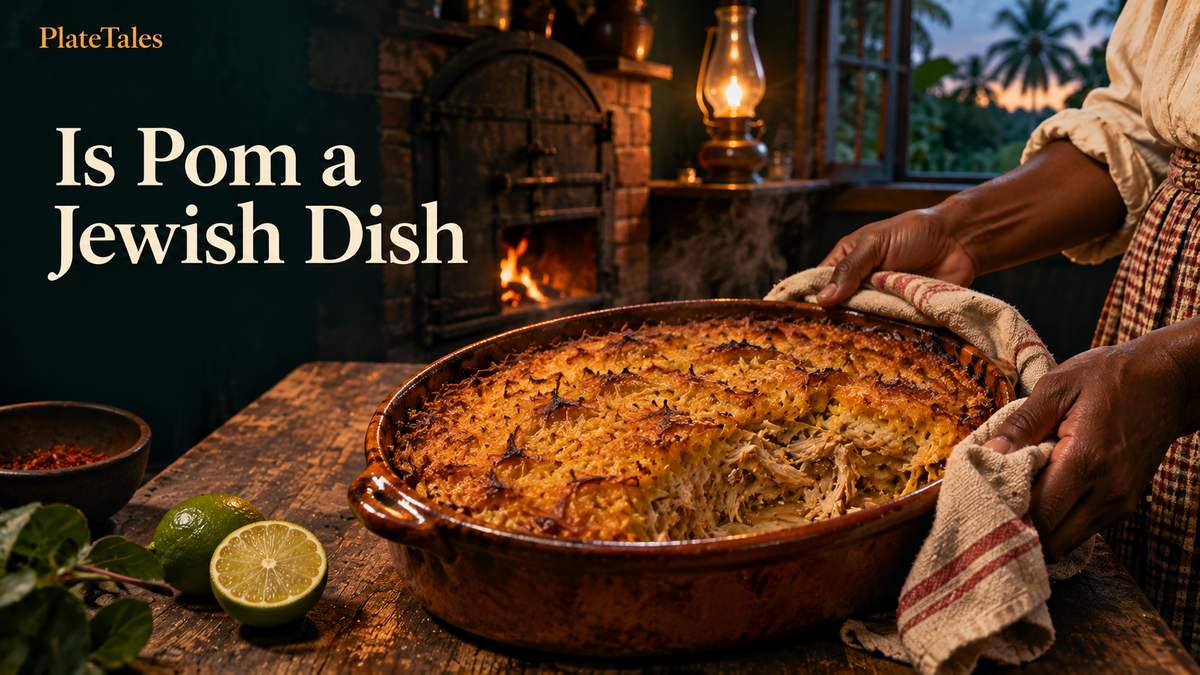
Surinamese pom is a baked dish of grated tayer root, chicken and citrus juice, and its history points to Suriname's Jewish community, though nobody has found the recipe that proves it. The strongest case rests on a 2007 argument from a Dutch curator, Karin Vaneker, which she made in the newspaper Trouw. She read the oven, the citrus and the starchy root as signs of a Jewish dish that adapted to a tropical country. It is a reasoned theory, not a documented fact, and many Surinamese people dispute it.
Surinamese pom history starts with a root, not a recipe
Pom is an oven dish. The base is the grated corm of the tayer plant (Xanthosoma sagittifolium), which Surinamese and Dutch cooks call pomtayer or pongtaya. Chicken is cooked in advance with spices and mixed in, and the whole thing is baked in an ovenproof dish. It is a main course for birthdays, family gatherings, Easter and Christmas, served with white rice and vegetables, or put on bread as a broodje pom.
The plant itself is American. The plant is native to tropical America, and the smaller corms are cooked much like potatoes. In Suriname and the Netherlands the root is called tayer, and that the shredded root is baked with chicken, fruit juice, salted meat and spices to make pom. Pomtayer was once eaten only by South America's original inhabitants.
So the ingredient is Amerindian in origin, while the claim of Jewish origin is about the method and the dish's shape.
Who were Suriname's Jews, and when did they arrive?
Spanish and Portuguese Jews began to settle in the region from 1639, by most accounts. A group arrived in 1652, and many of them were planters from Pernambuco in Brazil who knew sugarcane. A third group came in 1664 under David Cohen Nassy after being expelled from Recife and French Guiana. In 1665 the English granted them freedom of religion and their own court and civic guard, and the Dutch kept those rights when they took the colony in 1667.
They built a settlement at Jodensavanne, up the Suriname River, where the Sephardic synagogue Beracha Ve Shalom went up in 1685. Paramaribo got an Ashkenazi synagogue, Neveh Shalom, in 1719 and a Sephardic one, Zedek ve Shalom, in 1735. A fire on 10 September 1832 destroyed the Jodensavanne village and its synagogue, by which time most Jews had moved to the capital.
This was a sugar society, and the sugar plantations ran on enslaved labor, as the Pernambuco ones had. The same source says Sephardic men often had children with enslaved African women and raised them as Jews, and that by the late 1700s about a tenth of the Jewish community was not white. The kitchens of Jewish households, in other words, were staffed and sometimes shared by people who were not Jewish by birth. That is the setting in which any recipe would have moved between cooks. For the wider sugar story, see the history of sugar.
Vaneker's argument from Trouw
Waterkant, a Suriname news site, reprinted the Trouw interview on 28 June 2007 under the headline "Pom van oorsprong Joods gerecht". Vaneker, introduced as a curator, was quoted at length. Her reasoning has four parts.
First, Jews were in Suriname from the middle of the 16th century, she said. The usual dates for Jewish settlement start later, in 1639, so that line of her argument is shaky.
Second, Jews in Europe already ate potatoes when most other Europeans still looked down on them, and plants are never forbidden by Jewish dietary law, so the potato went into everything. (The wider European story is in how potatoes changed Europe.)
Third, the oven. She pointed to the Sabbath stew, sjalet or cholent, chicken and potato put in the oven on Friday afternoon and served on Saturday by a non-Jewish helper. Africans and Amerindians, she said, cooked mostly on open fires and did not use ovens.
Fourth, citrus. Pom is prescribed with citrus juice, and she called rubbing chicken with citrus juice to soften it typically Jewish.
Potatoes do not grow naturally in the warm subtropics, she said, but tayer looks a little like one. Her conclusion, in her own phrasing as reported: on the basic ingredients and the cooking method, she was convinced pom was originally a Jewish dish.
Why the claim is still open
The reaction under the Waterkant article, which ran to dozens of comments over the following years, shows how contested this is. Some readers agreed. Others said a curator's inference was not evidence, that tayer is nothing like a potato in size or taste, and that the dish was a Creole creation. One reader pointed out that the claim leaned on oral tradition and asked for old family cookbooks from the 19th or early 20th century. Another asked a simple question: if pom were Jewish, where is the Jewish recipe today?
That last point is fair. The sources opened for this article contain no dated recipe, no cookbook and no archive record of pom before the 20th century. The Jewish origin is sometimes stated as fact, but the only citation behind it is the same 2007 Trouw piece. Accounts differ: other descriptions of Surinamese cuisine call pom a popular party dish "of Creole origin", also without citations. What can be said is that the idea is old enough to be a family story, that it has one public advocate with an argument, and that it has never been checked against written records.
One tale circulates in the comments: a Jewish master demands potato pom, the cook finds the tayer in the forest, and he likes it better. It is posted with no source, and nothing here backs it.
From Paramaribo to the Dutch birthday table
Whatever its origin, pom traveled with the people who cook it. Migration from Suriname to the Netherlands started in the colonial era among the elite, widened in the 1920s and 1930s, and surged in the years around independence in 1975. More than 100,000 Surinamese have come since 1975, and about 365,000 people of Surinamese descent in the Netherlands in 2023, the largest Caribbean community in Europe. The biggest groups live in Amsterdam, Rotterdam and The Hague.
In the Netherlands cooks could not always get fresh tayer, so ready-grated, frozen pomtayer is sold there. Pom is eaten across Suriname's population groups, much like roti. A dish that could have been a Sephardic plantation oven recipe became a birthday dish in the Netherlands. (For another birthday table, see why we have birthday cake.) It often arrives with white rice, the other great starch of the region; see the history of rice.
In Suriname's Jewish community itself, the numbers fell after 1975. A later census counted 181 people identifying as Jewish out of about 560,000, while Neveh Shalom in Paramaribo remains the only functioning synagogue.
Questions people ask
Is pom a Jewish dish?
Possibly, but it is unproven. In 2007 the Dutch curator Karin Vaneker told the newspaper Trouw that pom's oven cooking, citrus juice and potato-like root make it originally Jewish. No dated recipe or archive record has been found, and other descriptions call pom a Creole party dish.
What is pomtayer?
Pomtayer, also called pongtaya or tayer, is the grated corm of the plant Xanthosoma sagittifolium, which is native to tropical America. In Suriname and the Netherlands it is the base of pom, baked with chicken, citrus or fruit juice and spices. Frozen grated pomtayer is sold in the Netherlands.
Why do Surinamese people in the Netherlands eat pom at birthdays?
Pom is a main course for birthdays, family gatherings, Easter and Christmas in Suriname and in the Netherlands. About 365,000 people of Surinamese descent lived in the Netherlands in 2023, mostly after migration around independence in 1975, and they kept the dish as a party food.
When did Jews settle in Suriname?
Spanish and Portuguese Jews began settling in the area from 1639, and a group of planters from Pernambuco, Brazil arrived in 1652. The English granted them religious freedom in 1665, and the Dutch kept those rights from 1667. Their Jodensavanne settlement had a synagogue by 1685.
Filed under Migration Stories, Cultural Identity
Want more stories like this?
One food history story, every week. No spam, just the stories behind what the world eats.