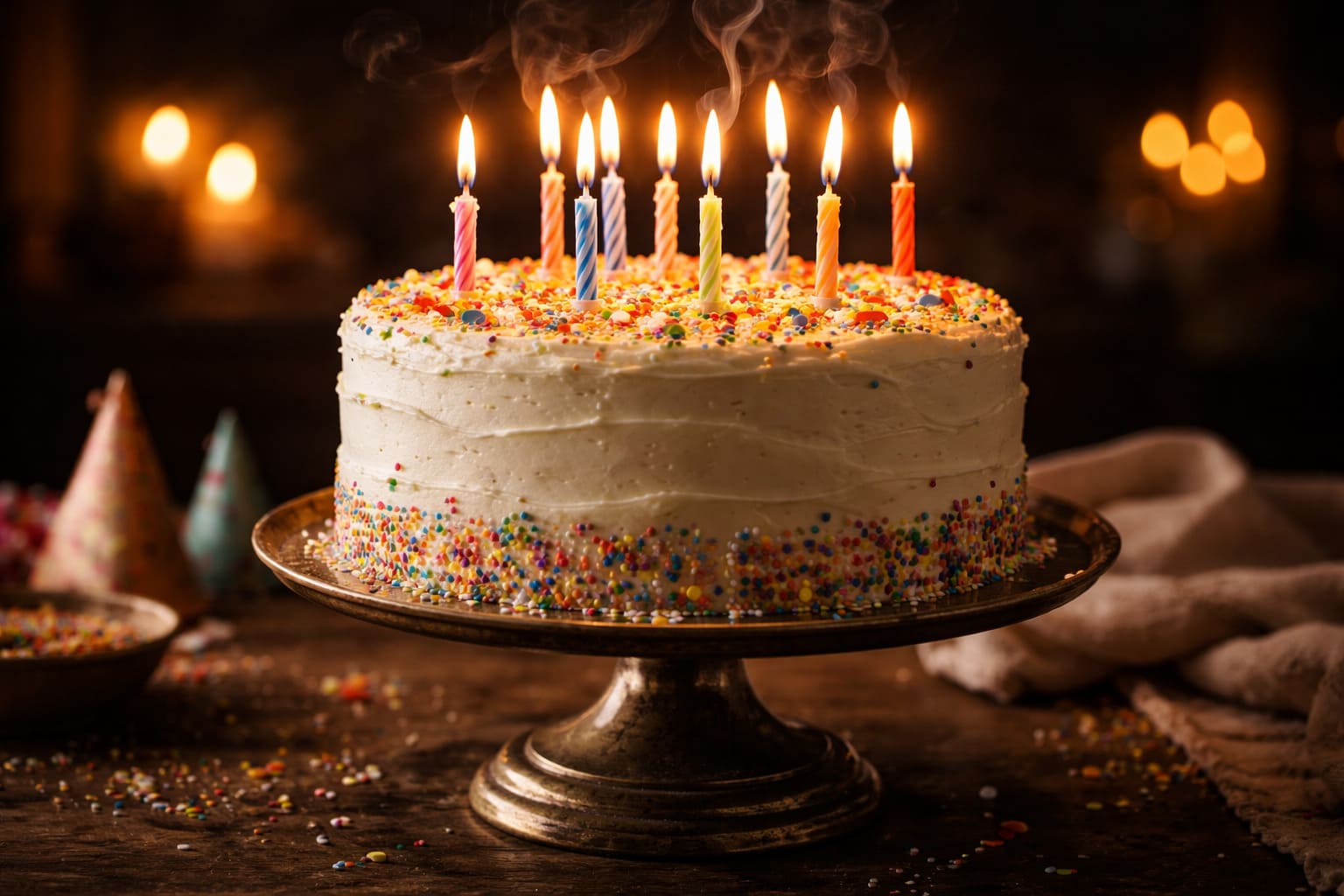
We eat cake on birthdays because, somewhere between ancient ritual offerings and eighteenth-century German noble households, a special baked treat with candles became the way to mark a person's day. The best-documented birthday cake with candles is from 1746, in Germany. The popular claim that the ancient Greeks started it is much shakier.
Nobody recorded the moment someone first put a candle on a cake. What survives is a trail of scattered clues, some solid and some wishful, and it is worth walking it carefully.
What the Greek moon-cake story actually rests on
You will read everywhere that Greeks baked round honey cakes for Artemis, lit candles on them to look like the moon, and carried the smoke of prayers to the heavens. One modern theory ties candles to Artemis's birth on the sixth day of each lunar month. Even the sources that mention the theory say the link has not been established.
The real ancient text is smaller. Athenaeus, a writer of the second century AD, quotes earlier comic poets about the amphiphon, a flat cake of flour and cheese with torches set around its edge, brought to the sanctuary of Artemis Munychia at Piraeus. A food-history site that traces the claim describes it as a temple offering, not a birthday treat, and notes that no source has anyone singing, wishing or blowing out the flames. The moon, the honey and the prayer smoke come from later retellings, not from any ancient source that has been identified.
Roman birthdays and the cakes that came with them
Rome is on firmer ground for birthdays, if not for candles. A Roman man had a guardian spirit, the Genius, and a woman had a Juno, and each was honored on the person's birthday (dies natalis) with offerings at a household shrine. Incense, cakes and wine were common offerings.
Women were not left out. The poet Ovid, in exile, marked his wife's birthday along with his own, and a tablet found at Vindolanda in Britain preserves one officer's wife inviting another to a birthday party.
What a Roman birthday cake looked like is a question of degree. The food historian Nicola Humble, in Cake: A Global History (2010), describes flour-and-nut circles, leavened with yeast and sweetened with honey, served at special birthdays and weddings. That is a long way from frosting, and the link to modern birthday cake is speculative. For more on what Romans actually ate, see ancient Roman recipes.
Why birthdays went quiet in Christian Europe
According to The World Book Encyclopedia, early Christians considered celebrating anyone's birth a pagan custom. Origen, in his commentary On Leviticus, urged Christians to regard birthdays with disgust. Saints were remembered on the day they died, not the day they were born.
That is the reason the line from Rome to the modern party is so faint. The popular claim that nobody celebrated birthdays for a thousand years is too tidy, and no source consulted here measures it, but the church's attitude explains why records of birthday cakes are so hard to find.
The count's cake at Marienborn, 1746
The first clearly documented birthday cake with candles comes from Germany. In 1746, Count Nikolaus Ludwig von Zinzendorf, leader of the Moravian Church, celebrated his birthday at Marienborn, near Büdingen. A visitor, Andreas Frey, described it in an account published in 1753. In the English translation that circulates, there was "a Cake as large as any Oven could be found to bake it, and Holes made in the Cake according to the Years of the Person's Age, every one having a Candle stuck into it, and one in the Middle."
A candle for each year, plus one at the center. That is the earliest account found of the pattern we still use. It describes a rich man's party, not an ordinary family's, and it does not mention blowing anything out or making a wish.
A popular account calls the central candle the Lebenslicht, the "light of life," and says German children's parties burned the candles from dawn until after dinner. The site that repeats this cites no source for it that could be checked, so treat it as plausible, not proven.
Goethe and the fifty candles
The poet Johann Wolfgang von Goethe left another account, in his Tag- und Jahreshefte. He describes a torte with some fifty flaming candles that began to melt and threatened to burn, so that there was no room left for candles marking the years to come. One source dates it to 1801 in Gotha, which would be his 52nd birthday. Another site ties it to a prince's cake and a different year, and a third puts a cake with candles in Goethe's memoirs in 1772. The sources disagree, so the safest conclusion is that Goethe knew candles on cakes, and the details need checking against the original.
Blowing out candles and keeping the wish secret
The blowing comes later. A Swiss folklore record has the celebrant blowing out candles one by one, dated 1881 in one reading and 1883 in the citation. Wishing on the candles is the more recent habit: the belief that your wish comes true only if one breath puts out every flame is described as an American custom of the twentieth century.
Candles themselves were not casual. Tallow candles smelled and gave poor light, and clean beeswax was kept for the wealthy. Paraffin, from the 1850s, made cheap clean candles widely available, which is why a cake bristling with them could become a household event instead of a luxury. If you want the sweetness side of the story, the cost of cake follows the cost of sugar, and the way sweets mark a milestone shows up again in wedding food traditions.
The song came last
"Happy Birthday to You" is younger than the cake. In 1893, the sisters Patty Hill, a kindergarten principal in Louisville, Kentucky, and Mildred J. Hill, a pianist, published the tune as "Good Morning to All" in Song Stories for the Kindergarten. The authorship of the tune is disputed. The complete birthday words first appeared in print in 1901, as the last lines of Edith Goodyear Alger's poem "Roy's Birthday," and the lyrics were first set to that melody in print around 1911 or 1912.
In 1935 a copyright was registered covering a particular piano arrangement. Warner/Chappell bought the company that held it in 1988 for 25 million dollars. On 22 September 2015, Judge George H. King ruled that the claim covered only that arrangement, not the words or the melody, and on 30 June 2016 the court declared the song to be in the public domain.
Questions people ask
Did ancient Greeks really put candles on birthday cakes?
There is no archaeological evidence for it. The ancient text is Athenaeus, who describes the amphiphon, a flour-and-cheese cake with torches around its edge, brought to Artemis at Piraeus. It was an offering, and no source describes a birthday, a wish or blowing out flames.
When was the first birthday cake with candles recorded?
The earliest well-documented one is from 1746 in Germany. At Count Nikolaus Ludwig von Zinzendorf's birthday at Marienborn, near Büdingen, an account published in 1753 describes a huge cake with a candle for each year of his age and one in the middle.
Did the Romans eat birthday cake?
Romans marked a birthday, the dies natalis, with offerings of incense, cakes and wine at a household shrine. Food historian Nicola Humble describes flour-and-nut circles, leavened with yeast and sweetened with honey, served at special birthdays, though the link to modern cake is speculative.
Who wrote the Happy Birthday song?
The tune came from "Good Morning to All," published in 1893 by Patty and Mildred Hill in Louisville, Kentucky, though authorship of the melody is disputed. The birthday words appeared in print by around 1911 or 1912, and a court declared the song public domain on 30 June 2016.
Filed under Ritual Foods
Want more stories like this?
One food history story, every week. No spam, just the stories behind what the world eats.