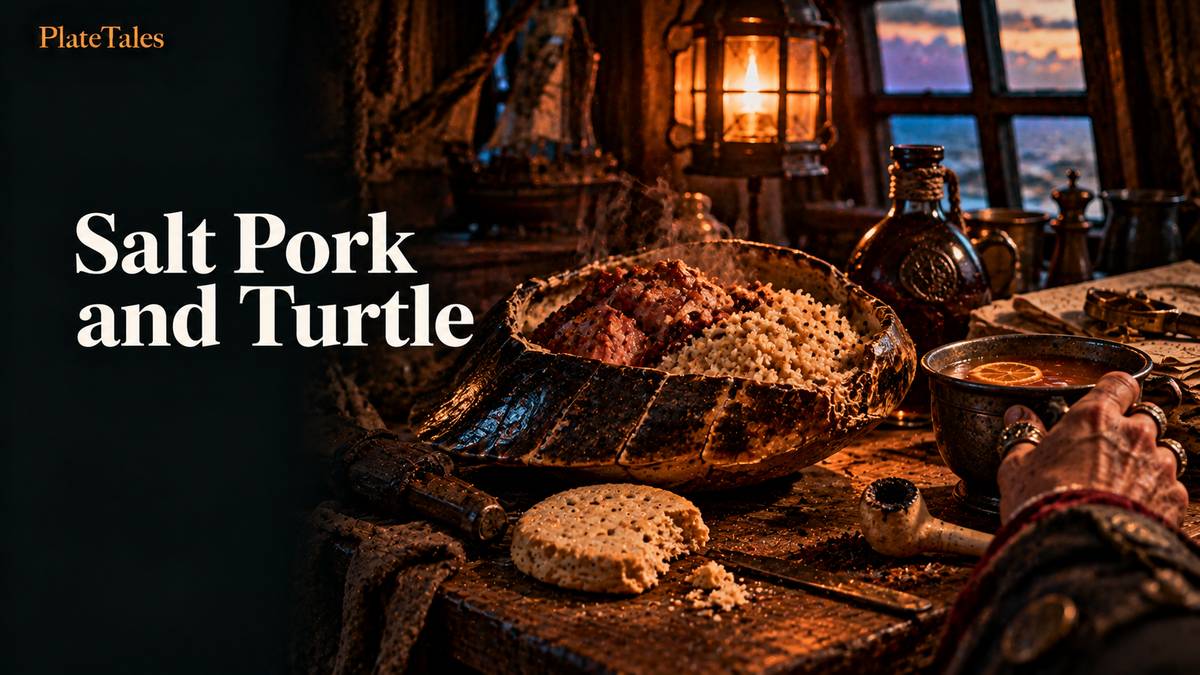
Pirates ate whatever the last ship they robbed was carrying, which in the Caribbean of the late 1600s and early 1700s mostly meant salt pork, salt beef, ship's bread, rice and turtle. Even the word is a food word: "buccaneer" comes from the boucan, the wooden grill over which hunters on Hispaniola smoked meat. When a prize came in, pirates ate and drank without limit. When it did not, they starved.
That feast-or-famine rhythm runs through the two books that most of what we know comes from. One is The Buccaneers of America by A. O. Exquemelin (John Esquemeling in the English edition), a barber-surgeon who sailed with the buccaneers until 1672, first printed in Dutch in Amsterdam in 1678 and in English in 1684. The other is A General History of the Pyrates (1724) by "Captain Charles Johnson", whose real identity is still argued over. Johnson worked partly from trial records and the pirates' own testimony, and both books are full of food.
What did pirates eat on a normal day at sea?
Meat, mostly, and as much of it as they could get. Exquemelin says that before a cruise the crew's first question was where to find provisions, "especially flesh, seeing they scarce eat anything else; and of this the most common sort is pork; the next food is tortoises, which they salt a little." The pork was often stolen. Spanish ranchers kept hog-yards with "a thousand head of swine together," and buccaneers would surround the keeper's hut at night and leave with as many animals as they wanted.
Once the meat was aboard, the rules were strikingly generous. Twice a day, Exquemelin writes, every man got "as much as he can eat, without weight or measure," and the steward gave no more to the captain "than to the meanest mariner."
Bartholomew Roberts's crew wrote the same principle into the first of their articles around 1720: every man "has equal Title to the fresh Provisions, or strong Liquors, at any Time seized," unless a scarcity, "no uncommon Thing among them," forced a vote to cut rations.
The stores themselves were the same ones every merchant ship carried. The Royal Museums Greenwich lists the standard rations of the age of sail as salt beef or pork, cheese, fish, ale and ship's biscuit. Johnson shows how pirates restocked. Off the Virginia capes, shortly after taking the king's pardon, Stede Bonnet's crew lifted "ten or twelve Barrels of Pork, and about 400 Weight of Bread" from a passing ship and, so it would not count as piracy, left eight or ten casks of rice and an old cable in exchange.
Why are buccaneers named after a barbecue grill?
Before they were sea raiders, the boucaniers were hunters. In the 1600s the western end of Hispaniola was full of feral cattle and pigs, descendants of animals the Spanish had brought, and French and English drifters made a living killing them. Exquemelin, who arrived at Tortuga in 1666, says the hunters of wild bulls and cows "are called bucaniers" and that about six hundred of them had once worked the island. They sold hides, salted pork for the planters, and smoked meat on a frame the French called a boucan.
Even the flesh of wild horses, he notes, they "harden with smoke, using it for provisions when they go to sea."
Where the word boucan itself came from is less settled. Wiktionary derives the French word from Old Tupi, a language of the Brazilian coast, where mboka'e meant a wooden grill. The historian Benerson Little gives a Caribbean Arawak word, buccan, for a frame on which the Taino and Caribs slow-roasted meat, often manatee. The two disagree on the language and agree on the object: a wooden frame over a slow fire. The English word "buccaneer" named a meat smoker first and a sea raider later.
Did pirates eat turtle?
Constantly, and they were happy about it. Johnson explains that the Caribbean was crowded with pirates partly because of the cays, the sandy islets that offered hiding places and "Water, Sea-Fowl, Turtle, Shell, and other Fish." Jamaica sent out whole turtling voyages to feed the island, and the meat was "a common and approved Food" there.
The best record is the crew of Thomas Anstis, which hid out for about nine months on an unnamed island off the southwest end of Cuba while it waited to hear whether a petition to His Majesty for a pardon had worked. They had provisions for two months. For the rest, Johnson says, they "eat not a Bit of any kind of Flesh-Meat, nor Bread," living on turtle and rice "boyl'd and squeez'd dry." Nobody seems to have minded. The turtles on that island were small, 10 or 12 pounds each, and the meat was "sweet and tender, some Part of it eating like Chicken, some like Veal."
The catching method was simple: watch the beach at night in the laying season, flip each turtle onto its back as it came ashore, and collect it in the morning. Not every Englishman approved. Johnson quotes a writer named Ward who called turtle "a Toad in a Shell."
What did pirates drink, and was it really rum?
Rum, often, but the bottle-of-rum pirate is a later polish on a messier picture. Rum was new. The earliest record, from Barbados in 1651, calls it "Rumbullion, alias Kill-Divil," and the short word "rum" turns up by 1654. Exquemelin's buccaneers of the 1660s drank brandy, "as liberally as the Spaniards do water," and when they bought a pipe of wine they would stave in one end "and never cease drinking till it is out." Another account goes further and argues that pirates mostly drank stolen Spanish wine and brandy, since Spain banned rum making in its colonies.
That holds for the early buccaneers raiding Spanish targets. It does not hold for the English-speaking pirates of the 1710s and 1720s, and Johnson's book is soaked in rum. Bonnet's crew took "two Hogsheads of Rum, and as many of Molosses" off Cape Henry. Roberts's men once took so much "rum and sugar" that "liquor was as plenty as water," and a sober man came under suspicion of plotting. Their trials of deserters were held around "a large Bowl of Rum Punch."
Blackbeard's journal, which was captured, recorded the whole cycle in a few lines: "Such a Day, Rum all out," then "Our Company somewhat sober," then rogues plotting and talk of splitting up. Then a prize "with a great deal of Liquor on Board," which "kept the Company hot, damned hot, then all Things went well again."
So the better-supported answer is: buccaneers drank brandy and wine, the later Golden Age pirates drank rum and punch, and Robert Louis Stevenson's Treasure Island (1883), with its "Yo-ho-ho, and a bottle of rum," fixed the second picture for good. (For where the cane behind all that rum came from, see the history of sugar.)
Was hardtack pirate food?
The thing was; the word was not. Hard, twice-baked biscuit was the staple of every ship afloat, and pirates ate it, but they called it bread or biscuit. Johnson writes of "Barrels of Bread" and "a few Biskets." According to the Oxford English Dictionary, "hardtack" is first recorded in 1830, more than a century after the pirates in this story were dead. The word belongs to the nineteenth century. The longer story is in the evolution of military rations from hardtack to MREs.
The navy comparison is worth making carefully, because the popular claim that pirates ate better than sailors is half true. In 1665 Samuel Pepys set the Royal Navy ration at a pound of biscuit a day, and the navy's beer allowance in this period was a gallon of weak beer a day. That was a measured ration, the same every day. Pirates had no ration at all: unlimited meat when the hold was full, and nothing when it was empty. Johnson's own preface, arguing about why men turned pirate, says ordinary merchant seamen were "poorly paid, and but poorly fed."
When the food ran out, did pirates really eat leather?
They did, and Exquemelin was there. On Henry Morgan's march on Panama in January 1671, about twelve hundred men went up the Chagres River, and the Spanish emptied the country ahead of him. (The 1684 English text dates the start to August 18, 1670, but the raid itself took place in January 1671.)
The first day most of them had "only a pipe of tobacco" for dinner. On the fourth day they reached an abandoned Spanish post and found nothing but "a few leathern bags, all empty, and a few crumbs of bread." So they ate the bags.
Exquemelin records "divers quarrels arising concerning the greatest shares," and gives the method: slice the leather, beat it between two stones and rub it, dipping it often in water to soften it, scrape off the hair, broil it, cut it small and wash it down with water. That night, he writes, a man was lucky if he had saved a bit of leather since noon to make his supper.
Bags were not the worst of it. Roberts's company, sailing for Surinam with "one Hogshead of Water left to supply 124 Souls," came down to a single mouthful of water every 24 hours, and some drank sea water and died of it. The siege-like logic of a ship running out of everything is familiar from what people ate during the great sieges of history.
What did pirates eat for breakfast?
On one morning we know exactly. On 10 February 1722, Bartholomew Roberts, a Welshman from near Haverfordwest in Pembrokeshire, was anchored off Cape Lopez on the coast of Gabon in the Royal Fortune. His crew came down to tell him a ship was rounding the cape. Roberts was "then at Breakfast with his new Guest, Captain Hill, on a savory Dish of Solomongundy, and some of his own Beer." Hill was master of the Neptune, a ship the pirates had taken the day before.
Is salmagundi pirate food?
Solomongundy, or salmagundi, was not a pirate invention. It was an English dish of cold chopped meats and pickled things, defined in Thomas Blount's Glossographia of 1656 as "a dish of meat made of cold Turkey and other ingredients," and later built up into large composed salads.
Roberts was also, Johnson notes in passing, a man who "drank his Tea constantly." The crew voted their captain small parcels of plate and china for the great cabin, then helped themselves to it whenever they liked. Tea had its own route to that cabin, told in how tea conquered the world.
The ship was HMS Swallow, Captain Chaloner Ogle. Some of the crew said she was Portuguese, some a French slaver, and most swore she was their own consort coming back. Roberts could see that most of his men were drunk. In the fight that followed, grapeshot struck Roberts in the throat, and his men threw him overboard, as he had asked, in his crimson damask waistcoat with his gold chain and diamond cross still on.
Questions people ask
Did pirates really eat leather?
Yes. On Henry Morgan's march on Panama in January 1671, the buccaneers reached an abandoned Spanish post and found only empty leather bags and a few crumbs of bread. According to the surgeon A. O. Exquemelin, who was there, they sliced the leather, beat it between stones, softened it in water, broiled it and ate it.
Did pirates drink rum or something else?
Both, depending on the era. Exquemelin's buccaneers of the 1660s drank brandy and wine, which they took from Spanish targets. The English-speaking pirates of the 1710s and 1720s, described in the 1724 book A General History of the Pyrates, drank rum and rum punch whenever a prize carried it, as Bonnet's and Roberts's crews did.
Did pirates eat better than navy sailors?
Only sometimes. The Royal Navy gave sailors a fixed daily ration, set in 1665 at a pound of biscuit plus beer. Pirate crews had no ration at all: every man ate as much meat as he wanted when the hold was full, and went hungry when it was empty.
What did buccaneers eat on land in the Caribbean?
Mostly pork and wild beef, smoked on a wooden frame called a boucan, which gave buccaneers their name. Exquemelin says they also ate tortoises lightly salted, and on Hispaniola they sold hides and salted pork to planters. Their food on land was meat first, with little else on the plate.
Filed under War & Famine, Trade Routes
Want more stories like this?
One food history story, every week. No spam, just the stories behind what the world eats.