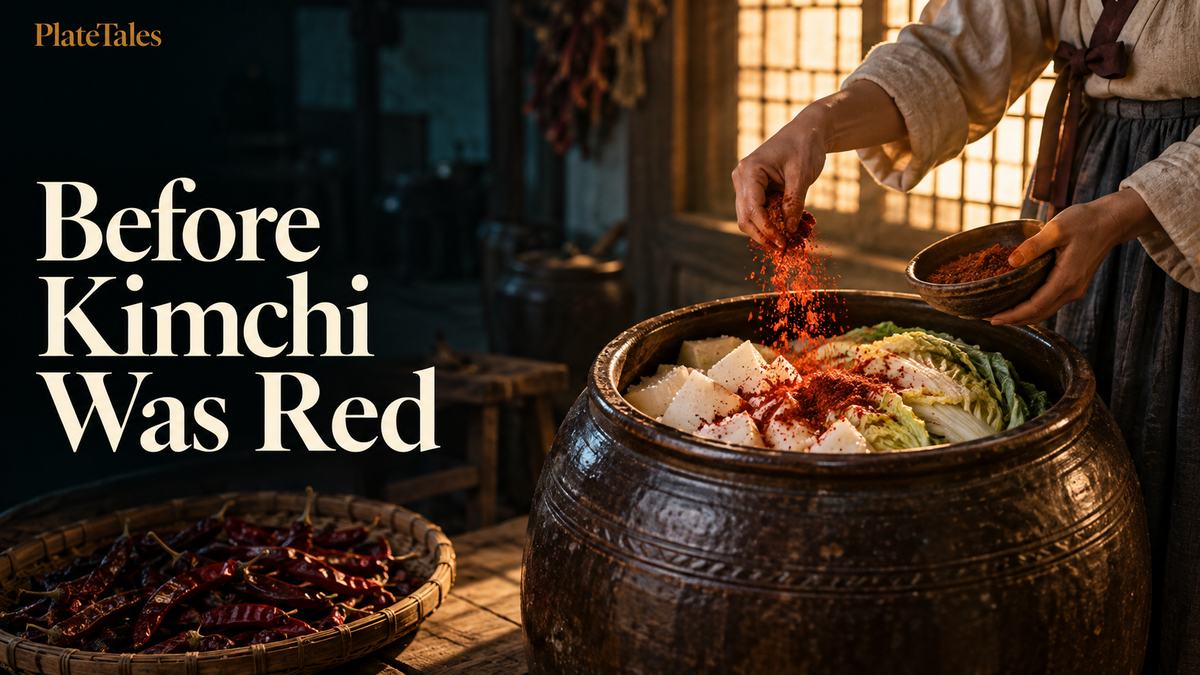
Kimchi became spicy in the 1700s, more than a century after the chili pepper reached Korea, and chili did not become standard in kimchi across the country until the 1800s. The word is older than the heat. "Kimchi" descends from the Sino-Korean chimchae, written with characters meaning "submerged vegetable", and for most of its life that is what it was: vegetables sunk in brine, sour and salty, but not hot.
That gap surprises people, because red now looks like the definition of the dish. The paper trail is unusually good. Korean scholars kept encyclopedias, farm manuals and household cookbooks, and in them you can watch the chili arrive, get a name, get distrusted, get planted, and finally go into the crock.
What kimchi was like before chili
The oldest kimchi is radish, salt and time. The Samguk sagi, the 12th-century history of the Three Kingdoms, mentions jars used to ferment vegetables. Buddhism's meatless diet in the Silla kingdom probably made vegetable pickles more common, though that is an inference rather than a record.
The firmest early evidence is a poem. Yi Gyu-bo, a scholar-official of the Goryeo dynasty, wrote six verses about the vegetables in his garden, collected in Dongguk Isanggukjip in 1241. In the one on radish, he says that radish with soybean paste is good eating in summer, and radish soaked in salt lasts through the long winter. A jar, salt and a vegetable were the whole technology.
A later Goryeo poem by Yi Dal-chung, preserved in the 1478 anthology Dongmunseon, mentions water caltrop mixed in among salted smartweed. None of this sounds like a modern side dish, and none of it is red.
So what did these pickles taste of besides salt and sour? The pre-chili seasonings were cheoncho and sancho, both relatives of Sichuan pepper with its tingling, numbing bite, and hocho, black pepper. Black pepper came a long way to reach Korea, a trade told in the history of black pepper and the empires built on it. Early records of kimchi do not mention garlic either.
Where the word kimchi comes from
Korean has two old words for the dish. The native one is ji, from an archaic dihi, which survives in names like jjanji (a salty radish pickle) and seokbakji. The other is the borrowed chimchae.
Written in the Korean alphabet, it appears as dimchae in Byeogonbang, a 1518 book of remedies for epidemics, and in the character primer Hunmong jahoe in 1527. Then it shows up as thimchoy in Sohak eonhae (1587), a Korean version of a Chinese primer for children.
From there the sounds slid. In the 17th and 18th centuries the opening "d" turned into "j", giving jimchae. In the 19th century the "j" flipped to a "k", a change linguists call reverse palatalization: speakers had seen many old "k" words turn into "j" words, and some of them "corrected" this one too. That is how kimchi got its "k". Forms like jimchi and jimchae still survive in regional dialects.
When did chili peppers come to Korea?
Chili peppers are American plants. European ships carried them into Asia in the 1500s, part of the same traffic that put chili into Indian and Thai cooking (see how curry spread around the world).
In Korea the first clear record is in Jibong yuseol, an encyclopedia by the scholar and official Yi Su-gwang, published in 1614. His entry is short and unfriendly. Rendered into English from the classical Chinese, it says that namman cho, the "southern barbarian pepper", is highly poisonous, and that because it first came from Japan, people commonly call it waegaeja, "Japanese mustard".
He does not mention kimchi, or eating it at all. A plant he calls poisonous is not one people would rush into the winter crock.
Later Korean writers agree on the source. Yi Ik's 18th-century encyclopedia Seongho saseol calls the plant beoncho, and Yi Gyu-gyeong's 19th-century Oju yeonmun jangjeon sango says it came from Japan after the Imjin War, the Japanese invasions of 1592 to 1598.
Japanese books tell it the other way round. The 1709 Yamato honzo says chili was not native to Japan and was brought back from Korea during Toyotomi Hideyoshi's invasion, and some accounts name the general Kato Kiyomasa. Armies carried seeds in both directions, so both sides may be partly right. What the Korean record shows clearly is that in the early 1600s the chili was a new, foreign and slightly alarming plant.
When did kimchi become spicy?
Slowly, and the cookbooks let you date it. Around 1670, Jang Gye-hyang (1598 to 1680), a woman from an aristocratic yangban family, wrote Eumsik dimibang for her daughters and daughters-in-law. Her kimchi entries, listed under chimchae, are pheasant kimchi, a mountain mustard (sangat) kimchi set in a small jar with warm water on the heated floor, and garlic preserved in brine. As described, none of them uses chili.
Around 1700, Hong Man-seon's farm manual Sallim gyeongje explained how to cultivate chili peppers. By then the plant was in Korean fields. How often it went into kimchi at that point is less clear.
The clear turn comes in 1766, with Jeungbo sallim gyeongje, Yu Jung-rim's enlarged edition of Hong's manual. It has many kimchi made with chili or chili powder, alongside familiar forms such as stuffed cucumber kimchi and dongchimi, a radish water kimchi. It also has a recipe for gochujang, the chili paste.
And it holds the best detail in the whole story: a note that kimchi was dyed red with cockscomb flowers. Cooks apparently already liked the color, and when chili did not supply it, a garden flower did.
In the early 19th century, Seo Yu-gu's encyclopedia Imwon gyeongjeji reported that using plenty of chili in kimchi helped radish keep longer. Chili became a standard ingredient, not an optional one, during the 1800s, and early 19th-century recipes already look a lot like modern kimchi.
| Year | Text | What it shows |
|---|---|---|
| 1241 | Dongguk Isanggukjip, Yi Gyu-bo | Radish pickled in salt, no chili |
| 1614 | Jibong yuseol, Yi Su-gwang | Chili known, called poisonous, no kimchi |
| c. 1670 | Eumsik dimibang, Jang Gye-hyang | A few kimchi, none listed with chili |
| c. 1700 | Sallim gyeongje, Hong Man-seon | How to grow chili |
| 1766 | Jeungbo sallim gyeongje, Yu Jung-rim | Many chili kimchi, plus cockscomb for red color |
| early 1800s | Imwon gyeongjeji, Seo Yu-gu | Plenty of chili helps radish kimchi keep |
Was kimchi always red? The argument over the dates
Not everyone accepts this timeline. In February 2009 a Korea Food Research Institute team led by Kwon Dae-young announced that chili had existed in Korea before the Imjin War. Kwon argued that the namman cho of 1614 may not be the same plant as the Korean chili, and he has said that one kimchi recipe in the 1670 cookbook does use chili.
In 2015 the Journal of Ethnic Foods published a paper by Dai-Ja Jang, Kyung Rhan Chung, Hye-Jeong Yang, Kang-sung Kim and Dae Young Kwon. Its abstract says the claim that red pepper arrived with the 1592 invasion lacks support, and it reads the Samguk sagi as showing that Koreans ate cabbage kimchi about 1,500 years ago.
There is a real puzzle underneath. Characters later used to write gochujang appear in a 9th-century Chinese text and in Korean medical books of 1433 and 1445, before the American plant could have arrived. Something hot and called "pepper" was being written down. The simplest reading is that those words named the older peppers, such as the Sichuan-pepper relatives, and that the name moved to the new plant later.
Most of the evidence favors the later date. Yi Su-gwang says the chili came from Japan and gives it a foreign nickname, and later Korean writers repeat the story. The first cookbook with many chili kimchi appears in 1766. An early-arrival theory has to explain why all of those writers missed it.
When was cabbage kimchi invented?
The napa-cabbage kimchi sold in every supermarket is younger than red kimchi. Radish, not cabbage, was the main kimchi vegetable for most of history, and cabbage kimchi only overtook radish kimchi in the 20th century.
The cabbage that reached Korea from China in the Goryeo period was a loose, leafy kind that spread out like lettuce instead of forming a head. A heading cabbage came from China in the late 18th century, and crosses produced a half-headed type that took hold around Gaeseong and Seoul. In the late 19th and early 20th centuries, Chinese immigrants from Shandong spread the heading type much more widely.
The cookbook Siuijeonseo, from the late 1800s, describes whole-cabbage kimchi much like today's. It survives in a copy made in 1919 by Sim Hwan-jin, the magistrate of Sangju, who gave it to his daughter-in-law.
Then came the plant breeders. A Korean government research station began breeding napa cabbage in 1906, and the agricultural scientist Woo Jang-choon later developed hybrid cultivars; the modern variety is registered internationally as "kimchi cabbage". A cold-resistant variety, Dong-Pung, was released in 1992, and Korea now grows napa cabbage all year.
Red kimchi now, and the white kind that never left
The older kimchi never disappeared. White, chili-free styles such as dongchimi are still made, and they are the nearest thing on a modern table to the pre-chili crock. North Korean kimchi, which UNESCO listed in 2015, tends to be less spicy and less red than the southern kind, with less seafood and salt. The fermentation itself is the same trick found in every culture that ferments, and how the dish went abroad belongs to the story of Korean food going global.
UNESCO inscribed South Korea's kimjang, the communal making and sharing of winter kimchi, in 2013. Its description follows the year: shrimp and anchovy salted in spring, sea salt bought in summer, and in late summer, red chili peppers dried and ground into powder. Kimjang itself comes in late autumn, and households watch the weather forecast to choose the right day.
Questions people ask
Was kimchi always red?
No. Early Korean kimchi was radish and other vegetables soaked in salt, with seasonings such as Sichuan-pepper relatives and black pepper. Chili kimchi recipes appear in quantity in the 1766 farm manual Jeungbo sallim gyeongje, and chili became a standard kimchi ingredient across Korea during the 1800s. White styles such as dongchimi are still made.
When did chili peppers come to Korea?
Chili peppers are American plants that reached Asia on European ships in the 1500s. The first clear Korean record is Yi Su-gwang's 1614 encyclopedia Jibong yuseol, which calls the pepper poisonous and says it came from Japan. Some Korean researchers argue it arrived before the Imjin War, but most evidence favors the later date.
What was kimchi like before chili?
Before chili, Korean kimchi was salted and fermented vegetables, mainly radish, tasting sour and salty rather than hot. Yi Gyu-bo's 1241 poem describes radish soaked in salt to last through winter. Seasonings included relatives of Sichuan pepper and black pepper, and early records do not mention garlic.
When was napa cabbage kimchi invented?
Napa-cabbage kimchi is younger than red kimchi. A heading cabbage came from China in the late 18th century, and the late 1800s cookbook Siuijeonseo describes whole-cabbage kimchi much like today's. Radish stayed the main kimchi vegetable for most of history, and cabbage kimchi only overtook radish kimchi in the 20th century.
Filed under Origin Stories, Fermentation
Want more stories like this?
One food history story, every week. No spam, just the stories behind what the world eats.