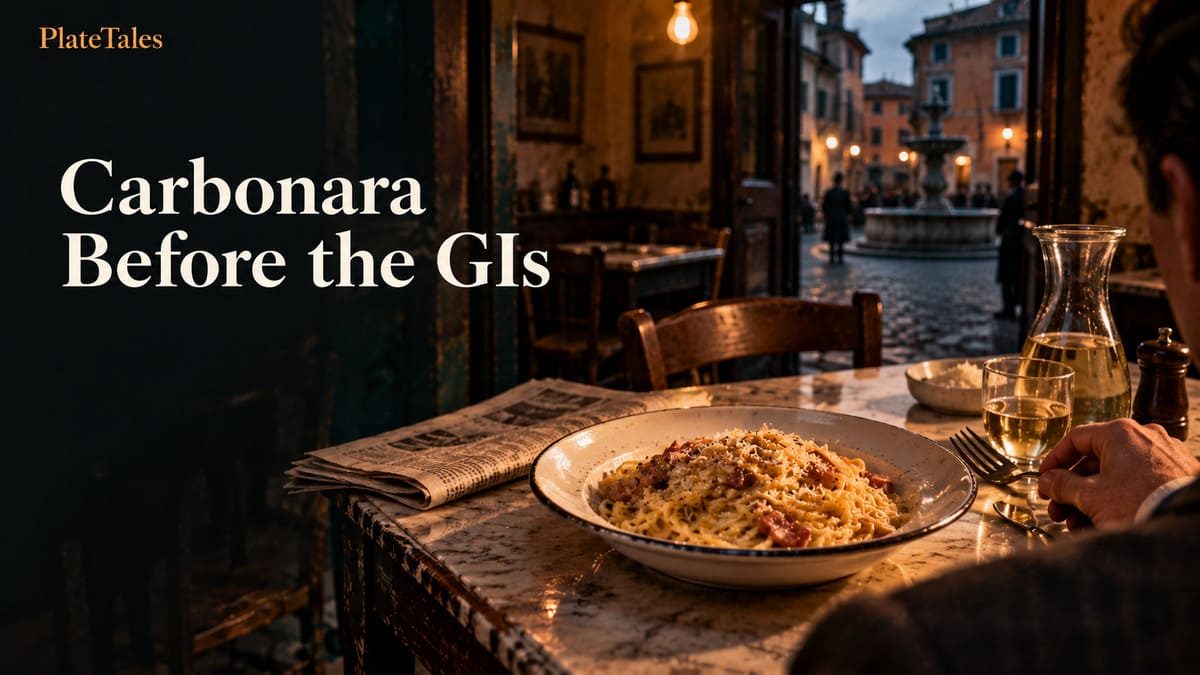
Nobody knows who invented carbonara. No cook's name survives, and no claimant has a document to back him. The oldest known use of the name in print is from 23 August 1939, describing a trattoria in Trastevere, Rome, five years before the American soldiers who usually get the credit arrived in the city.
The word itself gives away less than you would hope. Carbonara comes from carbonaro, Roman dialect for carbonaio, a charcoal burner, so the dish is spaghetti "the charcoal burner's way". The 1939 date only surfaced in February 2026. Before that, the wartime story was the one most food historians backed, and it was a reasonable guess.
Did American soldiers invent carbonara in 1944?
The version repeated in most places runs like this. Allied troops entered Rome in June 1944. They brought rations of bacon and powdered egg, and the city had pasta and not much else. Some unnamed cook put the two together for soldiers who wanted something like breakfast.
The journalist Eleonora Cozzella has described the request as a "spaghetti breakfast", a kind of bacon and eggs served on top of spaghetti. The story sits comfortably beside the other things the war put in the pantry.
Its evidence was all negative, but there was a lot of it. Ada Boni's La cucina romana of 1930, the standard book on Roman cooking, has no carbonara. Neither does Il cucchiaio d'argento, the big Italian cookbook of 1950. Until 2026 the oldest known mention was from 1948, and the oldest recipe from 1952.
Alan Davidson accepted a postwar origin in The Oxford Companion to Food. So did Luca Cesari, the Italian food historian who has spent years in newspaper archives tracing this one dish. In 2021 Barilla made a short film set in newly liberated Rome that told the same story.
Renato Gualandi and the lunch at Riccione
One man did claim to have been at the stove. Renato Gualandi, a young cook from Bologna, said that on 22 September 1944 he cooked a lunch in Riccione, on the Adriatic coast, for a meeting of the British Eighth Army and the American Fifth Army. In Cesari's retelling, Gualandi said the Americans had "fantastic bacon, delicious heavy cream, cheese and powdered egg yolks", and he finished the pasta with black pepper.
He then cooked for Allied troops in Rome from September 1944 to April 1945, which would explain how the dish reached the capital. Riccione liked the story. On 21 September 2008 the town staged a reenactment dinner at Villa Mussolini, with actors playing the Allied generals and Churchill, waiters dressed as Canadian soldiers, and Gualandi, then 88, as guest of honour.
The trouble is his own book. Renato Gualandi: peripezie di un cuoco bolognese, published by Slow Food in 2006, describes his wartime cooking but never mentions carbonara. Cesari treats the Riccione claim as unproven, and the 1939 article rules out Gualandi as the first.
When was carbonara invented? A Dutch newspaper says by 1939
On 23 August 1939 De Koerier, a Dutch-language daily in what was then the Dutch East Indies, printed a piece from its Rome correspondent under a headline that translates as "Roman dream of a midsummer night". It was signed N.K. The writer was Nora Koch Berkhuijsen, born in Malacca, who covered Rome for the paper from 1933 to 1948.
She described the Piazza di Santa Maria in Trastevere and two trattorias on it, Umberto and Alfredo, which she called peaceful competitors. Umberto was known for risotto with large prawns. Alfredo's dish was spaghetti alla carbonara, which she explained to her readers as little cords made the way the charcoal burner's wife makes them. That is a paraphrase of Cesari's Italian translation, not her Dutch. She gives no ingredients.
Two Dutch journalists, Edwin Winkels and Janneke Vreugdenhil, found the article and sent it to Alberto Grandi, a food history professor at the University of Parma. Cesari published it in Gambero Rosso on 4 February 2026. In August 1939 Italy had not yet entered the war. There were no American soldiers in Rome and no ration tins to raid.
The find also makes sense of evidence that was already known. Nearly every early Roman mention points back to that one square.
| Date | Where it appears | What it says |
|---|---|---|
| 23 Aug 1939 | De Koerier | Carbonara at Alfredo, Piazza di Santa Maria in Trastevere |
| 1 May 1948 | Giornale di Trieste | Renato Mucci praises the carbonara in the same piazza |
| 1949 | The film Yvonne la Nuit | A waiter at a trattoria on the square calls an order of carbonara for three |
| 26 Jul 1950 | La Stampa | American officers recalled seeking the dish at a trattoria a few metres from the square |
| 20 Apr 1952 | La Croix du Nord, Lille | First known recipe, signed by the actor Aldo Fabrizi |
| Dec 1952 | Vittles and Vice, Chicago | First recipe in English |
| 1954 | La Cucina Italiana | The magazine's first carbonara recipe |
Why is it called carbonara?
The 1939 article settles one thing about the name. Before the war, people in Rome already heard "charcoal burner" in it, and Koch Berkhuijsen passed that along to her readers.
Why a charcoal burner is another matter. The most popular account says the carbonai of the hills around L'Aquila invented it, men who tended charcoal kilns for days and carried food that kept: cured pork, hard cheese, dried pasta. Nobody has found a document that shows them eating it. A second theory, reported by the American food writer John Mariani, makes the name a tribute to the Carbonari, the secret society of the Italian unification era. There is no evidence for that one either.
The plainest reading has the most support. It was the name a Trastevere trattoria gave to a pasta, and the name stayed with whatever that pasta became. A 1957 American guide to Italian restaurants, as Cesari summarizes it, describes the dish at Alfredo as butter, cheese, pancetta and guanciale, with no egg listed. Cesari compares it to a gricia, the Roman pasta of cured pork and cheese.
Cooks had been near the combination for decades. Francesco Palma's Il principe dei cuochi, printed in Naples in 1881, has macaroni with cheese and eggs, with melted pork fat. The Touring Club's 1931 food guide describes the strascinati of Cascia in Umbria, dressed with whisked eggs, cheese, sausage, pork fat and pepper. Like the tomato sauces that came late to Italian pasta, the pieces were on the table well before anyone wrote the dish down under its present name.
Is carbonara American?
In March 2023 Alberto Grandi caused a national row by telling La Repubblica that the first carbonara recipe came from Chicago and that the dish was Italian-American. On the evidence then known, the first recipe was indeed American.
It is in Vittles and Vice, a Chicago restaurant guide by Patricia Bronté printed in December 1952. The recipe came from Armando's and its owner, Pietro Lencioni. It calls for a pound and a half of tagliarini, half a pound of "Mezzina (Italian bacon)", four eggs and a quarter pound of grated Parmesan. Accounts differ on Lencioni's origins: Cesari says he was from Lucca, while other accounts say he was born into an immigrant coal-mining family in Iowa, which would be a neat coincidence for the name if anyone could confirm it.
Then Cesari found an earlier one. On 20 April 1952 La Croix du Nord, a regional paper in Lille, ran a recipe for spaghetti alla carbonara in its Sunday page of curiosities, signed by the Roman actor Aldo Fabrizi. Beat an egg with a little salt in a dish, add the boiled spaghetti while still firm, mix, then add lardo fried in butter and oil. Finish with Parmesan and a pinch of pepper.
Fabrizi is a believable source. On 12 April 1949 the Giornale di Trieste found him in a restaurant kitchen, in shirtsleeves, telling the cook how to make carbonara. In the 1951 film Cameriera bella presenza offresi... his character asks a would-be maid, "Tell me, can you make spaghetti alla carbonara?" She cannot.
So the oldest recipes were printed in France and America, and the oldest mention in a Dutch paper. The dish they describe was Roman, eaten in Trastevere and noticed by visitors before Italian cookbook editors bothered with it. The Americans keep one large credit, in Cesari's view: they carried the taste home and made it known abroad. For pasta with pork and egg, a soldier raised on breakfast bacon needed no persuading, whatever his ration tins held.
What the first carbonara recipes called for
Anyone defending the strict version (guanciale, pecorino, egg, pepper, nothing else) should avoid the early paperwork.
The 1954 La Cucina Italiana recipe uses pancetta, Gruyere and garlic with the eggs. When Cesari cooked it on video in 2023, the eggs came out closer to scrambled, and the clip drew an angry response online. Elizabeth David's Italian Food, also 1954, gives "maccheroni alla carbonara" with ham, bacon or coppa fried in butter, using information from the Roman restaurant Il Buco. Harper's Bazaar that year printed a version with chopped clams and saffron. La pentola magica, a 1959 Italian cookbook, adds onion and white wine.
Guanciale, cured pork cheek, first shows up in 1957, when Richard Hammond and George Martin's Eating in Italy says the dish can be made with "bacon and pig's cheek". Pecorino appeared as an option in Felix Dessì's 1955 cookbook, and it and guanciale spread slowly through the late 1950s and 1960s. Cream stayed in respectable Italian versions for decades. Gualtiero Marchesi's 1989 recipe used a quarter litre of it for 400 grams of spaghetti, and cream was only widely dropped in the 1990s. The strict version is younger than many of the people who enforce it, a pattern familiar from the long prehistory of pizza.
What was on the plate in 1939 is still unknown, because Nora Koch Berkhuijsen ate her supper and did not ask for the recipe. The square is easier to trace. In the 1949 film Yvonne la Nuit, starring Totò, a sign in the Piazza di Santa Maria in Trastevere reads "Trattoria U. Galeassi", and a waiter shouts an order through to the kitchen: spaghetti alla carbonara for three.
Questions people ask
Did American soldiers invent carbonara?
Probably not. A Dutch-language newspaper, De Koerier, mentioned spaghetti alla carbonara at a Trastevere trattoria in Rome on 23 August 1939, five years before Allied troops reached the city in June 1944. Renato Gualandi claimed to have cooked it for Allied officers in 1944, but his own 2006 book never mentions carbonara.
Why is carbonara called carbonara?
The name comes from carbonaro, Roman dialect for carbonaio, a charcoal burner, so carbonara means the charcoal burner's way. The 1939 article shows Romans already heard that meaning before the war. Why a charcoal burner is attached to the dish is unknown, and the stories about L'Aquila charcoal makers or the Carbonari society have no documentary proof.
Is carbonara an American dish?
No, the evidence points to Rome. The first known English recipe appeared in a Chicago guide, Vittles and Vice, in December 1952, but a recipe signed by the Roman actor Aldo Fabrizi ran in a French paper in April 1952, and the earliest mentions place the dish in Trastevere. Americans helped spread the taste abroad.
What was in the first carbonara recipes?
Early recipes varied widely. Fabrizi's 1952 version used egg, spaghetti, lardo and Parmesan. The 1954 La Cucina Italiana recipe used pancetta, Gruyere and garlic. Guanciale first appears in 1957, pecorino in 1955, and cream stayed in respectable Italian versions into the 1990s, so the strict modern version is fairly recent.
Filed under Origin Stories, War & Famine
Want more stories like this?
One food history story, every week. No spam, just the stories behind what the world eats.