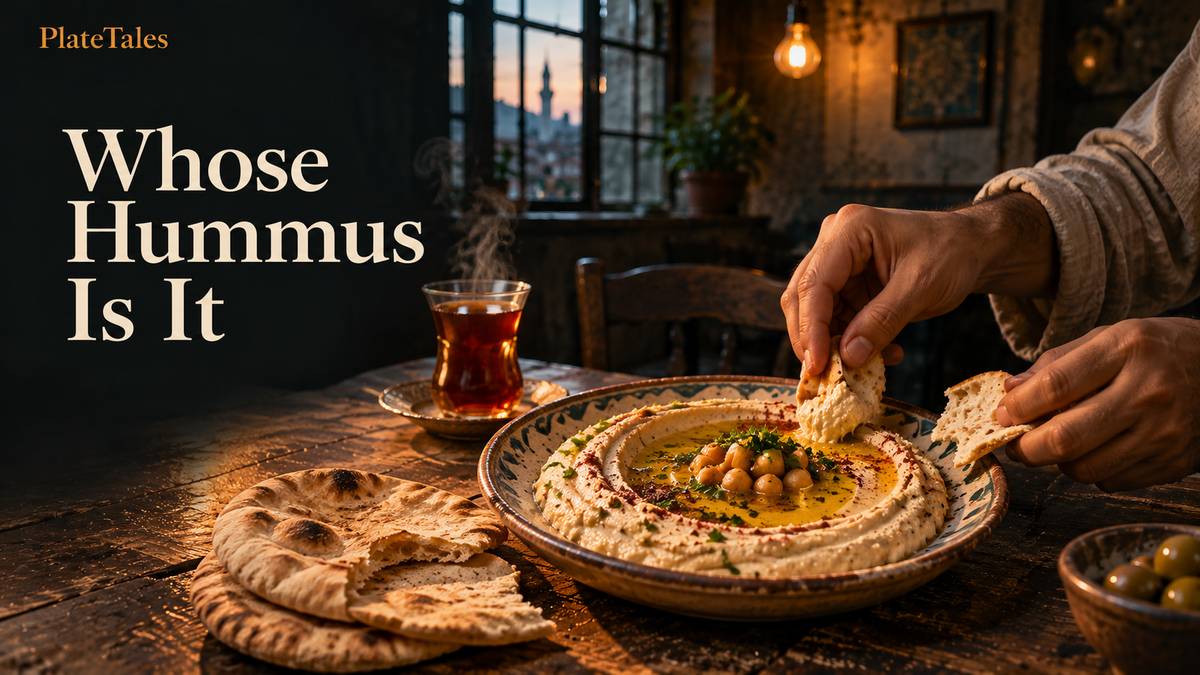
Nobody can say for certain who invented hummus. The earliest surviving written recipes for chickpea purees come from 13th and 14th century Arabic cookbooks, and only some of them include tahini. Lebanon and Israel have each claimed the dish in public, with Guinness World Records as the arena, and historians quoted in the press say the question predates the modern borders that the argument depends on.
What do the oldest hummus recipes say?
The word is plain Arabic. Hummus means "chickpeas," and the full name of the dish is hummus bi tahina, chickpeas with tahini.
The written trail is thin. One 13th century Syrian text attributed to Ibn al-Adim of Aleppo, the Kitab al-Wusla ila l-Habib, has a chickpea dish that uses lemon, sesame and olive oil but no garlic. Fourteenth century Cairo cookbooks have a cold chickpea puree dressed with vinegar and pickled lemons, with no tahini and no garlic. A 13th century Baghdad book, Muhammad bin Hasan al-Baghdadi's Kitab al-Tabikh, has a recipe called hummus kasa: chickpeas and tahini, soured with vinegar instead of lemon, again without garlic.
So the dish people now call hummus has relatives in at least three medieval cities, none of them in modern Lebanon or Israel. The food historian Nawal Nasrallah describes a long silence after that: no hummus recipes, she says, between the 14th century and an 1885 Lebanese cookbook, by which time garlic was standard.
One historian offers a later date. James Grehan, a professor at Portland State University, told Moment magazine that hummus was probably first made in 18th century Damascus, and that ownership is a moot point because the region's modern nation-states did not yet exist. Those two timelines do not agree, and the sources read for this article do not settle which is right.
How did a chickpea dip start a war?
The phrase "hummus wars" covers a run of record attempts in the late 2000s. The sequence ran: Israel in 2008, Lebanon in 2009, Israel in January 2010, and Lebanon again in May 2010.
The background was commercial as well as cultural. Moment reports that in 2008 Fadi Abboud, then president of the Association of Lebanese Industrialists, announced a plan to sue Israel over the marketing of hummus as an Israeli product. The association also asked Lebanon's economy ministry in October 2008 to seek protected status for hummus from the European Commission, similar to a protected geographical designation. As of 2009 it was still collecting documents. Abboud cited the 2002 feta ruling as a precedent, Moment writes. The magazine's own assessment is that the comparison is weak: a geographical label needs qualities unique to a place, and feta's character comes from specific local sheep and goats. (For more on that kind of dispute, see the history of cheese.) If Lebanon had won exclusive rights to the name, in the magazine's account, other makers might have had to call their product "Lebanese-style spread."
Abboud became Lebanon's tourism minister in November 2009 in Saad Hariri's cabinet and held the post until February 2014.
The two plates that decided the record
In January 2010, the village of Abu Ghosh, about 10 km west of Jerusalem, produced a plate that weighed about 4,087.5 kg. That was roughly double the Lebanese record from October 2009. The event was organised by Jawdat Ibrahim, who owns a hummus restaurant there, and involved 50 Jewish and Arab chefs from Israel.
Abu Ghosh is an Arab local council, named for its dominant clan. In 2007 it was already being called the "hummus capital of Israel." Moment reports that Ibrahim's first giant batch was so large that he borrowed a 6.5 meter satellite dish to hold it.
Lebanon answered on 8 May 2010 in Fanar, east of Beirut. About 300 cooks prepared a dish of 10,452 kg. Some accounts round it to about 10,450 kg; Moment gives 10,452 kg. Moment says that figure matches Lebanon's area of 10,452 square kilometers, and presents it as symbolic.
The record has been stated in several slightly different weights across outlets, so treat the figures as approximate.
What does each side actually claim?
The positions differ more than the headlines suggest, and they are worth keeping apart.
The Lebanese case. Lebanese industrial and official figures describe hummus as a national dish and have pursued it through trade law and publicity. Moment reports that Lebanese chefs promoted a festival called "Hummus and Tabbouleh Are 100 Percent Lebanese." Abboud's legal plan was aimed at how Israeli companies sell the product abroad.
The Israeli case. According to Moment, few Israelis claim outright national ownership, but hummus is strongly associated with daily life in Israel, and the magazine says Israelis eat about twice as much of it as their Arab neighbors. The Israeli writer Meir Shalev argued in 2007 in Yedioth Ahronot that hummus has biblical roots, reading the word hometz in the Book of Ruth as hummus and not as vinegar. Shalev later called the hummus war "a repulsive, vulgar competition," in the magazine's account.
The Palestinian position. Palestinian writers describe the dish as theirs and as part of a wider pattern. Marcel Shamshoum, a Palestinian food writer, argued in This Week in Palestine that Israelis feel the need to put "Israeli" in front of dishes such as hummus and falafel, while for Palestinians "hummus is hummus." He also said that Mizrahi Jews from the Levant, Iraq, Yemen and North Africa often consider local Arabic food their own cuisine, so the difference lies in religious custom more than in the food. That is one writer's opinion piece, not a survey of Palestinian views, and it is aimed at the slogan "Make hummus, not walls" as much as at any record attempt. Foods shared by Palestinian and Israeli cooking, hummus and falafel among them, have been the subject of debates about cultural appropriation.
Arab citizens of Israel. Abu Ghosh's record was set by Arab and Jewish chefs together. Ibrahim, an Arab citizen of Israel, told the Jerusalem Post, in Moment's retelling, that he would "show who hummus belongs to," and later proposed a joint Israeli-Lebanese attempt.
The skeptics. Shooky Galili, who writes The Hummus Blog, called the dispute a public relations effort by Lebanese food manufacturers aimed at the American market for ethnic foods, Moment reports, and stressed that regional variation is part of hummus tradition. Muhammad Diyab, a Saudi writer quoted by the same magazine, accused Israel of waging a psychological war to distract Arabs with minor issues.
Who owns a dish that crosses borders?
The commercial stakes were real. Moment says Sabra, a brand partly owned by Israel's Strauss Group, was the top-selling hummus in the United States in 2010, with sales above $177 million.
The historical record gives no one a clean claim. The oldest texts come from Aleppo, Cairo and Baghdad, under rulers whose territories did not match any present-day state. Chickpeas themselves were domesticated thousands of years ago in what is now Turkey, Moment notes. Trade carried the ingredients along the routes described in how silk road foods moved, and the later Ottoman period shaped how street food was sold across the Levant, a subject taken up in Ottoman street food history. The broader question of why people fight over a dish at all is the subject of how food shaped cultural identity.
What can be said without taking a side is narrower. Lebanon's record stands in the Guinness story as the largest of 2010, set in Fanar on 8 May with 10,452 kg. Abu Ghosh's January plate, about 4,087.5 kg, had held the title for about four months.
Questions people ask
What does the word hummus mean?
Hummus is plain Arabic for "chickpeas." The full name of the dish is hummus bi tahina, which means chickpeas with tahini. The word itself says nothing about which modern country the dish belongs to, since the oldest recipes come from medieval Aleppo, Cairo and Baghdad.
Where are the oldest hummus-like recipes from?
The oldest surviving written recipes for chickpea purees come from 13th and 14th century Arabic cookbooks. One is a Syrian text attributed to Ibn al-Adim of Aleppo, one is from Baghdad, and others are from Cairo. Only some of them use tahini, and none of them include garlic.
Did Lebanon or Israel hold the bigger hummus record?
Lebanon's record, set in Fanar on 8 May 2010, was a dish of about 10,452 kg, prepared by roughly 300 cooks. It beat the January 2010 plate from Abu Ghosh in Israel, which weighed about 4,087.5 kg. Reported weights vary slightly between outlets, so the figures are approximate.
Who was involved in the Abu Ghosh hummus record?
The January 2010 record in Abu Ghosh, near Jerusalem, was organised by Jawdat Ibrahim, an Arab citizen of Israel who owns a hummus restaurant there. About 50 Jewish and Arab chefs from Israel took part. Ibrahim later proposed a joint Israeli-Lebanese attempt.
Filed under Origin Stories, Cultural Identity
Want more stories like this?
One food history story, every week. No spam, just the stories behind what the world eats.