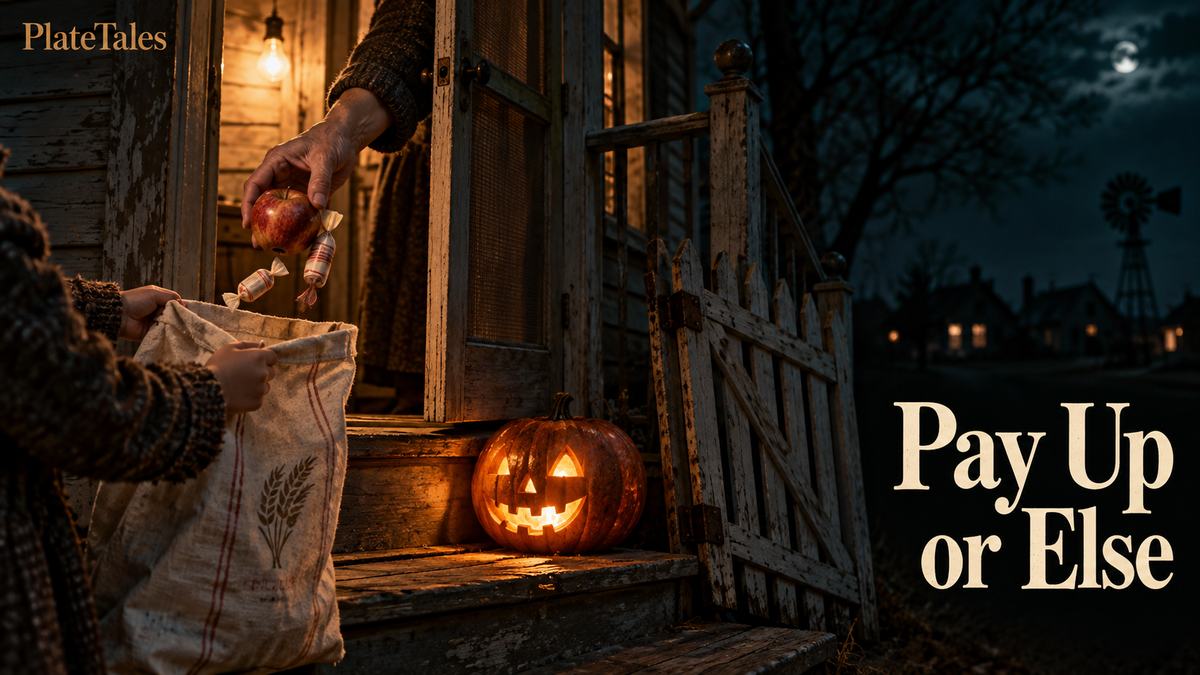
We give out candy on Halloween because North American householders, starting around 1917, began paying costumed children in food or coins to leave their gates, windows and outhouses alone, and in the 1950s candy proved the easiest thing to pay with. The oldest known printed version of the chant, from an Ontario newspaper in 1917, says plainly that a household that paid up would be "immune from attack".
Candy itself is the latecomer. For the first thirty years or so the payment was as likely to be an apple, a doughnut or a coin.
Soul cakes, guisers and the old habit of asking at the door
Going door to door for food at the end of October is far older than the candy bar. In England, handing out soul cakes over Allhallowtide (October 31 to November 2) is recorded from the 15th century. Callers were given small spiced cakes in return for prayers for the household's dead. Shakespeare could assume his audience knew the sound of it: in The Two Gentlemen of Verona, from the early 1590s, Speed teases his lovesick master for "puling" like a beggar at Hallowmas.
Scotland had guising, recorded from the 16th century, in which the callers wore disguises and performed for their reward. An 1895 article in Frank Leslie's Popular Monthly describes guisers carrying turnip lanterns and collecting cakes, fruit and money. The custom crossed the Atlantic with Scottish and Irish families, one small part of how immigration built American food habits. On November 1, 1911, the Daily British Whig of Kingston, Ontario, reported children in masks and costumes performing around the neighborhood for money, apples and nuts.
A straight line from soul cakes to miniature chocolate bars would be tidy, and the Library of Congress declines to draw it. Its newspaper blog says there is "much debate" and offers three theories: Celtic food offerings left out for spirits, souling and its Scottish offshoot guising, and belsnickeling, a German-American Christmas custom of calling on neighbors in costume.
What the old accounts do show is a gap. Nobody in them is threatening anyone.
Gate Night: Halloween before anyone offered a treat
In 19th-century America the threat was the whole holiday. Rural boys hoisted farmers' wagons and livestock onto barn roofs and tipped over outhouses, occupied or not. So many gates were lifted off their hinges that October 31 was known in places as Gate Night.
It got worse as it moved into towns. After a bad night in Arlington Heights, Illinois, in 1902, the Cook County Herald complained that "when property is damaged or destroyed it is time to call a halt." In Kansas City, boys waxed the streetcar rails on a steep hill, and the crash that followed seriously injured a conductor. In Tucson in 1907 a man tripped by a wire strung across the sidewalk pulled a revolver and killed one of the pranksters.
When did trick-or-treating start? The newspapers say 1917
The usual answer online is that the phrase first appeared in 1927 in Blackie, Alberta. That citation is real, but the etymologist Barry Popik has collected earlier ones, nearly all Canadian, from years when the wording had not yet settled.
| Date | Newspaper | Wording |
|---|---|---|
| Nov 1, 1917 | Sault Daily Star, Sault Ste. Marie, Ontario | "Tricks or treats" |
| Nov 2, 1917 | Sun, Owen Sound, Ontario | "treat or trick" |
| Nov 2, 1922 | Bulletin, Edmonton, Alberta | "Treat up or tricks" |
| Nov 4, 1925 | Red Deer News, Alberta | "trick or treat" |
| Nov 1, 1928 | Daily Times, Bay City, Michigan | "Tricks or treats!" |
The 1917 Sault Ste. Marie report is the one that gives the game away. "Tricks or treats" you could hear the gangs call out, it says, and if the householder passed out the "coin" for the "treats" his establishment would be immune from attack. The protection lasted only until another gang came along that had no part in the agreement. Soap was used plentifully on windows, and some of the boys "found their way into the police court" the next morning.
By 1925 the Red Deer News had the modern word order and a menu: callers shouting "trick or treat" were "regaled with plentiful supplies of candy, peanuts, apples". Two years later the Blackie correspondent of the Lethbridge Herald described children at back door and front "demanding edible plunder", and added, with audible relief: "No real damage was done except to the temper of some". The Bay City item of 1928, which compares the town's children to the Black Hand gang practicing "the gentle art of blackmail", is among the earliest from the United States.
Nobody in these reports is selling anything or running a committee. They describe children who had worked out that a threat could be converted into groceries.
The 1930s, when towns decided to buy the kids off
Adults caught up during the Depression. Lisa Morton, author of Trick or Treat: A History of Halloween, says that by 1933 the vandalism was bad enough that cities considered banning the holiday. Many doubted a ban would hold, so they tried, in her words, to "buy these kids off". Civic groups, churches and neighbors organized parades, carnivals and house-to-house parties, with families pooling what little they had to provide costumes, a haunted basement and something to eat.
Morton argues that these parties gradually turned into trick-or-treating. The Canadian newspapers complicate that, since children were already running the scheme themselves in 1917, long before any committee met. Our reading of the dates, not one any historian has stated outright, is that adults in the 1930s adopted and tamed something kids had started, and helped spread it to towns that had never seen it.
It was not tame yet. In Helena, Montana, in 1934, teenagers who were refused a treat smashed a woman's birdbath. The Helena Independent gave their leader the alias "Pretty Boy", after the bank robber Pretty Boy Floyd, shot dead by federal agents in Ohio on October 22.
Samira Kawash, a retired Rutgers literature professor and the author of Candy: A Century of Panic and Pleasure, went through this coverage for the American Journal of Play in 2011 and noticed how much of it borrowed from the crime pages. A doorstep demand was a "shakedown". The costumed groups were "goon squads". In Beatrice, Nebraska, in 1938, a boy told the police chief, "Boy, have we been eating!" As late as 1942 the school superintendent in Reno, Nevada, wanted children warned off the custom for its "tinge of gangsterism".
What did people give out before candy on Halloween?
Nearly anything. Kawash's list for the 1930s runs to nuts, coins, small toys, cookies and popcorn balls, with candy only sometimes, perhaps a few jelly beans or a licorice stick. The newspapers agree with her. In Helena in 1934, "many women have some apples, cookies or doughnuts for them." In 1938 the Los Angeles Times reported children "bought off with cookies, candy, tickless alarm clocks or the price of an ice cream cone."
Candy was in the mix from the start (a Red Deer advertisement offered "Trick-or-Treat Candy" as early as October 1928), but no child could count on it. The confectioners were not paying attention either. Kawash found that when the candy trade discussed holiday marketing in the 1920s and 1930s, Halloween did not come up. An industry built on cheap sugar and mass-market chocolate had overlooked the one night when children came to the door to collect.
Then the war stopped everything. Sugar rationing in the United States began in April 1942 and lasted until June 1947, one of the many ways the war rearranged the American pantry, and there was little to hand out.
Why we give out candy on Halloween and not apples
Rationing ended in June 1947, and that autumn the custom went national. In October 1947 the children's magazines Jack and Jill and Children's Activities both gave trick-or-treating national attention. Peanuts showed it in 1951, and in 1952 Disney released the Donald Duck cartoon Trick or Treat. A custom first reported from Ontario and the Canadian prairies was now on every suburban street, with a baby boom's worth of children to carry it out.
Candy won on convenience. Kawash dates the change to well into the 1950s, when Americans began buying treats instead of making them, and candy was the easiest thing to buy. Manufacturers obliged with small, individually wrapped pieces, and later with heavy advertising and miniature bars sized for the doorstep.
The last rival, the homemade treat, was finished off by fear. In the 1970s stories spread of strangers handing out poisoned or doctored treats, and anything unwrapped or home-baked became suspect. The sociologist Joel Best has tracked those reports since a 1985 study of four newspapers, among them the New York Times and the Chicago Tribune, covering 1958 to 1984. His finding: "I have been unable to find a substantiated report of a child being killed or seriously injured by a contaminated treat picked up in the course of trick-or-treating."
The deaths blamed on strangers each turned out to be something else. Kevin Totson, a five-year-old in Detroit who died in 1970, had found the heroin at a relative's home, not in his candy. In Pasadena, Texas, in 1974, eight-year-old Timothy O'Bryan died of cyanide in his Halloween candy. It had come from his own father, who had insured the boy's life and was tried, convicted and executed. The panic outlived the facts, and the sealed, branded, factory-wrapped bar became the only treat a parent trusted.
Who invented candy corn?
Probably George Renninger, though the evidence is thin. Oral histories credit Renninger, an employee of the Wunderle Candy Company in Philadelphia, with the three-colored kernel in the 1880s, when candy makers were molding a soft confection called mellowcreme into pumpkins, turnips and other farm produce. History.com calls the origins "a little iffy", which is fair, because the accounts rest on company memory and not on a dated document.
The firmer date is 1898, when the Goelitz Candy Company (now Jelly Belly) took up the recipe and sold it as Chicken Feed. The name made sense at the time, when corn was thought of as animal feed. Kawash describes the corn of that era as "coarse and cheap and not very tasty: good food for pigs and chickens." Goelitz boxes in the 1920s carried a rooster and the slogan "King of the Candy Corn Fields".
Farm-themed candies like it were sold to rural children all year round. Candy corn became a Halloween sweet only when Halloween became a candy holiday, and Kawash found "a dramatic spike in October advertising of candy corn beginning in the 1950s." The National Confectioners Association now estimates sales at more than 35 million pounds a year.
What the bribe bought
Less than the householders of 1917 hoped. A GateHouse Media analysis of FBI incident data from more than 4,000 police agencies counted about 19,900 vandalism offenses on October 31 between 2009 and 2018. Only New Year's Day, with 21,000, had more.
Even that ranking may flatter New Year's. When a police report lacks an exact date, the Northeastern University criminologist James Alan Fox told the analysts, the first of the month is probably entered by default. The quietest day for vandals in the same ten years was Christmas, with 10,013 reports.
Questions people ask
When did trick-or-treating start?
The earliest printed versions come from Canadian newspapers in 1917, when a Sault Ste. Marie paper reported gangs calling "Tricks or treats" at doors. The often-cited 1927 Blackie, Alberta, citation is real but later. The custom spread across North America through the 1930s and went national after 1947.
What did people give out before candy on Halloween?
Treats were mixed: apples, nuts, cookies, doughnuts, popcorn balls, small toys and coins, with candy only sometimes. A 1934 Helena, Montana, report says many women had apples, cookies or doughnuts ready, and a 1938 Los Angeles Times story listed cookies, candy, alarm clocks and ice cream money.
Who invented candy corn?
Probably George Renninger of the Wunderle Candy Company in Philadelphia, in the 1880s, though the evidence is oral company history, not a dated document. The firmer date is 1898, when the Goelitz Candy Company, now Jelly Belly, took up the recipe and sold it as Chicken Feed.
Did people really poison Halloween candy?
Sociologist Joel Best found no substantiated case of a child killed or seriously injured by a contaminated treat from trick-or-treating. The deaths blamed on strangers had other causes, such as the 1974 Pasadena, Texas, case where the boy's own father poisoned him. The panic still made wrapped factory candy the trusted treat.
Filed under Origin Stories, Ritual Foods
Want more stories like this?
One food history story, every week. No spam, just the stories behind what the world eats.