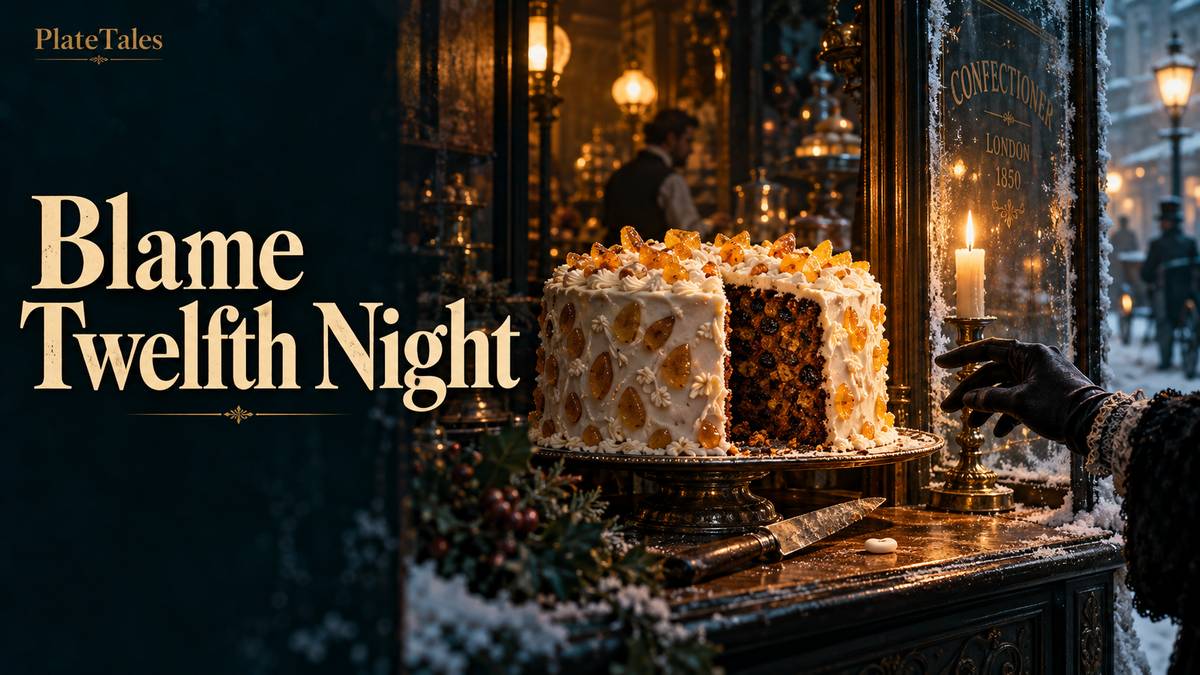
We eat fruitcake at Christmas because of England's Twelfth-cake, a big iced cake full of costly dried fruit and sugar that belonged to Twelfth Night, January 6. As that January party faded in the 1800s, the rich fruit cake settled on Christmas Day instead. Americans later turned it into the gift everyone mails and nobody admits to wanting.
In 1864 Chambers's Book of Days recalled that London confectioners' shops on Twelfth-Day had once been "entirely filled with Twelfth-cakes," priced "from several guineas to a few shillings." Rome and Dresden have their own claims on the cake's origin. They rest on very different evidence.
Rome's satura: the "first fruitcake" was a stuffing
Bakery history pages, including the one Collin Street Bakery publishes, say the Romans ate a dense fruit and nut cake called satura at Saturnalia. The bakery dates this to "around 753 BCE," when, it says, the Roman Republic flourished. The Republic was founded more than two centuries later. The satura-as-cake idea is widely repeated. The trouble is where the word comes from.
Satura survives mainly because Roman scholars argued about the origin of the word for satire. The grammarian Diomedes quotes the antiquarian Varro, who described satura as a kind of stuffing and gave its makeup in the second book of his Plautine Questions: raisins, barley meal and pine nuts, moistened with honeyed wine, and some cooks added pomegranate seeds. The classicist B. L. Ullman worked through the Latin in a 1913 paper in Classical Philology, "Satura and Satire".
So the ingredients are real, and they do look like a fruitcake filling. But the source calls it a stuffing, says nothing about baking, and never mentions Saturnalia. The festival link appears to be a modern decoration. Rome left us the word satire and plenty of real Roman cookery. Its claim on fruitcake is a coincidence of raisins.
Dresden, 1474: a fasting loaf and the butter letter
Germany has the stronger paper trail for a Christmas fruit bread. According to the European Union's protected-name file for Dresdner Christstollen, the first recorded mention of stollen is on a 1474 bill from the hospital of St. Bartholomew in Dresden. That stollen was a fasting food of flour, yeast and water. No fruit, no butter.
The butter problem was the Church's. The same file says a 1450 rule banned baking with butter during Advent, leaving Saxon bakers with oil. The rulers of Saxony, Prince Ernst and Duke Albrecht, asked for an exemption and were refused. In 1490 Pope Innocent VIII issued the Butterbrief, the "butter letter", which let Dresden's stollen bakers off. The name Christstollen shows up in 1530. By 1730 Augustus the Strong could order a stollen of about 1.8 tonnes for his Zeithain military display, made by roughly a hundred bakers.
Was fruitcake ever outlawed?
No law against fruitcake turned up in any source consulted for this story. The closest thing is that Church rule about fat in Advent baking, which Saxony spent forty years trying to get around. If you hear that fruitcake was once banned for being too rich, ask for the date and the statute.
London's Twelfth-cake, king of the bean
England supplies the direct ancestor of the Christmas fruitcake, though it was not baked for December 25. The Twelfth-cake marked Twelfth Night, January 5 or 6, the end of the twelve days. A bean and a pea went into the batter. Whoever found the bean was king for the night, and the pea made a queen. A history blog from the University of Reading traces English references to the bean cake back to the reigns of Edward II and Edward III in the 1300s.
Robert Herrick put it into verse in Hesperides, published in 1648:
Now, now the mirth comes / With the cake full of plums, / Where bean's the king of the sport here
The "plums" there are dried fruit in general, a usage that lasted for centuries: Mrs Beeton's 1861 recipe for Christmas plum-pudding calls for raisins, currants and candied peel, and not one plum. Chambers's Book of Days quotes the Rev. Henry Teonge, a chaplain on one of Charles II's warships, describing a cake on board with "a beane for the king, a pease for the queen, a cloave for the knave."
By the early 1800s the Twelfth-cake was a London spectacle. Chambers describes shops "tastefully illuminated," and its writer remembered one cake built as a fortress, with sentinels and flags, "so large as to fill two ovens in baking." By 1864 the same book reported that the costly Twelfth-cake "has much declined within the last half-century."
How the Twelfth-cake became the Christmas cake
Chambers does not say why the custom declined. The usual explanation is that industrial Victorian Britain no longer kept twelve days of holiday, so the January party lost out to Christmas Day. That account is widely repeated, but no source consulted here pins it to a document. What is clear is the result: the big iced fruit cake survived, and it now turns up in December.
Mrs Beeton's Book of Household Management, published in 1861, catches the moment halfway through. Her recipe headed "Christmas Cake" is a modest treacle and ginger cake with half a pound of raisins, costing about 1s. 6d. The lavish fruitcake in the book is recipe 1753, the "Rich Bride or Christening Cake": five pounds of flour, three of butter, five of currants, sixteen eggs, almonds, candied citron, orange and lemon peel, a gill of wine and a gill of brandy, baked for five to six hours and covered in almond icing and then sugar icing. It cost 2s. a pound. That recipe, not the one labeled Christmas, is the one that looks like a modern British Christmas cake, and like the fruit cake tier at many a British wedding.
The ingredient list explains why this was a feast cake. Imported sugar, candied citrus, almonds, nutmeg, mace and cloves had been luxury goods for centuries, and a cake built from pounds of them was something a household made for a wedding, a christening or the biggest holiday of the year. In a 2002 history of fruitcake for the Village Voice, Robert Sietsema dates the fruitcake proper to the sixteenth century, when cheap colonial sugar made it possible to preserve fruit in ever stronger syrups and Europe found itself with a surplus of candied fruit.
Corsicana and Claxton: America's two fruitcake capitals
The United States did not invent fruitcake, but it industrialized the Christmas gift version, and two small Southern towns both claim the title of fruitcake capital of the world.
In 1896 August Weidmann, a baker from Wiesbaden in Germany, opened a bakery on Collin Street in Corsicana, Texas, backed by Tom McElwee, a local cotton buyer and opera-house owner. Weidmann's fruitcake came from a recipe he brought from Germany. McElwee named it the DeLuxe Fruitcake. According to the Handbook of Texas, in 1914 a Ringling Brothers circus troupe playing Corsicana bought dozens of the cakes as Christmas presents for people around the United States and in Europe. The recipients wrote back for more, and the bakery found itself in the mail-order business. The Handbook puts its season at about 30,000 fruitcakes a day from October to mid-December, shipped to more than 190 countries.
Claxton, Georgia, has a water tower that says the same thing about itself. The Claxton Bakery was founded in 1910 by Savino Tos, an Italian immigrant pastry maker. Albert Parker started working for him at age 11, took over when Tos retired in 1945 and ran it until his death in 1995. After the Second World War, supermarket bread and ice cream ate into the bakery's trade, so Parker decided to specialize in fruitcake. Fundraiser sales carried it through the 1950s. His son Dale Parker calls the rivalry with Corsicana "a friendly competition."
Why is fruitcake a joke?
Mail order is half the answer. A cake that keeps for weeks and ships well in a tin is the perfect gift for an aunt you see once a year, which means a lot of people receive one without choosing it.
Johnny Carson supplied the other half, or at least gets the credit. Sietsema's Village Voice piece quotes the line usually attributed to him: "The worst gift is fruitcake. There is only one fruitcake in the entire world, and people keep sending it to each other." No transcript or air date came up to pin the line to a specific Tonight Show, so treat the wording as the version that circulates. The slang was older than Carson anyway. Sietsema dates "nutty as a fruitcake" to 1935.
By 2002 the joke had its own sport. In Manitou Springs, Colorado, people gathered each year for the Great Fruitcake Toss, and anyone who arrived without a cake could rent one for 25 cents. Sietsema tasted the commercial cakes that year. He called the Collin Street cake's flavor "blah," found Claxton's pale cake too close to pound cake, and gave his vote to a sherry and brandy cake from the monks of Holy Cross Abbey in Berryville, Virginia.
Why does fruitcake last so long?
The quality that made it mailable is the same one that let a household bake it weeks before the feast. The fruit has been preserved in sugar, the cake is dense, and recipes like Beeton's add wine and brandy. Wrapped in paper and sealed in a tin, it keeps for a very long time.
In 2017 conservators from New Zealand's Antarctic Heritage Trust, working through the last badly corroded tins from the huts at Cape Adare, found that one held a Huntley & Palmers fruitcake, still in its paper wrapper. It probably came south with the Northern Party of Robert Falcon Scott's Terra Nova expedition of 1910 to 1913. The trust reported that the cake looked and smelled "(almost) edible." Its artefacts manager, Lizzie Meek, called fruitcake "an ideal high-energy food for Antarctic conditions."
Questions people ask
What was the Twelfth-cake?
The Twelfth-cake was England's big iced fruit cake for Twelfth Night, January 5 or 6, the end of the twelve days of Christmas. A bean and a pea were baked into the batter, and whoever found them became king and queen for the night. English references to the bean cake go back to the 1300s.
Is stollen the same as fruitcake?
No. Dresden's Christstollen is a related German Christmas bread, but its early form was a fasting loaf of flour, yeast and water. The first recorded mention is a 1474 bill from a Dresden hospital. A 1490 papal "butter letter" later let Saxon bakers use butter during Advent. England's Twelfth-cake is the closer ancestor of the fruitcake.
How did Texas make fruitcake a mail-order gift?
Collin Street Bakery in Corsicana, Texas, opened in 1896 and sold a fruitcake called the DeLuxe. In 1914 a Ringling Brothers circus troupe bought dozens as Christmas presents for people across the United States and Europe. The recipients wrote back for more, and the bakery grew into a mail-order business shipping to more than 190 countries.
Did the Romans really eat fruitcake at Saturnalia?
Probably not. The Roman "satura" comes from Varro, quoted by the grammarian Diomedes, who described it as a stuffing of raisins, barley meal and pine nuts in honeyed wine. The source says nothing about baking a cake or about Saturnalia, so the festival link looks like a modern addition.
Filed under Origin Stories, Ritual Foods
Want more stories like this?
One food history story, every week. No spam, just the stories behind what the world eats.