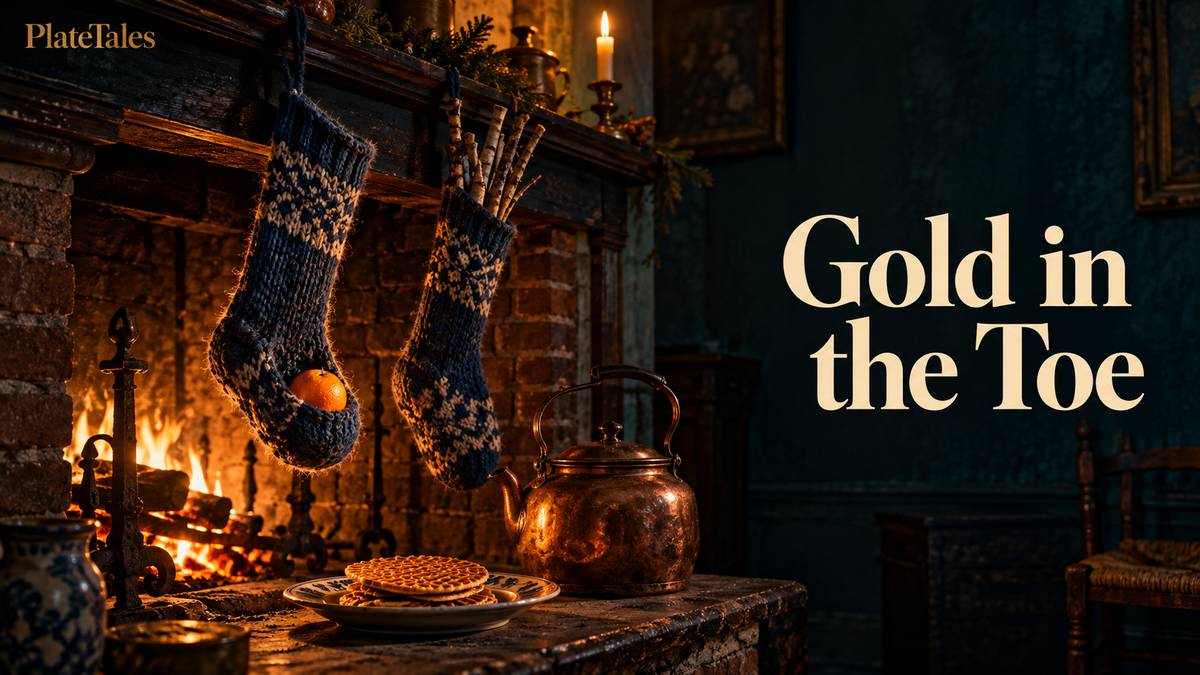
We put an orange in a Christmas stocking because oranges were a sweet, imported fruit that came into season in December, and by the 1800s they were cheap enough in many places to give every child. The popular explanation, that the orange stands for St. Nicholas's gold, has no early source behind it. The earliest dated stocking with oranges in it is described in a New York print from 1810.
Nobody wrote the custom down as a rule. It turns up already in place, in prints, poems and London price lists, and the explanations arrive afterwards.
Is the orange in the Christmas stocking St. Nicholas's gold?
The legend first. Nicholas was a fourth-century bishop of Myra, in what is now southern Turkey. A poor man in his town had three daughters and no money for their dowries, which meant no marriages and a real risk of something worse. Nicholas threw a purse of gold through the family's window at night, then a second. When he came back for the third daughter, the father was awake and caught him.
The earliest full written version is the Life of Saint Nicholas by Michael the Archimandrite, from the early ninth century. That is nearly five hundred years after the saint died, and it has no stocking in it.
In church art the three dowries became three purses, three coins or three balls of gold in the saint's hand. Nicholas is also the patron saint of pawnbrokers, and their sign of three gold balls is often tied to the same story, though some trace it to the Medici instead.
The modern retelling adds the stocking. The St. Nicholas Center, which has gathered Nicholas lore for decades, has the gold sailing through an open window, "landing in a stocking left before the fire to dry." A footnote says plainly: "This is the origin of the custom of hanging a stocking for Santa Claus." Its page on American customs adds that the gold is often shown as balls, and "So the orange in the toe of the stocking is a reminder of Nicholas' gift."
Where the gold-ball story comes from
So the chain runs purse, then gold ball, then orange. Each step works as a symbol. What is missing is an early source that makes the jump to fruit.
The gold-ball reading turns up in devotional writing and in family explanations. Paul Marion of Lowell, Massachusetts, put it this way in a 2010 radio essay: "Nicholas's bag of gold became a ball of gold as the story evolved." It reads like a meaning found for a habit people already had.
When did oranges first show up in a Christmas stocking?
On December 6, 1810, the New-York Historical Society held its first St. Nicholas Festival dinner. John Pintard, one of the society's founders, commissioned a broadside (a single printed sheet) from the engraver Alexander Anderson for the occasion. The New York Commercial Advertiser described it on December 11.
Beside a Dutch fireplace, with a plate of waffles, broiling sausages and a copper tea-kettle, "hang the Annual Blue Yarn Stockings. One, replete with Toys, Oranges, Sugar-plumbs & Oley-cooks, the reward of filial respect and duty; the other containing, alas, nothing but a Birchen Rod." Oley-cooks (oliekoeken, "oil cakes") were fried Dutch dough balls, the ancestor of the oliebol doughnut.
That is the earliest dated American stocking with oranges in it, and it deserves a raised eyebrow. The scene was a Dutch past staged by a New York historical society. The historian Charles W. Jones, quoted by the St. Nicholas Center, said the episode shows "how little true Dutch life existed on Manhattan at the time." Still, Pintard was drawing on something. The Dutch verse printed with the picture came from the memory of an "ancient lady 87 years of age."
The oranges did not become standard overnight. The 1821 New York booklet The Children's Friend, the first to give Santa a reindeer and sleigh, has him leave good children "an apple, or a tart." Clement Clarke Moore's poem, printed anonymously in the Troy Sentinel on December 23, 1823, fills the stockings with toys and names no fruit at all. The sugar-plums are only in the children's dreams (the story of sugar explains why sweets were worth dreaming about).
Why an orange and not an apple?
The Dutch verse on Pintard's broadside answers part of that. It asks the saint to travel "From Amsterdam to Hispanje, Where apples bright of Oranje" grow, in the St. Nicholas Center's translation. Accounts treat the 1810 pamphlet as the earliest source that connects the saint with Spain, and the connection runs through the fruit: he went to Spain for the oranges.
Over time the fruit errand turned into an address. Sinterklaas is now said to come from Spain, and he arrives in the Netherlands each year by steamboat. Mandarins are still among the typical Sinterklaas treats.
The calendar did the rest. An apple was something you kept in your own cellar. An orange came from somewhere warm, and it came in winter. Henry Mayhew recorded that London's orange cargoes kept arriving "from October to August." In California the Washington navel orange ripens at Riverside from November to January.
By the time Clement Miles wrote Christmas in Ritual and Tradition in 1912, oranges were Christmas objects in several corners of Europe. He quotes a Derbyshire account of the "kissing bunch," a frame of hoops dressed in holly and ivy, hung with "apples, oranges tied to strings." In the mountains above Risano, in Lower Dalmatia, the head of the house set a bowl of corn, an orange and a ploughshare on the badnjak, the Christmas log, "in order that the corn may grow well and the beasts be healthy." Our ritual foods stories cover more food tied to one day of the year.
Why were oranges a Christmas gift if they were so cheap?
In London they were cheap, and this is where the popular story wobbles. Mayhew's London Labour and the London Poor (1851) reports that between 250 and 300 million oranges and lemons were shipped to England every year.
Retailers bought them by the "hundred," which actually meant 110. In December a hundred cost 2s. 6d. to 4s. (two shillings and sixpence to four shillings), and Mayhew notes they were "rarely lower than 4s. about Christmas, as there is then a better demand for them." That works out to under a halfpenny an orange, wholesale. The street trade was "almost entirely in the hands of the Irish and their children," and costermongers (street sellers) called the orange season the "Irishman's harvest."
Charles Dickens shows the same thing in 1843. Bob Cratchit earns fifteen shillings a week, and after the goose and the pudding, "apples and oranges" go on the table.
America was a different market, because distance set the price. Florida had the Dancy tangerine from 1867, a loose-peeled fruit also known as the "kid-glove orange." By 1895 the state was producing as much as six million boxes of citrus a year. Then came the Great Freeze, in December 1894 and again in February 1895. Production fell to about 100,000 boxes and did not pass a million again until 1901.
In California, William Saunders mailed two young navel trees from Washington, D.C., to Eliza Tibbets in Riverside (accounts differ: some give 1873, while the University of California, Riverside citrus collection dates the planting to March 1874). The Santa Fe railroad opened a direct line to Riverside in 1886, and refrigerated cars carried oranges east about eight years later. For a family in Ohio or Iowa, a December orange cost whatever the freight cost.
Did the citrus growers invent the Christmas orange?
A common version of this story says the growers' advertising made oranges a Christmas gift. The better-documented story runs the other way.
The Southern California Fruit Exchange formed in Claremont in 1893. By 1907 the state was growing five times as many oranges as fifteen years before, and some growers were cutting down trees. The Lord & Thomas agency, under Albert Lasker, ran a 1907 campaign in Iowa that reportedly lifted orange sales there by half. The Sunkist name came out of the same push, and in 1909 an offer of a branded spoon for twelve wrappers drew about a million claims in its first year.
The historian Douglas Cazaux Sackman, in Orange Empire (2005), describes the goal as turning the orange from a Christmas luxury into something people ate every day. The Christmas orange was the habit the growers wanted to move past. They still used it when it suited them; a 1928 Sunkist ad features Santa Claus.
Why were oranges a Christmas gift in the Depression?
This is the part everyone has heard from a grandparent, and it rests almost entirely on memory. Marion's essay recalls that when his parents were growing up in Lowell in the 1930s, "an orange was a treat in a poor family." Years later they put oranges in their own sons' stockings, giving them "their own kind of gold."
A reader replying to the essay remembered a grandfather, born in Lowell in 1900, who "would always tell my brothers and I about getting an orange for Christmas." Stories like these are everywhere, and nothing in the record contradicts them.
What the sources read for this piece do not hold is any count of how many children got an orange and little else. Treat "the orange was the whole gift" as family history, often true and rarely counted. The same thrift runs through our forgotten recipes from grandmother's kitchen.
Where does the mandarin in the toe come from?
In Canada the stocking fruit is often a small, easy-peeling mandarin, and it has its own line of descent. According to BC Agriculture in the Classroom, the custom goes back to the 1880s, when Japanese immigrants in Canada and the United States began receiving mandarins from home as New Year gifts. Their neighbours took it up, and the fruit, each one wrapped in soft green paper, went into Christmas stockings.
Marion's essay notes that in British Columbia the arrival of the first mandarins from Japan is greeted with a festival in Vancouver, Santa Claus and Japanese dancers together. "Orange Trains," with boxcars painted orange, told people along the line that the fruit was back. It is one of the quieter cases of immigration reshaping North American food.
Imports of the Japanese fruit to the United States stopped during the Second World War. When it came back, the hostility had not worn off, and the boxes were sold as "Mandarin" oranges instead of "Japanese" ones.
Questions people ask
Who was the first to describe oranges in a Christmas stocking?
The earliest dated example is a broadside by the engraver Alexander Anderson, commissioned by John Pintard for the New-York Historical Society's St. Nicholas dinner on December 6, 1810. One blue yarn stocking held toys, oranges, sugar-plums and oley-cooks, while the other held only a birch rod.
Were oranges expensive in the 1800s?
It depended on where you lived. In London, Henry Mayhew's 1851 survey found a hundred oranges cost 2s. 6d. to 4s. in December, under a halfpenny each wholesale. In America, distance set the price, so a December orange in Ohio or Iowa cost whatever the freight cost.
Why do Canadians put a mandarin in the stocking?
The custom is traced to the 1880s, when Japanese immigrants in Canada and the United States received mandarins from home as New Year gifts. Neighbours took up the habit, and the small, easy-peeling fruit, wrapped in soft green paper, went into Christmas stockings.
Did citrus growers invent the Christmas orange?
No. The better-documented story runs the other way. Californian growers, including the Southern California Fruit Exchange and the Sunkist campaigns, wanted oranges eaten every day, and the historian Douglas Cazaux Sackman describes the Christmas luxury as the habit they wanted to move past.
Filed under Origin Stories, Ritual Foods
Want more stories like this?
One food history story, every week. No spam, just the stories behind what the world eats.