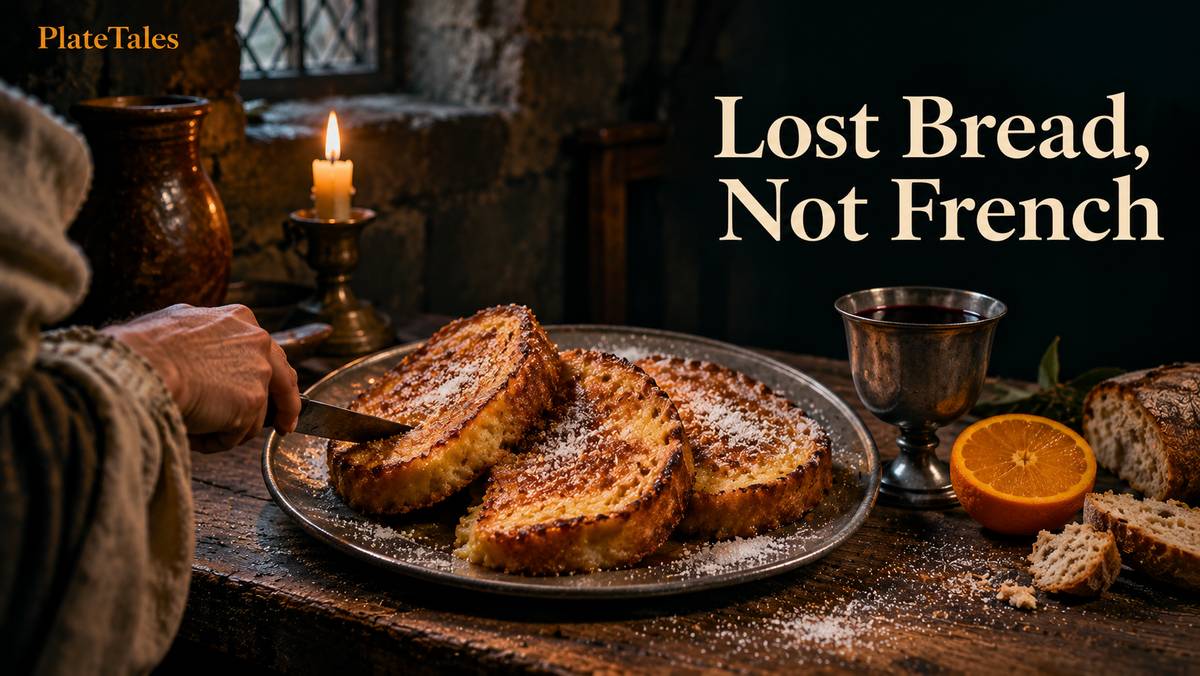
French toast starts in Rome, not France. A late Roman cookbook attributed to Apicius has a recipe for white bread soaked in milk, fried in oil and covered with honey. The English phrase "French toasts" is on record by 1660, for a dish with no egg at all. The tale of an Albany innkeeper named Joseph French in 1724 is a legend.
French toast begins with an Apicius recipe
The collection called Apicius, usually dated to the late Roman Empire, has a short chapter of sweets. One entry is numbered 296 in Joseph Dommers Vehling's English edition, Cookery and Dining in Imperial Rome, with a preface signed in Chicago in the spring of 1926. The Latin heading is aliter dulcia, "another sweet dish."
Vehling's translation reads: "Break fine white bread, crust removed, into rather large pieces which soak in milk [and beaten eggs] fry in oil, cover with honey and serve." The words in square brackets are his own addition, a guess that eggs belonged there. The Latin as he gives it does not say so, which is why careful writers call this a relative of French toast and not the dish itself.
Vehling saw the family likeness at once. His footnote to the recipe reads: "'French' Toast, indeed!"
The idea behind it is plain enough. Bread that has gone dry will drink up a liquid, and a hot pan turns the soaked slice into something soft inside and crisp outside. A Roman kitchen could have used up yesterday's loaf the same way (more in our look at ancient Roman recipes).
Medieval fried bread in wine and syrup
No single line of cooks leads from Apicius to the breakfast table. What the record shows is the same trick turning up again whenever stale bread needed a second life.
The Forme of Cury, an English roll of recipes compiled about 1390, has one called payn fondew. Its instruction is to take bread and fry it in grease or oil, then lay it in red wine, with a honey, sugar and spice syrup made from egg whites to go with it. It is fried bread, soaked, sweetened and dressed up for a noble table. It is not the milk-and-egg slice, though the family resemblance is hard to miss. For more dishes of this age, see forgotten medieval recipes.
The French name, pain perdu, means "lost bread." Slate's explainer on the name suggests the reason may be that the batter rescues bread that would otherwise be thrown away. In Cajun country, the same writer notes, "pain perdu" is local slang for a richer version of French toast. Food Republic adds that the French dish was a custard-soaked treatment of stale bread, and that its French name does not prove it began in France.
The 1660 recipe that has no egg
Here is the odd part. The oldest use of "French toast" the Oxford English Dictionary cites, according to Slate, is from 1660, in Robert May's The Accomplisht Cook. The text of May's book on Project Gutenberg is the 1685 edition printed in London for Obadiah Blagrave, and it still carries the recipe.
Under the heading "French Toasts," May writes: "Cut French bread, and toast it in pretty thick toasts on a clean gridiron, and serve them steeped in claret, sack, or any wine, with sugar and juyce of orange."
Read it again. The bread is toasted on a gridiron, the liquid is wine, and there is no egg, no milk and no frying pan. The recipe sits among his other "toasts of divers sorts," which include cinnamon toasts and bread fried in butter. As far as this page shows, "French" here describes the loaf, "French bread," and May does not say it describes a country of origin. That is a reading of the recipe, not something May states, and nothing in it says the dish came from France.
So the name was in English print for a dish that looks little like what we mean today. The sweet fried slice dipped in egg and milk would arrive under that name later.
Panperdy, the egg version in 1615
Eggs enter the English record earlier than the 1870 date suggests. Food Republic points to The English Huswife, printed in 1615, which has a recipe it spells "panperdy": sliced bread soaked in eggs, spices, sugar and salt. The name is plainly the French pain perdu in English spelling, 45 years before May's eggless "French Toasts." Two names, then, for two different treatments of bread, sitting side by side in seventeenth-century England.
The same article notes that the dish carries other names elsewhere, among them "eggy bread" and "Gypsy toast."
The Albany innkeeper who probably never existed
The story most often told online is this. In 1724 an innkeeper in Albany, New York, named Joseph French served the dish and called it French toast because he never learned to use an apostrophe-s. Slate's explainer calls it a "contradictory, though highly dubious" creation myth.
The date alone sinks it. May's recipe was in print in 1660, 64 years before Joseph French is supposed to have named anything, and the 1390 roll and the Roman text are older still. A name that was already in a cookbook cannot be coined by a man in a tavern more than six decades later.
Egg toast, Spanish toast, German toast
The egg-and-milk version took its time. Slate reports that the Dictionary of American Food and Drink places the first egg-based recipe in print in 1870, and that in the late nineteenth century similar recipes went by names like "Egg toast," "Spanish toast" and "German toast." Food Republic, for its part, quotes the term "French toast" appearing in an 1871 American food reference.
Other breakfast batters have their own tangled names, as the stories of pancakes and waffles show.
Slate also dismisses a tidy First World War story, that "German toast" was renamed "French toast" out of patriotic feeling, as apocryphal.
The name has had a more recent political life. In spring 2003 some American menus renamed the dish "Freedom toast" in protest at France's opposition to Gulf War II, and that September Representative Sheila Jackson Lee of Texas wanted the House cafeteria to list "French toast" again.
Questions people ask
Is French toast actually French?
No. A Roman cookbook attributed to Apicius has a related recipe of fried milk-soaked bread with honey, and an English roll from about 1390 has fried bread in wine. The English phrase "French toasts" appears in Robert May's The Accomplisht Cook, cited by the Oxford English Dictionary as of 1660, for a wine-soaked toast.
What does pain perdu mean?
Pain perdu is French for "lost bread." One explanation is that the soaking batter saves bread that would otherwise be thrown away. In Cajun country in Louisiana, the name is also slang for a richer version of French toast.
Did Joseph French invent French toast in Albany in 1724?
Almost certainly not. The story says an Albany innkeeper named Joseph French named the dish after himself in 1724, but Robert May printed a recipe titled "French Toasts" in The Accomplisht Cook in 1660, and Slate calls the tale a dubious creation myth.
Did the Romans eat French toast?
Something close to it. Joseph Dommers Vehling's English edition of Apicius gives recipe 296 as fine white bread without the crust, soaked in milk, fried in oil and covered with honey. The translator added a bracketed note that beaten eggs may belong in it, so the Latin text itself may not mention eggs.
Filed under Forgotten Recipes
Want more stories like this?
One food history story, every week. No spam, just the stories behind what the world eats.