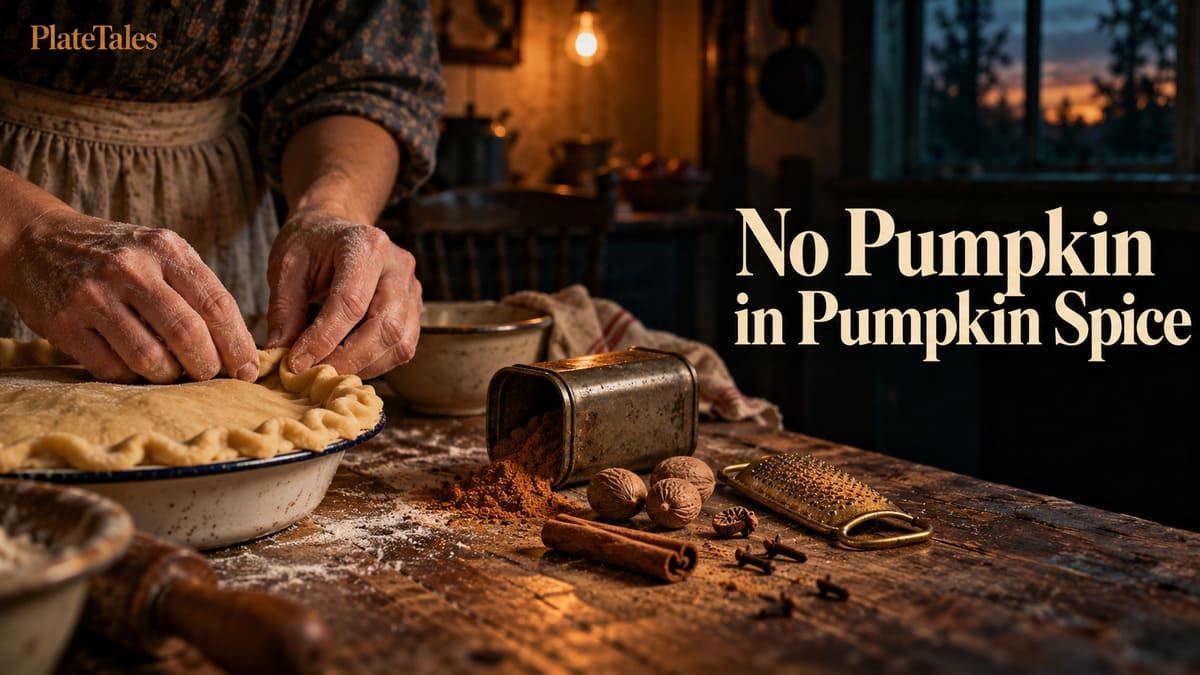
The history of pumpkin spice starts long before the latte and has almost nothing to do with pumpkin. The blend is cinnamon, ginger, nutmeg and allspice or cloves, and American cooks were putting some mix of those spices in pumpkin pie by 1796. Spice companies began selling it premixed in the early 1930s, and Starbucks turned it into a drink in 2003.
No single person can be credited with inventing it. What survives is a paper trail: a Hartford cookbook, some Depression-era newspaper ads, a company's own account of itself, and a trial run in 100 coffee shops. The trail has holes, and they are marked below.
What is pumpkin spice made of?
Dried and ground plant parts. Cinnamon is bark, nutmeg is a seed, cloves are flower buds, allspice is a berry and ginger is a rhizome. McCormick's current tin holds cinnamon, ginger, nutmeg and allspice, a formula the company told Food Republic it has used since June 2002. Its earlier version also had cloves, and plenty of rival blends still do.
There is no pumpkin in it. The name is shorthand for "pumpkin pie spice", meaning spice for a pumpkin pie, the way poultry seasoning contains no poultry. The Newspapers.com archive blog says newspapers trying to save space sometimes dropped the "pie", and it shows an ad from 1931 that does exactly that.
The cinnamon in an American tin is probably cassia, the usual commercial type in the United States. It comes from a related tree and is thicker and harder than true Ceylon cinnamon, which is thin and crumbles easily. That the cinnamon trade sells two different barks under one name is a story of its own.
Who invented pumpkin spice, and when did it start?
The first company known to have sold a ready-mixed "Pumpkin Pie Spice" was Thomson & Taylor, and it got there before McCormick. Karen Lee, writing for Newspapers.com in 2019 from that site's scanned pages, puts the product's introduction in 1930 and reproduces an ad for it from the St. Louis Post-Dispatch of October 20, 1933. Food Republic describes the blend in the 1933 advertising as a mix of nine spices. The two accounts cannot even agree on the firm's spelling: Thompson in one, Thomson in the other.
McCormick & Company of Baltimore followed in 1934. That date comes from the company and is repeated by Preservation Maryland and most other accounts. What McCormick first sold is less tidy than the usual telling. A company representative told Food Republic that the 1934 product included cloves and was marketed as "Pumpkin Pie & Gingerbread Spice", and Newspapers.com says McCormick briefly sold a "Pumpkin Pie & Ginger Bread Spice" in the mid-1930s. The famous tin began as a two-purpose baking mix.
| Year | What the record shows |
|---|---|
| 1796 | Amelia Simmons prints two spiced "pompkin" puddings in Hartford |
| 1930 | Thomson & Taylor's premixed Pumpkin Pie Spice, per Newspapers.com |
| 1931 | "Pumpkin spice" appears as a shortened name in an ad |
| 1934 | McCormick's blend goes on sale |
| 1957 | A pumpkin spice ice cream is advertised in the News-Messenger |
| 2003 | Starbucks tests the Pumpkin Spice Latte |
Was it made to go with canned pumpkin?
Possibly. The common explanation is that McCormick was answering Libby's canned pumpkin, which Tasting Table, citing Better Homes & Gardens, dates to 1929. One can, one tin, one pie. As a guess about timing it is reasonable. But nobody quotes a McCormick memo or advertisement that says so, and Thomson & Taylor was already in the market. It is an inference, and should be read as one.
How far back does the history of pumpkin spice go in the kitchen?
In America, to 1796. That year Amelia Simmons, who signed herself "an American Orphan", had American Cookery printed by Hudson & Goodwin in Hartford. It is generally called the first cookbook written by an American and published in the United States, and it has two recipes under the heading "Pompkin". The first is seasoned with "mace, nutmeg and ginger". The second reads, in full:
One quart of milk, 1 pint pompkin, 4 eggs, molasses, allspice and ginger in a crust, bake 1 hour.
Look at what is missing. Neither pudding has cinnamon, though Simmons uses it elsewhere in the same book, in her apple pie and her molasses gingerbread. Cloves are absent too. The modern blend settled later, and Simmons would have recognized about half of it. Her timing was good, though: according to Andrew F. Smith's entry in The Oxford Encyclopedia of Food and Drink in America, pumpkin pie became a regular part of Thanksgiving dinner in the early nineteenth century.
English cooks had been baking pumpkin for longer and seasoning it differently. Hannah Woolley's The Queen-like Closet, from the 1670s, has a recipe "To make a Pumpion Pie" in which slices of pumpkin are dipped in beaten eggs and "Herbs shred small", then baked with apples, currants and sack. Amanda Herbert, who cooked from it for the Folger Shakespeare Library in 2017, put cinnamon, nutmeg and cloves into her modern adaptation. The original names no spices at all.
Sweet spice mixtures themselves are medieval. The historian Ken Mondschein points to Le Ménagier de Paris, a household book of the early 1390s, which gives a powder of 17 parts ginger, 4 parts each of cinnamon and sugar, and 2 parts each of cloves and grains of paradise. Spices like these went into sauces for capon and rabbit and into spiced wine. Keeping them for dessert is the newer habit, as medieval recipes make plain.
Where did pumpkin pie spice come from before the tin?
From a short list of islands, and at a cost. Nutmeg and mace are two parts of the same fruit, and for most of recorded history the trees grew in one place, the Banda Islands of eastern Indonesia. A team led by the archaeologist Peter Lape reported in 2018 that residue on potsherds from Pulau Ai, one of the Bandas, showed nutmeg in use about 3,500 years ago.
In 1621 the Dutch East India Company under Jan Pieterszoon Coen took the islands by force to secure a monopoly. The islands had perhaps 13,000 to 15,000 people before the conquest. Historians estimate that about 1,000 Bandanese were left on the islands afterward; the rest were killed, enslaved or fled, in numbers nobody can pin down. In 1667, under the Treaty of Breda, England gave up its claim to the small nutmeg island of Run and kept New Amsterdam, which it had already renamed New York. So the nutmeg in a pie tin is tangled up with the deed to Manhattan.
The Dutch monopoly broke during the Napoleonic Wars, when the British briefly held the Bandas and carried nutmeg trees off, soil and all, to Ceylon, Penang, Bencoolen and Singapore.
Cinnamon has a parallel story in Sri Lanka, controlled by the Portuguese in the 1500s, by the Dutch from the middle of the 1600s and by the British from 1796, the same year Simmons went to press. These spices traveled the routes that had already made fortunes in black pepper.
Allspice is the odd one out. It is native to the Greater Antilles, southern Mexico and Central America, and the Oxford English Dictionary dates the English name to 1621, coined because the berry seemed to taste of cinnamon, nutmeg and clove at once. One berry, doing an impression of the whole blend, three centuries before anyone tinned the blend.
When did pumpkin spice become a latte?
In 2003, though Starbucks was not first. Stereogum turned up a September 1995 review in The Rocket of a Tori Amos show in Seattle, where she described a brew of her own: "Well, I have one that tastes like pumpkin pie. It's my own invention." The Daily Meal cites a 1980 item in the Montreal Gazette recommending pumpkin spice in coffee in place of sugar, and says a roaster called Fasig's Coffee started experimenting with a pumpkin spice coffee in the fall of 1997.
Starbucks began work early in 2003, looking for an autumn counterpart to its Peppermint Mocha and Eggnog Latte. Peter Dukes, then a product manager in the company's espresso division, led the team. Seattle Met's 2014 account says his team drew up about 20 possible flavors, and in an online customer survey the pumpkin pie latte landed "near the bottom middle".
It went ahead anyway as one of four prototypes, alongside a chocolate-caramel drink, a cinnamon streusel latte and an orange-and-spice one. Tim Kern, a former Starbucks executive, later recalled colleagues worrying about a drink "so dominated by a flavor other than coffee".
That fall the drink went on trial in 100 stores in Vancouver and Washington, D.C. Sales beat expectations, and in 2004 it went to every Starbucks in the United States. By 2013 the company had sold more than 200 million of them.
Is there any pumpkin in pumpkin spice now?
In the tin, none, and there never was. In the cup, some. For its first twelve years the Starbucks sauce had no pumpkin in it, and its orange color came from artificial dye. The company applied to trademark the initials "PSL" in 2013. Then, in August 2015, it changed the sauce to include pumpkin puree along with cinnamon, ginger, nutmeg and cloves, and dropped the artificial coloring. The pumpkin arrived 12 years after the drink and 219 years after Amelia Simmons wrote down her pint of pompkin.
Questions people ask
Is there really no pumpkin in pumpkin spice?
Right. Pumpkin spice, also sold as pumpkin pie spice, is a blend of cinnamon, ginger, nutmeg and allspice, and sometimes cloves. The name is shorthand for spice for a pumpkin pie. Starbucks made its Pumpkin Spice Latte sauce without pumpkin for its first twelve years, adding puree only in August 2015.
Who made the first premixed pumpkin pie spice?
The earliest known seller of a ready-mixed Pumpkin Pie Spice was Thomson & Taylor, which Newspapers.com places in 1930, with a surviving ad from 1933. McCormick & Company of Baltimore followed in 1934, first marketing its blend as Pumpkin Pie & Gingerbread Spice.
Did Starbucks invent the pumpkin spice latte?
Starbucks popularized it but may not have been first. The company tested the drink in 100 stores in Vancouver and Washington, D.C. in fall 2003, then sold it nationwide in 2004. Earlier mentions include a 1980 Montreal Gazette item about pumpkin spice in coffee and a roaster's pumpkin spice coffee in 1997.
What was the earliest American pumpkin pie recipe with these spices?
Amelia Simmons printed two spiced pumpkin puddings in American Cookery, published in Hartford in 1796. One used mace, nutmeg and ginger, the other allspice and ginger. Neither used cinnamon or cloves, so the modern blend settled on its familiar mix of spices later.
Filed under Origin Stories, Trade Routes
Want more stories like this?
One food history story, every week. No spam, just the stories behind what the world eats.