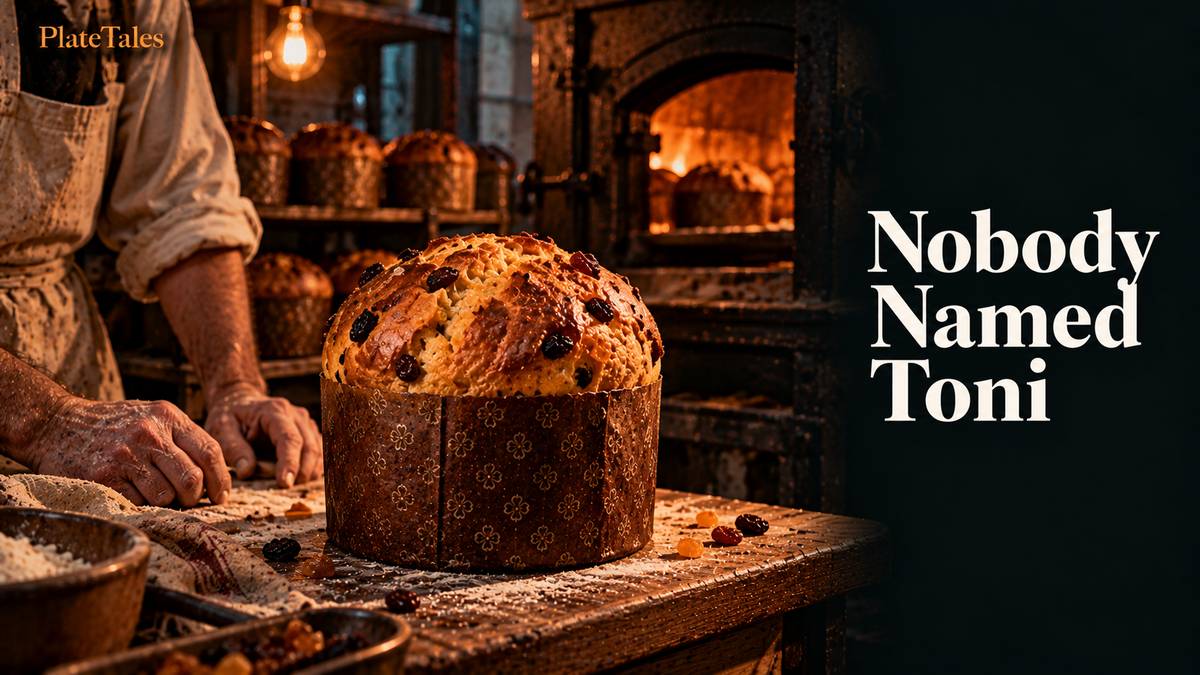
Panettone's origin is Milan, where it grew slowly out of the big wheat loaves baked for Christmas in the late Middle Ages. No single person invented it, least of all a kitchen boy named Toni. The famous shape is the recent part: the tall, domed cake in a paper collar dates from Milan just after the First World War. Before that, the Christmas bread was lower and flatter.
The legends are older than the shape but far younger than the bread. Here is what the paper trail shows, oldest first.
The oldest panettone origin record: three loaves at the Sforza court
The earliest text usually cited is a Latin manuscript by Giorgio Valagussa, a tutor at the Sforza court in Milan. Its title, De origine et causis caerimoniarum quae celebrantur in Nataliciis, promises to explain the ceremonies held at Christmas. In the version retold by the Italian food site Dissapore, the duke's sons ask him about the customs, and he answers: "Panes tres magnitudine praestantes, ut scis, hic diebus conficiuntur." As you know, three breads of outstanding size are made on these days.
The breads belonged to the rito del ciocco, the rite of the log. A big log burned in the hearth on Christmas Eve, and the head of the household marked a cross on the three great loaves before sharing them out. La Voce di New York adds that the three stood for the Trinity.
The manuscript is in Milan's Ambrosiana Library. La Voce dates it to about 1470, while Italian accounts say only the late fifteenth century.
Nothing in the passage mentions butter, raisins or candied fruit. Valagussa's loaves are ancestors, part of the long story of bread, and the habit of breaking one loaf for a whole household is a reminder of why bread carries so much weight at feasts.
Dissapore and the panettone maker Flamigni both mention a Milan rule, tied to 1395 and the Visconti dukes, about ordinary bakers being allowed to make wheat bread at Christmas. They tell it differently and neither quotes the edict, so treat it as unconfirmed.
A college ledger in Pavia, 1599
The first record of a Christmas bread with ingredients we would recognize comes from an accountant. On 23 December 1599 the expense register of the Collegio Borromeo in Pavia, a residential college for students, listed 5 libbre (pounds) of butter, 2 libbre of raisins and 3 once (ounces) of spices. They went to the baker to make 13 "pani grossi," big breads, for the students on Christmas Day.
This is the oldest certain record of big breads made with butter, raisins and spices, and the 13 loaves are the oldest attestation of such a bread.
Why is it called panettone?
The name turns up in print a few years later. Giovanni Capis, a scholar from Domodossola, compiled the Varon milanes de la lengua de Milan, a glossary of about 570 Milanese words. It was first printed in Pavia, and its second edition came out in Milan in 1606. Dissapore gives its entry as "Paneton de Danedaa."
The gloss, as the linguist Giuseppe Sergio quotes it for the Accademia della Crusca, is "pan grosso, qual si suol fare il giorno di Natale": a big bread of the kind usually made on Christmas Day. That is the etymology. The Treccani dictionary derives the Italian word from Milanese panattón, from pane, bread, and the ending marks something large. Panettone is "the big bread."
The eighteenth century adds a writer. Pietro Verri, the Milanese economist, wrote in his Storia di Milano (1783) that on Christmas Day in the ninth century "si usavano dei pani grandi," big breads were used. Several modern accounts also credit Verri with the phrase "pan de ton," glossed as luxury bread. The sources read for this story never showed that phrase in Verri's own text, so the safe claim is the plain one: Verri tied big bread to Christmas.
Who invented panettone? The legend of pan de Toni and two rivals
Three legends do the inventing, and they contradict each other.
| Legend | The story | What it explains |
|---|---|---|
| Toni the kitchen boy | At a Christmas banquet of Ludovico il Moro, the dessert burns and a boy named Toni saves the night with a loaf made from leftover dough | The name, as "Toni's bread" |
| Ughetto degli Atellani | A young man, in some versions a falconer called Ulivo, works for a baker to win his daughter, Adalgisa, and enriches the bread with butter and fruit | The rich dough |
| Sister Ughetta | A cook in a poor convent cuts a cross into the dough before baking | The cross on top, and the Milanese word ughetta, raisin |
None of them has a document behind it. Flamigni dates the Toni story to the late nineteenth or early twentieth century, about four hundred years after Ludovico's banquets. Linkiesta, drawing on the Crusca, notes that Motta used the Ughetto story in an advertisement in 1949. The Ughetta version gives itself away: it explains raisins with a nun named after them.
The croissant went through the same thing, as the Vienna siege story shows. An old food picks up a named inventor and a royal banquet, usually around the time someone starts selling it in bulk.
The history of panettone in 19th-century cookbooks
In the nineteenth century panettone stops being only a custom and becomes a recipe. Francesco Cherubini's Milanese-Italian dictionary, in its 1841 volume, defines "Panatton de Nadal" as "Spe' di pane di frumento addobbato con burro, uova, zucchero e uva passerina o sultana." That is a kind of wheat bread dressed up with butter, eggs, sugar and currants or sultanas. (Some accounts give 1839, the year the first volume came out.)
In 1853 Giovanni Felice Luraschi printed "Pasta per far panatoni" in the third edition of his Nuovo cuoco milanese economico, the first recipe to name yeast. A year later Giovanni Vialardi, cook to the House of Savoy, added candied citron in his Trattato di cucina, pasticceria moderna. That joined the cake to the long trade in sugar-preserved fruit.
Pellegrino Artusi, the Florentine who wrote Italy's best-known home cookbook, included a "Panettone Marietta," named for his cook, Marietta. His version rises with cream of tartar and baking soda, not yeast. Artusi says it is much better than the panettone of Milan sold in shops.
Why is panettone tall? Angelo Motta's paper collar
Until the early twentieth century, according to Flamigni, panettone was baked without a mould. Angelo Motta, born in Gessate near Milan in 1890, opened his first oven in Milan in 1919.
Motta used more eggs and butter and, according to La Voce, let the dough rise three times over nearly 20 hours. Then he baked it inside a tall band of paper, so it had nowhere to go but up. The result is the cylinder with a mushroom cap that fills Italian supermarkets every December.
Flamigni and Dissapore both say the idea came from kulich, the tall Russian Easter bread. Flamigni adds that Motta had to make two hundred of them for Milan's Russian community in the 1920s. Both sources sell or celebrate panettone, and no document is cited, so the kulich story is likely, not proven.
Around 1925 a rival Milanese baker, Gioacchino Alemagna, adapted the method under his own name. Between them, the two firms turned a city's Christmas bread into a factory product. Flamigni now says flatly that panettone cannot be made without paper baking cups.
Motta was made a Cavaliere del lavoro, an Italian honor for business leaders, in 1938, and moved into ice cream in the late 1940s. He died in Milan on 26 December 1957, of a heart attack, after spending Christmas with his family.
A 2005 decree, pan dulce and panetón
The two brands outlived their founders but not their independence. Nestle took over Motta and Alemagna in the late 1990s, and in 2009 Bauli of Verona bought their baked goods from Nestle. Italian producers made 117 million panettoni and pandori for Christmas 2007.
By then the state had decided what the word means. A ministerial decree of 22 July 2005 sets minimums by weight for a cake sold as panettone in Italy: at least 16 percent butterfat, at least 4 percent egg yolk, and at least 20 percent sultanas plus candied orange and citron peel. Valagussa's three wheat loaves would fail on every count.
The bread also left Milan with emigrants. Ruggero Bauli sailed for Argentina in October 1927 aboard the liner Principessa Mafalda, survived its sinking off Brazil, and worked as a pastry cook in Buenos Aires before going home to Verona in 1937. His company spread panettone in Argentina, where it is called pan dulce. In Peru, where Italian immigrants brought it, it is panetón, and by the late 2010s Peruvians ate more of it per person than Italians, about 1.1 kilograms each a year.
Questions people ask
What does the word panettone mean?
Panettone means "big bread." It comes from the Milanese word panattón, from pane, bread, with an ending that marks something large. A Milan glossary of 1606 defined the Christmas loaf as "pan grosso," a big bread of the kind usually made on Christmas Day.
Was there a real boy named Toni who invented panettone?
No document supports the story of Toni, the kitchen boy of Ludovico il Moro. The panettone maker Flamigni dates the tale to the late nineteenth or early twentieth century, about four hundred years after the banquets it describes. The name comes from the Milanese word for a big bread.
What is the oldest record of Milan's Christmas bread with butter and raisins?
The oldest certain record is an expense register of the Collegio Borromeo in Pavia, dated 23 December 1599. It lists butter, raisins and spices bought for a baker to make 13 big breads for the students on Christmas Day. Earlier Milanese sources mention only plain wheat loaves.
Why is panettone tall and domed?
Panettone is tall because Angelo Motta, a baker who opened his first Milan oven in 1919, baked the dough inside a high band of paper. The dough had nowhere to go but up. His rival Gioacchino Alemagna copied the method around 1925, and the paper collar became standard.
What must a cake contain to be sold as panettone in Italy?
A ministerial decree of 22 July 2005 sets minimums by weight for panettone sold in Italy: at least 16 percent butterfat, at least 4 percent egg yolk, and at least 20 percent sultanas plus candied orange and citron peel.
Filed under Origin Stories, Ritual Foods
Want more stories like this?
One food history story, every week. No spam, just the stories behind what the world eats.