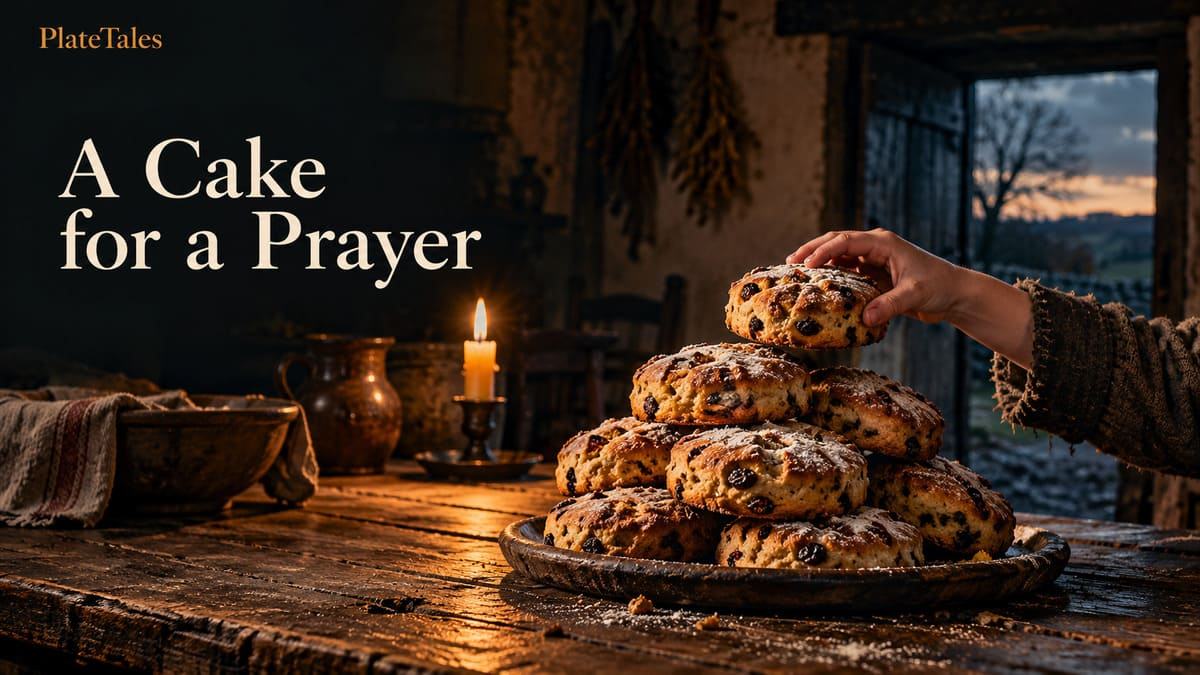
Soul cakes were small spiced cakes handed out in England around All Souls' Day, November 2, in return for prayers for the dead. The custom was reported by 1511, and its clearest early description comes from Shropshire in 1686, where John Aubrey recorded "a high heap of Soule-cakes" set out for visitors. The popular claim that soul cakes turned into trick-or-treating is weaker than it looks.
What are soul cakes? Aubrey's heap in Shropshire, 1686
Aubrey wrote the scene into a manuscript he called Remaines of Gentilisme and Judaisme, dated 1686 to 1687 and not printed until the Folk-Lore Society published it in 1881. His note is short. "In Salop," he wrote, on All Souls' Day "there is sett on the Board a high heap of Soule-cakes, lyeing one upon another like the picture of the Sew-Bread in the old Bibles."
They were "about the bignesse of 2d cakes", the size of a twopenny cake, and nearly every visitor that day took one. Aubrey added that "This custome is continued to this time." Then he wrote down what he called "an old Rhythm or saying":
A Soule-cake, a Soule-cake, Have mercy on all Christen soules for a Soule-cake.
That couplet is the whole deal. All Souls' Day was set aside for praying for the souls in purgatory, a feast the 11th-century abbot Odilo of Cluny established for his monasteries and the rest of the Western church then took up. If the dead could be helped along by the prayers of the living, a household with dead of its own had a reason to want prayers, and the poor had something to offer. A cake was the price.
A few pages on he describes the Herefordshire sin-eater, a poor man handed a loaf, a maple bowl of beer and sixpence over a corpse, in return for taking on the dead person's sins. Food for the dead, eaten by someone else, was an ordinary idea to him, and he compared the soul cakes to the Roman feast of the dead, the Feralia. It is the same instinct behind bread's sacred status in so many cultures.
Soul cake origin: how far back the custom goes
The Halloween historian Lisa Morton puts the earliest report of souling in 1511, and historians generally trace the custom to at least the 1400s.
Shakespeare assumed his audience knew it. In The Two Gentlemen of Verona, written in the early 1590s, the servant Speed mocks his lovesick master for learning "to speak puling, like a beggar at Hallowmas." Puling means whining. Hallowmas is the feast of All Saints, the day before All Souls, when the beggars were out.
Appleton, 1604: the oldest soul cake recipe has no measurements
What did a soul cake taste like? The earliest recipe usually cited belongs to Elinor Fettiplace, born Elinor Poole around 1570. She married Richard Fettiplace in 1589 and ran Appleton Manor, then in Berkshire and now in Oxfordshire. Her receipt book is signed and dated 1604. It passed down through the family until it reached the husband of the biographer Hilary Spurling, who published it in 1986.
The recipe reads, in full: "Take flower & sugar & nutmeg & cloves & mace & sweet butter & sack & a little ale barme, beat your spice, & put in your butter & your sack, cold, then work it well all together, & make it in little cakes, & so bake them, if you will you may put in some saffron into them and fruit."
There are no weights, no oven heat and no baking time. She was writing for a kitchen that already knew.
Sack was a fortified wine from Spain, so these were not a poor household's cakes. Ale barm is the yeasty froth skimmed off fermenting beer, which means her cakes were raised with yeast, closer to small buns than to biscuits. Today's recipes mostly make soul cakes flat and crumbly, like shortbread. Like most recipes that survive from before 1700, hers lists what went in and leaves the rest to the cook.
It also shows who was baking. The rhyme belonged to the people at the door. The recipe belonged to a manor that could afford nutmeg, mace and cloves.
The history of soul cakes after purgatory was abolished
Here is the awkward part. Soul cakes paid for prayers for souls in purgatory, and the English Reformation got rid of purgatory. Protestants attacked it as a "popish" doctrine, and the official ceremonies of prayer for souls in purgatory were abolished under Elizabeth I.
The custom should have died with them. Fettiplace wrote down her recipe a generation or two after the theology behind it had been struck out, and Aubrey found the cakes still stacked on Shropshire tables 80 years later. What survived was the habit, with the meaning draining out of it.
By the 19th century souling belonged to the north and west of England: Cheshire, Shropshire, Staffordshire, Lancashire, Yorkshire and a few other counties. In Wales it went by a name meaning "collecting the food of the messenger of the dead". And according to the folklorist Jacqueline Simpson, by the later 1800s it was mostly children who went souling.
Cheshire, 1891: a souling song with the cake going missing
George Ormerod printed a Chester souling song in his history of the county in 1819. A Staffordshire version collected in 1818, beginning "Soul, soul, for an apple or two", appeared in Aris's Birmingham Gazette in 1858. Charlotte Burne gave the custom a dozen pages in her Shropshire Folk-Lore of the 1880s.
The version most people know came to Lucy Broadwood and J. A. Fuller Maitland from the Rev. M. P. Holme of Tattenhall, Cheshire. Their English County Songs (1893) says it was sung "by a little girl in Tattenhall School, in October, 1891", and adds of souling: "It is still practised on All-Souls' Day in the district referred to."
That schoolgirl's song is the one Peter, Paul and Mary recorded in 1963 as "A' Soalin". Sting put a version on his winter album in 2009, and both moved it to Christmas.
Listen to what the songs ask for, though. Apples. Ale. A penny, or failing that a ha'penny ("I've got a little pocket to put a penny in"). Simpson's reading is that by then the memory of begging bread for the dead had faded, and only the name soul-cake was left. In Cheshire the soulers also put on a death-and-resurrection play, in which one of the gang wore a horse's skull. The prayers were gone. So, mostly, was the cake.
The barmbrack Halloween tradition: what is baked inside
Ireland kept a different part of the season. Its Halloween loaf is the barmbrack, usually explained as bairin breac, "speckled loaf", for the dried fruit in it. Nobody prayed for it. It told fortunes.
A Halloween brack was baked with small objects inside, and what turned up in your slice was your year ahead:
- a ring: married within the year
- a coin, once a silver sixpence: wealth
- a pea: no wedding this year
- a stick: an unhappy marriage, or a year of quarrels
- a rag: bad luck or poverty
- a thimble: never marrying
Commercial barmbracks have been sold in Ireland since the late 19th century. Because of food safety rules, the shop ones now carry only a toy ring.
James Joyce built a story around one. In "Clay", published in Dubliners in 1914, there are "four very big barmbracks" on a side table in a Dublin laundry on Hallow Eve. Lizzie Fleming says Maria "was sure to get the ring", and Maria laughs that she "didn't want any ring or man either."
Later, blindfolded for the saucer game, Maria touches "a soft wet substance". It is the clay of the title, a sign of death in the game, slipped in by one of the girls next door. Mrs Donnelly has it thrown out, and on her second try Maria gets the prayer-book.
So the barmbrack shares a calendar with the soul cake and little else. Its real relatives are the charms in a Christmas pudding and the other cakes we load with meaning on a set day. It was never payment for anything.
Did trick-or-treating come from souling?
Plenty of pages say flatly that trick-or-treating started as souling. The paper trail points somewhere else.
| Year | Place | What the record shows |
|---|---|---|
| 1511 | England | Earliest report of souling, per Lisa Morton |
| 1604 | Appleton | Fettiplace's soul cake recipe |
| 1686 | Shropshire | Aubrey's heap of cakes and rhyme |
| 1895 | Scotland | Guisers with turnip lanterns given cakes, fruit and money |
| 1911 | Kingston, Ontario | Newspaper reports children going "guising" |
| 1917 | Sault Ste. Marie, Ontario | "Tricks or treats" in the Sault Daily Star |
The direct ancestor is guising, the Scottish and Irish habit of going house to house in disguise and performing a verse or song for a reward. Guisers are on record in Scotland since the 16th century, often at New Year. An 1895 account of a Scottish Halloween describes masqueraders carrying lanterns made from scooped-out turnips and being given cakes, fruit and money.
Halloween became a big holiday in North America only after mass Irish and Scottish immigration in the 19th century. The early reports of costumed children at the door come from Canada. In 1911 a Kingston, Ontario, newspaper used the Scottish name for it: guising.
The phrase itself first shows up in the Sault Daily Star of November 1, 1917: "'Tricks or treats' you could hear the gangs call out." A day later the Sun of Owen Sound, Ontario, printed it backwards, as "treat or trick". According to the Oxford English Dictionary, the custom spread into the northern and western United States in the 1930s and the rest of the country in the 1940s and early 1950s, slowed by sugar rationing that ran from 1942 to 1947.
None of that runs through Shropshire. No one has documented an English souling custom crossing the Atlantic. When trick-or-treating reached Britain it came as an American import. In 1986 the House of Lords debated the "recently imported trick-or-treat custom of demanding money on threat of playing a nasty trick", and a BBC columnist later remembered it in the 1980s as "the Japanese knotweed of festivals".
Where the soul cake ended up
Souling and trick-or-treating are the same kind of thing: the poor or the young at the door on the darkest feast of the year, owed something by custom. Children in Portugal still go round on All Saints' and All Souls' asking for Pao-por-Deus, "bread for God", and the Philippines has its own version on All Hallows' Eve.
But a family resemblance is not a family tree. Souling was a religious exchange, cake for prayer, and it had lost the prayer before any child in Ontario shouted for treats. The best-supported line runs from Scottish and Irish guisers to Canada, and soul cakes sit off to one side of it.
The historian Ronald Hutton found souling hanging on into the 1950s in rural Cheshire, northern Shropshire and the neighbouring corner of Staffordshire. The cakes had a second life too, kept in the house for luck instead of eaten. In the 1860s a woman in Whitby, on the Yorkshire coast, was reported to own a soul-mass loaf one hundred years old.
Questions people ask
Who was allowed to take a soul cake, and what did they give back?
In Shropshire in 1686, John Aubrey recorded a high heap of soul cakes on the table for All Souls' Day, and nearly every visitor took one. The visitor gave prayers for the household's dead in return, and sang a rhyme asking for mercy on all Christian souls for a soul cake. The cake was the price of the prayer.
Did soul cakes survive the English Reformation?
Yes, in changed form. The Reformation abolished the official ceremonies of prayer for souls in purgatory under Elizabeth, which removed the theology behind soul cakes. Elinor Fettiplace still wrote down a recipe in 1604, and Aubrey found the cakes on Shropshire tables in 1686. By the 1800s the custom was mostly children souling for apples, ale or pennies.
What did a 17th-century soul cake taste like?
Elinor Fettiplace's 1604 recipe from Appleton Manor used flour, sugar, nutmeg, cloves, mace, sweet butter, sack (a fortified wine) and ale barm, with saffron and fruit optional. The barm means the cakes were yeast-raised, closer to small spiced buns. Modern recipes usually make them flat and crumbly, more like shortbread.
Is a barmbrack the same as a soul cake?
No. The barmbrack is the Irish Halloween loaf, usually explained as bairin breac, "speckled loaf", for its dried fruit. It was baked with a ring, coin, pea, stick, rag or thimble inside to foretell the year ahead. Nobody prayed for it, so it was never payment for anything, unlike the English soul cake.
Filed under Origin Stories, Ritual Foods
Want more stories like this?
One food history story, every week. No spam, just the stories behind what the world eats.