It is called mince pie because for most of its life it was a pie of minced meat: mutton, beef or ox tongue chopped fine with suet, dried fruit, sugar and spice. The name shows up in print around 1600. Gervase Markham's The English Huswife, first published in 1615, has a recipe for "minc't pies" made with mutton, and Ben Jonson put a character called "Minced-Pye" on stage in his 1616 Christmas masque. The meat then drained out of the filling over two and a half centuries. The name stayed.
To see what the pie meant to the people eating it, go to a London dinner table in 1662.
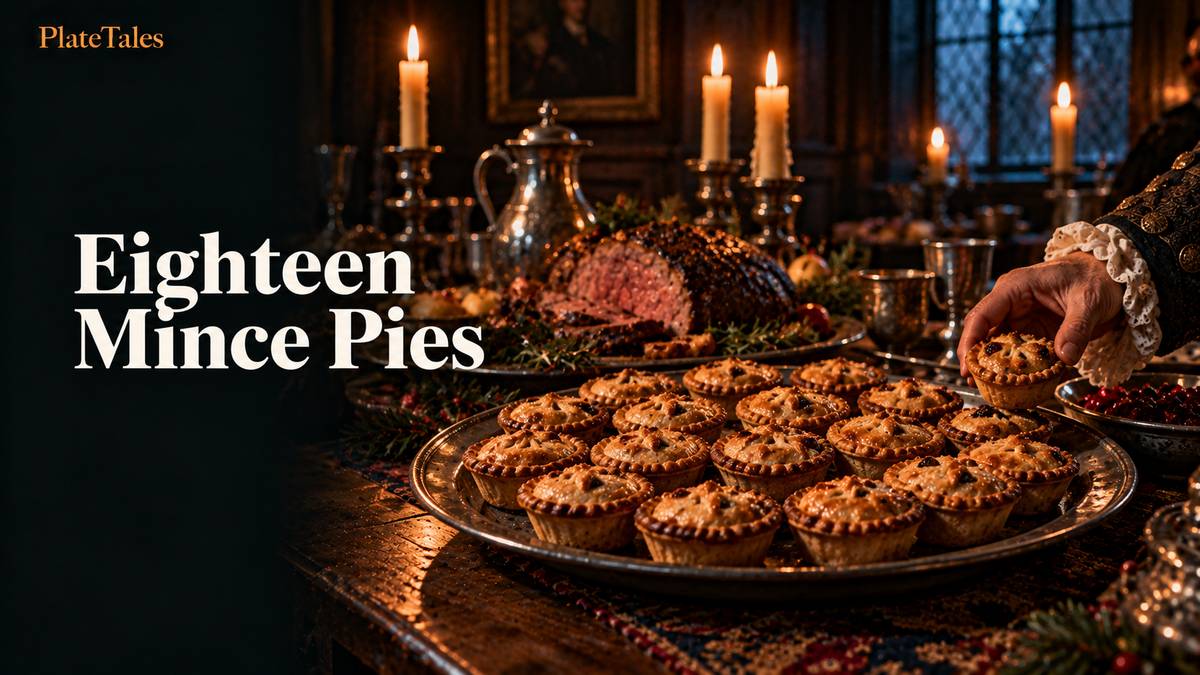
Eighteen mince pies at Sir William Penn's table, 1662
On January 6, 1662, Twelfth Day, Samuel Pepys went to dinner at the house of Sir William Penn, his neighbour and colleague at the Navy Office. It was Penn's wedding anniversary. Pepys wrote that they had "a good chine of beef and other good cheer, eighteen mince pies in a dish, the number of the years that he hath been married."
That is a man counting his marriage in pastry. It also shows the pie was already a fixed part of the season, as expected as the beef. Pepys keeps coming back to it.
On Christmas Day 1662 his wife was ill, so he "sent for a mince-pie abroad," meaning he bought one ready made, "my wife not being well to make any herself yet." On the last day of 1663 the two of them dined on "a fine turkey and a mince pie," having kept Christmas almost entirely alone. On Christmas Day 1666 he lay in bed late because his wife had sat up "till four this morning seeing her mayds make mince-pies." After church they "dined well on some good ribbs of beef roasted and mince pies."
Did mince pies have meat in them? Ask a French visitor
Yes, and an outsider spelled it out. The Frenchman Henri Misson, in the book published in English as Travels in England, told his readers that every English family made a famous Christmas pie. It was, in the English translation, "a most learned mixture of neat's-tongues, chicken, eggs, sugar, raisins, lemon and orange peel, various kinds of spicery." Neat's tongue is ox tongue, and Misson's French original says currants where the translator wrote raisins.
Tongue and chicken sat in the same crust as sugar and citrus peel. Misson found the mixture worth describing. The English found it normal.
Why is it called mince pie? Follow the knife
"Mince" comes partly from the Old French mincier, to cut into small pieces. The pie was named for what the cook did to the meat. In the seventeenth century the name was still loose, and writers used several:
| Name | Where it turns up |
|---|---|
| "Minched pies" | an undated tract printed under Queen Elizabeth or King James, owned by the antiquary John Brand |
| "Minc't pies" | Gervase Markham, The English Huswife, first published 1615 |
| "Minced-Pye" | Ben Jonson's Masque of Christmas, 1616 |
| "Shrid-pies" | Samuel Sheppard's Epigrams, 1651 |
| "Christmass or Minc'd Pies" | a satirical poem on the Presbyterians, 1661 |
"Shrid" is shred, the same idea with an English verb. "Christmas pie" named the occasion instead of the knife work. "Mincemeat" for the filling came later, an alteration of plain "minced meat."
Markham's recipe used parboiled mutton and mutton suet, seasoned with pepper, salt, cloves and mace, then mixed with currants, raisins, prunes, dates and orange peel. It ends: "put it into a coffin, or into divers coffins, and so bake them." A coffin was a pastry case. The word meant a crust long before it meant a box for a corpse, and the thick walls were often thrown away rather than eaten.
Markham was not the first to bake this kind of pie. English Heritage's reconstruction of a "real mince pie" comes from A Book of Cookrye, printed in London in 1591, and uses lean mutton or beef with suet, prunes, raisins and currants.
Before the name: pork, rabbit and small birds in 1390
The dish is older than any of its names. The Forme of Cury is a recipe roll compiled about 1390 by the master cooks of Richard II. The antiquary Samuel Pegge printed it in 1780. Most histories point to its recipe "Tartes of Flesh" as the ancestor of the mince pie, and here the sources disagree.
English Heritage describes this tart as figs, raisins, wine, pine kernels, lard, cheese, minced pork, honey and spices. Pegge's printed text says something else. It has boiled pork ground small, hard-boiled eggs, ground cheese, "gode powdour" (a ground spice mix), sugar, saffron and salt, packed into a pastry coffin and topped with small birds and pieces of rabbit. There is no fruit.
The fruit is in the recipes printed next to it. "Tartee" has pork, eggs, raisins, sugar, ginger, prunes and small birds. "Tartletes" has boiled veal with whole prunes, dates, pine nuts and currants. The popular description may come from another copy of the roll, or from blending recipes together.
The historian Madeline Shanahan points to a different dish, the chewette, a small pie of meat or offal with hard eggs, dried fruit and spice. In Pegge's text the meat-day chewette is pork and hens cut in pieces and fried, put in a small coffin with hard egg yolks and ground ginger, then fried in grease or baked. Either way the family likeness is plain: chopped meat, spice and sweetness in a pastry box. More of these cooks' work is in our piece on medieval recipes you can still make, and the spices came through the same trade that made black pepper worth fighting over.
Were mince pies banned by Cromwell?
No law ever banned them. On 8 June 1647 Parliament passed "An Ordinance for Abolishing of Festivals," which ended Christmas, Easter and Whitsun as holy days. It does not mention food. Oliver Cromwell did not become Lord Protector until 1653, and the ordinance was Parliament's, not his. Sam Bilton, writing for English Heritage, calls the story that Cromwell banned mince pies a myth.
The pie was a target all the same, in pamphlets rather than statutes. The Reading historian Helen Parish notes that the Royalist clergyman Edward Fisher, in The Feast of Feasts in 1644, was already defending the custom of eating mince pies, plum pottage and brawn in December. In 1656 Richard Fletcher's poem "Christmas Day" mocked the zealots by putting their complaints into verse:
"Prophaneness in a conclave? Nay, much more, Idolatrie in crust! Babylon's whore Rak'd from the grave, and bak'd by handles, then Serv'd up in Coffins to unholy men."
The grudge outlived the Commonwealth. An essay in the Gentleman's Magazine in December 1733 said the Quakers attacked Christmas pie as "an invention of the scarlet whore of Babylon, an hodge-podge of superstition, popery, the devil, and all his works." People do not write that about a pie nobody is eating.
The manger shape, and the stories added later
One piece of symbolism does have a seventeenth-century source. The lawyer and scholar John Selden, in the sayings collected as his Table Talk, said that "the Coffin of our Christmas Pies, in shape long, is in imitation of the Cratch," the manger where the infant Jesus was laid.
So the manger idea is old, but Selden was explaining a shape that already existed. Pies of the period came in many shapes. Hannah Bisaker's receipt book of 1692 and Henry Howard's England's Newest Way of 1708 both print pages of diagrams of mince pie shapes.
The extra details are harder to support. English Heritage says pastry figures of the baby Jesus were set on top of the pies, until the pies turned round and the baby disappeared. Shanahan and the food historian Laura Mason found little evidence for that, and nobody of the period describes a pastry baby on top.
The idea that the spices stand for the Wise Men's gifts first appears as a question, not a statement. A reader of the Gentleman's Magazine asked in July 1783: "May not the Minced Pye, a compound of the choicest productions of the East, have in view the offerings made by the Wise Men, who came from afar to worship, bringing spices?" The story that crusaders brought the recipe home has no medieval text behind it.
When did mince pies stop having meat?
Slowly, and never completely. Early in the eighteenth century the essayist writing as Isaac Bickerstaff still treated the pie as beef. Quoted in that 1733 Gentleman's Magazine essay, he complained that household chaplains were barred from the Christmas pie. A sirloin, he wrote, was fair game for the chaplain when entire, but "if minced into small pieces, and tossed up with plumbs and sugar, changes its property, and forsooth is meat for his master."
Through the century, cheap sugar from West Indian slave plantations made the filling steadily sweeter (our story on sugar and the plantations covers that trade). Hannah Glasse's The Art of Cookery, first published in 1747, gives a mincemeat of suet, raisins, currants, apples, spice, brandy and sack. Only then does it add: "If you chuse Meat in your Pies," use a boiled neat's tongue or the inside of a sirloin. The meat had become optional.
The Victorian books show both versions side by side. Eliza Acton's Modern Cookery of 1845 built her mincemeat on a boiled ox tongue, or the inside of a roasted sirloin. Isabella Beeton's Book of Household Management of 1861 printed two recipes on consecutive numbers.
No. 1309, "Mincemeat," called for a pound and a half of lean beef, three pounds of beef suet, two pounds of raisins, three of currants and half a pint of brandy, at an average cost of 8 shillings. Her mince pie recipe, No. 1311, uses that one. No. 1310, "Excellent Mincemeat," had lemons, apples, raisins, currants, suet, sugar, candied peel, brandy and two spoonfuls of orange marmalade, and no flesh at all.
What is mincemeat made of today?
What survived was the suet, which is why a jar of mincemeat today still lists beef fat or a vegetable substitute next to the dried fruit, peel, sugar and spice. Both of Beeton's recipes also tell the cook to seal the mixture in a jar and wait a fortnight before using it. The filling was always something made ahead and kept.
Across the Atlantic, meat-free "mock mince pies" appeared in American cookbooks before 1861. The American editor Sarah Josepha Hale grumbled that the Christmas mince pie was "too firmly rooted for the Pilgrim Fathers to abolish." It also found a place on the New England Thanksgiving table.
Meat never fully left. Jane Grigson's English Food of 1974 encouraged cooks to try Mrs Beeton's beef mincemeat. In 2014 Tom Kerridge's mince pie recipe in the Guardian put minced pork in the filling, the same meat Richard II's cooks ground for their tarts in 1390.
Questions people ask
What does the word mince mean in mince pie?
"Mince" comes partly from the Old French mincier, to cut into small pieces. The pie was named for what the cook did to the meat. Seventeenth-century English writers also called it "shrid-pies," from shred, and "Christmas pie," after the occasion, before "mince pie" settled.
Did Oliver Cromwell really ban mince pies?
No law ever banned them. Parliament's ordinance of 8 June 1647 abolished Christmas, Easter and Whitsun as holy days and does not mention food. Cromwell did not become Lord Protector until 1653. English Heritage calls the story a myth, though Puritan pamphlets did mock the Christmas pie.
Why are English mince pies said to be shaped like a manger?
The lawyer John Selden wrote in his Table Talk that the long "coffin" of the Christmas pie imitated the cratch, the manger where Jesus was laid. He was explaining a shape that already existed, and pies of the period came in many shapes, as 1692 and 1708 diagram books show.
Do mince pies still contain meat today?
Usually only suet. Meat became optional in the eighteenth century, as in Hannah Glasse's 1747 recipe, and Victorian cooks used both kinds. Isabella Beeton's 1861 mincemeat still had lean beef, while her "Excellent Mincemeat" had none. A jar today lists beef fat or a vegetable substitute with the dried fruit.
What did Samuel Pepys say about mince pies?
Pepys recorded mince pies as a fixed part of London Christmases in the 1660s. At Sir William Penn's table on 6 January 1662 he counted eighteen in a dish, one for each year of Penn's marriage. On Christmas Day 1662 he sent out to buy one because his wife was ill.
Filed under Origin Stories, Ritual Foods
Want more stories like this?
One food history story, every week. No spam, just the stories behind what the world eats.