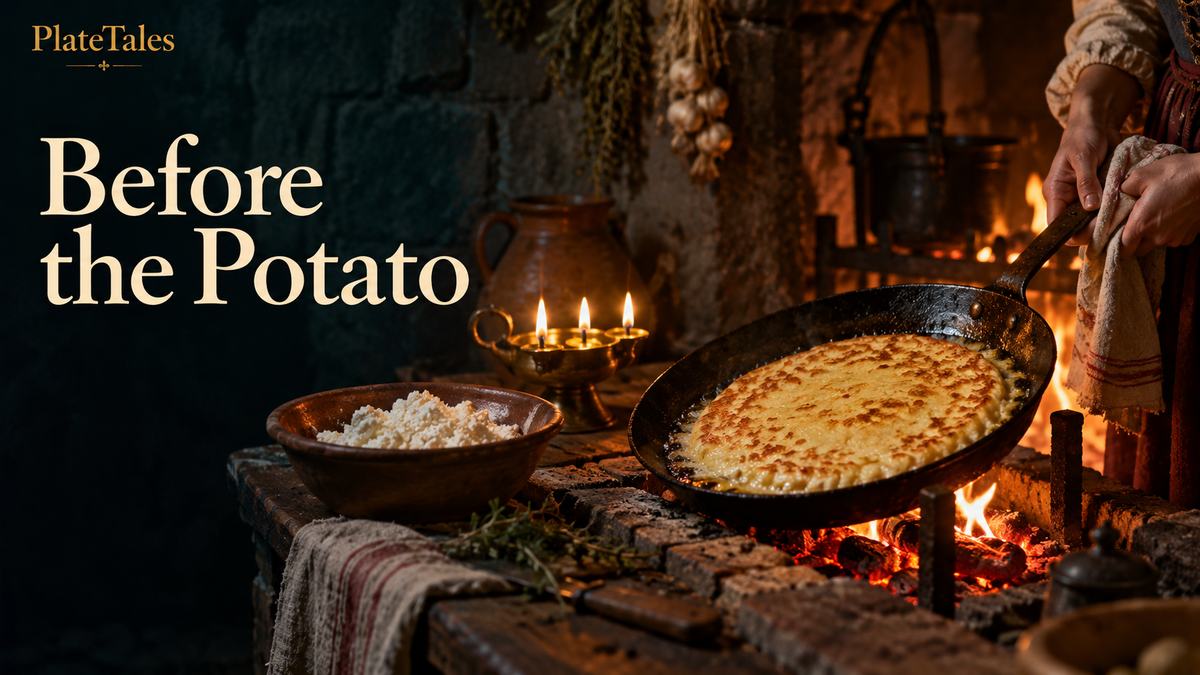
We eat latkes on Hanukkah because the holiday has a custom of eating fried food, and Jews tie that custom to the Talmud's story of one jar of Temple oil that burned for eight days. A pancake fried in a pan of fat is the household version of that oil. The latke is also much older than its potato: the first Hanukkah pancakes on record, from 1322, were probably cheese.
Even the name may point to oil. The Oxford English Dictionary traces Yiddish latke to the East Slavic oladka, a small fried pancake, and from there back to the Greek word for olive oil. Not everyone agrees; some dictionaries link it instead to a Slavic word for a patch.
A satirist in 1322 and a pancake the size of the pan
The earliest writer anyone has found putting pancakes on the Hanukkah table is Kalonymus ben Kalonymus. He was born in Arles in 1286, studied in Provence, settled in Avignon around 1314 and was sent for a time to Rome. He translated, and he mocked. His Even Bochan of 1322 is an ethical treatise in rhythmic prose that satirizes his contemporaries and himself, and in Rome he wrote a parody of a Talmud tractate meant to be read at Purim.
Gil Marks, whose Encyclopedia of Jewish Food (2010) is where most serious latke history begins, wrote that Kalonymus "included pancakes in a list of dishes to serve at an idealized Purim feast, as well as a poem about Hanukkah." Susannah Brodnitz, writing for The Nosher in 2022, dates the poem to 1322 and quotes its line about levivot, the Hebrew word for these pancakes, "large and round, the whole size of the frying pan."
Two cautions. Kalonymus is the first known for pancakes, but fried food on Hanukkah is older. Maimon ben Yosef, the father of Maimonides, wrote in the 12th century that "one must not make light of the custom of eating sofganim," fritters, on Hanukkah.
And Kalonymus gives no recipe. Whatever filled his frying pan, it was not potato. The potato was still in the Andes.
Were latkes originally made of cheese?
Marks thought so. In his account the medieval pancake was made of ricotta or curd cheese, fried in butter or oil and eaten with fruit preserves. He traces one line of it to Sicily, where Jews ate ricotta pancakes at Shavuot, the spring holiday of dairy foods.
After the Spanish expelled the Jews from Sicily in 1492, Marks wrote, "the exiles introduced their ricotta cheese pancakes, which were called cassola in Rome, to the Jews of northern Italy." There the pancake combined two things Hanukkah already had a taste for: fried food and cheese.
That dairy custom has its own first date. According to Marks, the link between dairy and Hanukkah is first mentioned around 1360 by Rabbi Nissim ben Reuben of Gerona, known as the Ran.
So the popular line that the first latke was an Italian ricotta pancake is about half right. Cheese, yes. Italy, in part. But the first man to mention Hanukkah pancakes grew up in Provence, and the Sicilian ricotta version reached northern Italy about 170 years after his poem. (How people came to have cheese in the first place is a much older story.)
Judith, Holofernes and the cheese that is not in the book
The Ran's reason for the dairy is a woman with a sword. He cites a midrash, a rabbinic retelling, in which "the daughter of Johanan" gives an enemy commander cheese to make him thirsty, lets him drink himself senseless and cuts off his head. The Kol Bo, a law code from the same period, tells it with a cheese dish and calls her the daughter of the high priest Johanan.
In the 16th century Moses Isserles wrote it into his notes on the Shulchan Arukh, the standard code of Jewish law. Some say, his gloss runs, that cheese should be eaten on Hanukkah because the miracle was done through milk that Yehudit fed the enemy.
Yehudit is Judith, and here the trail gets odd. The Book of Judith survives in Greek and is generally dated to about 100 BCE. It never mentions Hanukkah, and it barely mentions cheese.
When Judith packs for the enemy camp she takes, in the NRSV Updated Edition, "a skin of wine and a flask of oil" and a bag of "roasted grain, dried fig cakes, and fine bread." A footnote adds: "Other ancient authorities add and cheese." What undoes Holofernes is wine, more of it, the text says, "than he had ever drunk in any one day since he was born."
Deborah Levine Gera, a classicist at the Hebrew University of Jerusalem who published a commentary on Judith in 2014, points out that Judith then vanishes from Jewish writing. She is absent from the Dead Sea Scrolls, Philo, Josephus, the Mishnah and the Talmud. She turns up again only from the tenth or eleventh century, in Hebrew retellings that sometimes make her a relative of the Maccabees' family, the Hasmoneans.
Rashi's grandson Rashbam said the chief miracle of Hanukkah came through her, as Purim's came through Esther. The cheese belongs to these medieval versions. Gera's comment on it is two words: "compare Jael!" In the Book of Judges, Jael gives the enemy general Sisera milk when he asks for water, and while he sleeps she drives a tent peg through his temple.
So Judith did not start the cheese pancake. Medieval rabbis gave her as the reason for a dairy custom. The food historian Susan Weingarten has found the point where the two meet: a copy of the Judith story made in Provence in 1402, in which Judith feeds Holofernes fried cheese pancakes.
Why fried food on Hanukkah at all
The usual answer is the miracle of the oil, and that story also arrives late. The First Book of Maccabees describes the rededication of the Temple in 164 BCE, with lamps lit on the lampstand, and says nothing about a jar of oil. The Second calls the eight-day festival a delayed Sukkot, kept "in the manner of the Festival of Booths."
The single sealed jar that burned for eight days first appears in the Babylonian Talmud, in tractate Shabbat 21b. That was compiled around the sixth century CE, roughly 700 years after the events.
Read the passage and you find lamps, praise and thanksgiving. There is no food in it. Nothing there tells anyone to fry anything, so the latke is a custom rather than a commandment, and a custom can swap its ingredients without asking. This one did, more than once, as turkey at Thanksgiving also did.
When did potato latkes start?
North of the Alps the pancake ran into a supply problem. Olive oil was rare and expensive, so Ashkenazi kitchens, those of Central and Eastern European Jews, fried in schmaltz, rendered poultry fat.
Tina Wasserman, writing for ReformJudaism.org, ties the goose to the calendar. Geese were fattened for three months and slaughtered in early December, and their fat was rendered to cook with for most of the year. The fresh fat arrived just as Hanukkah did.
Goose fat is meat, and Jewish dietary law forbids cooking meat with milk, so the cheese had to go. Marks writes that rye and later buckwheat took the place of cheese and wheat, and the fruit preserves stayed on.
The potato came last. Marks puts its arrival in Europe at about 1570. He notes that Germans were making potato pancakes by the end of the 1700s, and says Jews in Ukraine and Poland began eating potatoes only after a series of crop failures there in 1839 and 1840.
Wasserman places the potato latke a little earlier, at the end of the 18th century or the start of the 19th. Marks's dates are tied to a specific event, so the mid-1800s is the safer answer. Once the potato had remade the European diet as food for the poor, it took over the pancake and then the word.
Latkes vs sufganiyot
Eastern European Jews carried the potato version to the United States in the early 20th century, part of the larger immigrant rewrite of American food. There the default frying fat became neutral vegetable oil, so the pancake whose name may mean oil was fried in oil again.
In Israel the latke lost ground. Polish Jews had brought their jam-filled doughnut, the ponchik, to Mandatory Palestine, where it took the Hebrew name sufganiyah. Until the 1920s the two foods were about equally popular there.
Then the Histadrut, the labor federation founded in 1920, pushed the doughnut on purpose, to provide more work for its members. Commercial bakeries began selling sufganiyot days and weeks before the holiday. Israel's Ministry of Defense now buys upwards of 400,000 of them for its soldiers each Hanukkah, 80 percent filled with jelly and 20 percent with chocolate.
Questions people ask
Were latkes originally made of cheese?
Probably. Gil Marks described the medieval Hanukkah pancake as ricotta or curd cheese fried in butter or oil. Sicilian Jews ate such pancakes at Shavuot, and after the 1492 expulsion exiles brought them to northern Italy, where they were called cassola in Rome. Potato came only in the 1800s.
When did potato latkes start?
Gil Marks ties potato latkes to Ukraine and Poland after crop failures in 1839 and 1840, so the mid-1800s is the safest date. Germans were making potato pancakes by the end of the 1700s. Before that, Ashkenazi Jews made Hanukkah pancakes from rye and later buckwheat, fried in goose fat.
Why is dairy eaten on Hanukkah?
The custom comes from a medieval story about Judith, called Yehudit, who fed an enemy commander cheese or milk before he was killed. Rabbi Nissim ben Reuben of Gerona linked dairy to Hanukkah around 1360, and Moses Isserles repeated the custom in his 16th-century notes on the Shulchan Arukh.
What is the difference between latkes and sufganiyot?
Latkes are fried pancakes, today usually potato. Sufganiyot are jam-filled doughnuts that Polish Jews brought to Mandatory Palestine. Until the 1920s the two were about equally popular there, but the Histadrut pushed the doughnut, and in Israel the latke lost ground.
Filed under Origin Stories, Ritual Foods
Want more stories like this?
One food history story, every week. No spam, just the stories behind what the world eats.